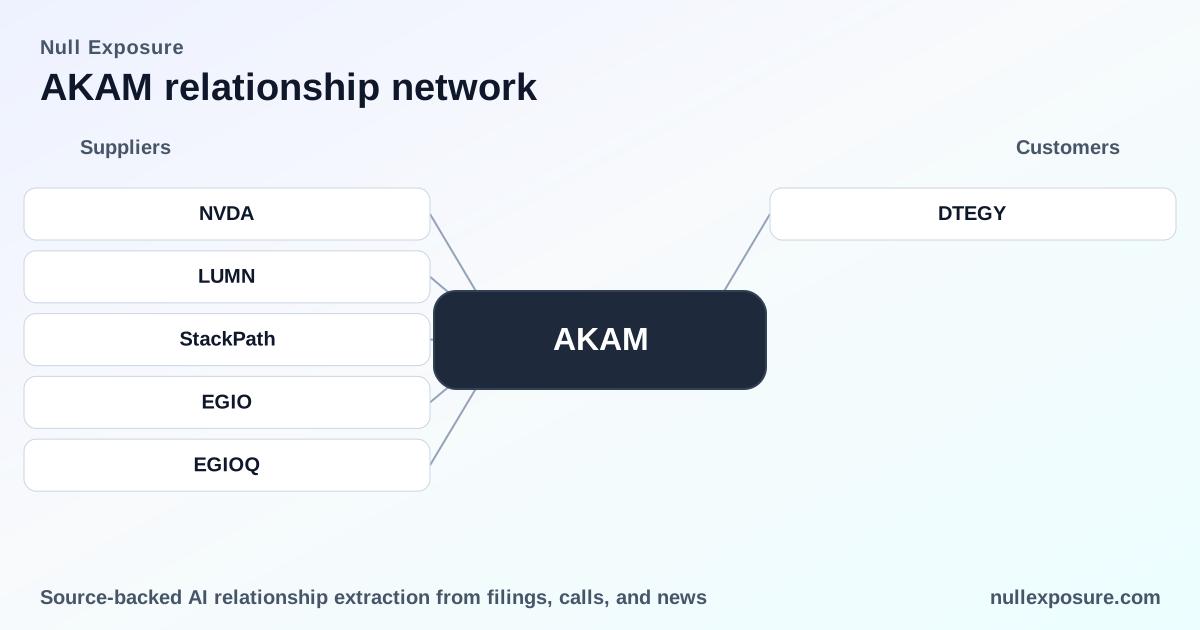
Akamai’s customer map: stability from scale, growth from channel acceleration
Akamai Technologies operates a globally distributed content delivery, edge compute and security platform that monetizes primarily through recurring, service-based contracts for delivery, security and compute capabilities. The company sells directly and through channel partners to large enterprises and government agencies, generating predictable revenue from contracts typically longer than one year and extracting margin from network scale, peering relationships, and value-added security services.
If you want a concise, investor-ready view of Akamai’s customer relationships and what recent media activity signals for revenue and go-to-market dynamics, read on — or learn more at https://nullexposure.com/.
How Akamai’s operating model drives commercial outcomes
Akamai’s business combines three durable characteristics that matter to investors: recurring contract revenue, global footprint, and enterprise/government counterparty mix.
- Contracting posture: Akamai primarily sells services under contracts with terms of one year or longer, which yields a high proportion of recurring, stand-ready obligations recognized over time and supports predictable revenue streams and visibility into future cash flows.
- Counterparties and concentration: The company’s customer roster emphasizes large enterprises and government buyers, but disclosed statements confirm no single customer accounted for 10% or more of revenue, so top-line concentration is immaterial; credit exposure in accounts receivable is likewise described as insignificant.
- Global delivery and criticality: Akamai operates a massively distributed network — thousands of edge points across ~130 countries and integrated with hundreds of network partners — positioning the company as a critical backbone for customers’ performance and security needs.
- Segment and role: Akamai positions itself as a service provider across security, delivery and compute, and the company manages the business as a single operating segment rather than discrete product lines, implying centralized go-to-market and product integration.
These structural attributes explain why investors value Akamai on a multiple reflecting growth plus predictability (trailing P/E ~33.8, forward P/E ~15.0), while also pricing in a premium for durable enterprise relationships and security product adjacency.
Recent press: what media coverage tells investors about customer relationships
Below I summarize every customer relationship identified in the sourced results and cite the original reporting.
Arrow Electronics (ARW)
Akamai announced a strategic channel partnership with Arrow Electronics to expand distribution of its cloud, security and application delivery solutions through Arrow’s enterprise computing ecosystem, positioning Arrow as a reseller and channel amplifier for Akamai’s cloud and security offerings. See the company announcement and coverage in GlobeNewswire (April 7, 2026) and follow-up analysis in InsiderMonkey and related outlets discussing the new channel momentum. (https://www.globenewswire.com/news-release/2026/04/07/3268929/0/en/Akamai-Teams-with-Arrow-Electronics-to-Power-and-Protect-Digital-Experiences-at-Scale.html; https://www.insidermonkey.com/blog/why-akamai-technologies-akam-just-opened-a-new-growth-channel-1739680/?amp=1)
Deutsche Telekom Security (DTEGY)
Deutsche Telekom Security expanded its cybersecurity offerings using Akamai’s agentless zero-trust capabilities, indicating Akamai is supplying security technology to major telecom security resellers — a validation of its platform’s integration into telco-managed security service portfolios. Reported coverage noted this partnership on January 21, 2026. (https://www.stocktitan.net/news/AKAM/akamai-secures-critical-infrastructure-with-agentless-zero-trust-mpgycqu0lwjz.html)
Visa (V)
Akamai entered a relationship with Visa to enhance identity verification, user recognition and e‑commerce security, reflecting Akamai’s role in transaction-layer protection for payments ecosystems and the strategic adjacency into fraud and identity services for high-volume merchants. Coverage cites a December 17 partnership announcement. (https://nationaltoday.com/us/ma/cambridge/news/2026/02/24/akamai-earnings-expected-to-rise-as-analysts-revise-forecasts/)
What these relationships mean for revenue and strategy
The Arrow Electronics arrangement is notable for go-to-market leverage: channel partnerships scale distribution faster than direct sales alone and reduce incremental customer acquisition cost. Deutsche Telekom Security’s integration underscores the telco and MSP route to market for Akamai’s security stack, while Visa’s partnership signals continued productization in identity and transaction security — an area that commands higher per-customer monetization than basic delivery services.
Collectively, these relationships reflect the company-level constraints and strengths:
- Long-term contracting supports recurring revenue and improves revenue visibility, making channel-driven expansion additive rather than lumpy.
- Global reach allows partnerships with multinational resellers and telcos to translate into multi-region deployments quickly.
- Immaterial concentration reduces single-client revenue risk even as Akamai deepens technical ties with enterprise and payment incumbents.
- Service-provider role and criticality mean Akamai’s platform often functions as essential infrastructure for customers’ digital presence, enhancing retention once integrated.
Risks and investor considerations
- Channel expansion accelerates reach but transfers some control over customer relationships to partners; investors should track margin mix over time as channel sales typically involve partner discounts and variable services revenue.
- Integration with large platforms and telcos strengthens scale, but operational complexity and SLA commitments increase with managed service relationships.
- Competitive pressure from cloud providers bundling edge and security services remains a structural risk; Akamai’s differentiated scale and partner ecosystem are the primary defenses.
Bottom line for investors
Akamai’s recent media-cited customer activity signals execution along a multi-pronged GTM strategy: deepen direct enterprise ties (Visa), and accelerate distribution through channel and telco partners (Arrow, Deutsche Telekom Security). These moves align with the company’s long-term contract-driven revenue model, global delivery footprint, and immaterial concentration of customers, which together support revenue predictability while enabling incremental growth.
For a compact, analysis-ready dossier on how these partnerships influence revenue trajectories and risk exposures, see more at https://nullexposure.com/.
Concluding recommendation: investors should value Akamai for its recurring revenue and critical role in security and edge delivery, while monitoring margin impact from channel expansion and competitive dynamics with hyperscale cloud providers.