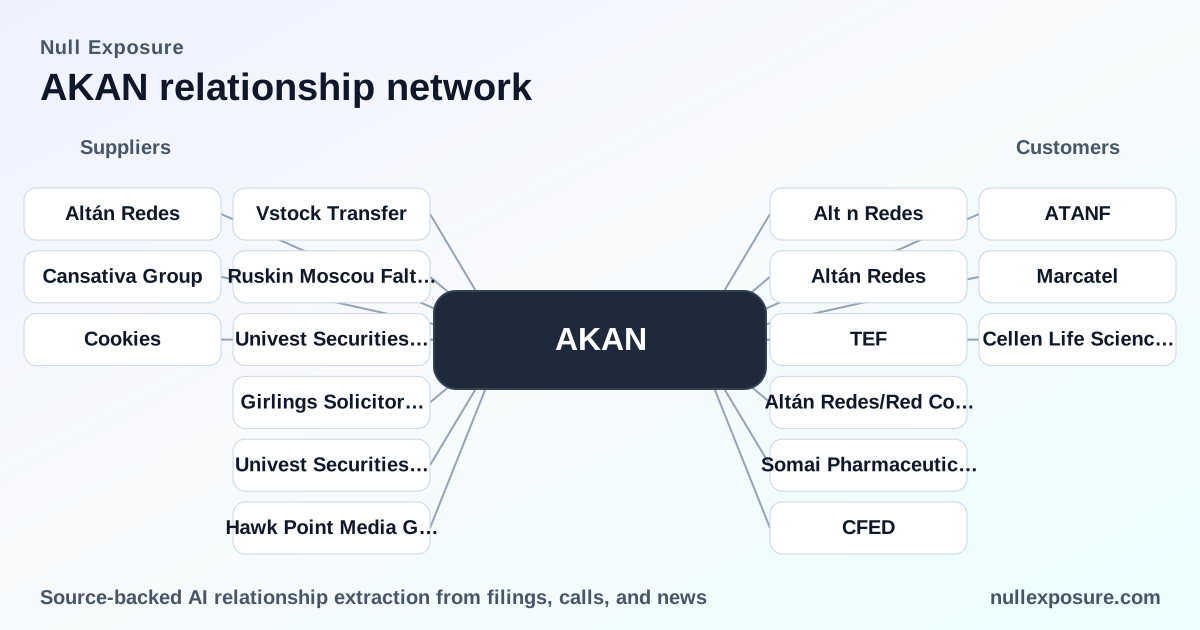
Akanda (AKAN): Customer map that drives recurring telecom cash flows and strategic asset sales
Akanda operates as a dual business: a healthcare/pharma asset owner and an infrastructure operator through its subsidiary First Towers & Fiber (FTF). The company monetizes by leasing dark fiber and cellular tower capacity in Mexico to large carriers and by selectively divesting non-core pharmaceutical assets, creating a mix of recurring telecom revenue and one-off sale proceeds that underpins valuation upside for investors. For a concise dossier on Akanda's customer disclosures and media-traced contracts, visit https://nullexposure.com/.
Why the customer list matters for Akanda’s thesis
Akanda’s commercial profile is built around FTF’s infrastructure contracts in Mexico. Anchor tenants and preferred-contractor roles translate directly into recurring revenue and network utilization, while strategic asset sales in pharmaceuticals provide balance-sheet liquidity. Reported relationships indicate two parallel revenue engines: (1) long-term fiber/tower leases with multinational carriers and Mexican state utilities that underpin repeatable cash flow, and (2) discrete asset sales to specialty pharma buyers that crystallize value from European holdings.
Customer relationships: itemized public record (each cited)
Below I cover every relationship flagged in the public results. Each entry contains a plain-English summary and the originating public report.
-
Alt n Redes — Akanda’s subsidiary First Towers & Fiber is described as a preferred contractor for Alt n Redes, with each built tower expected to expand coverage and increase cash flow to FTF. Reported by Newsfile in March 2026 (press release). (https://www.newsfilecorp.com/release/268677/Akanda-Discusses-Altn-Redes-7-Billion-Project)
-
Altán Redes — FTF was named a preferred contractor for Mexico’s Altán Redes Red Compartida project, a national telecom infrastructure program valued at over $7 billion, positioning FTF on a multi-year buildout. Coverage on AccessWire, March 2026. (https://www.accessnewswire.com/newsroom/en/telecommunications/akanda-jumps-49-after-scoring-20-tower-expansion-deal-in-mexicos-7b-telecom-proj-1088345)
-
Somai Pharmaceuticals — Akanda signed definitive Share Purchase and Escrow Agreements to sell Portuguese assets to Somai Pharmaceuticals, reflecting the company’s active program of monetizing non-core pharma holdings. Reported on FinViz/Newsfile in May 2026 and trading news in March 2026. (https://finviz.com/quote?t=AKAN; https://www.tradingview.com/news/benzinga:6fcc10155094b:0-why-netapp-shares-are-trading-higher-by-around-17-here-are-20-stocks-moving-premarket/)
-
TEF (Telefónica) — FTF’s dark fiber network was built after executing a 20-year dark fiber lease with Telefónica, which acts as the anchor tenant and currently leases two fiber pairs on the network, giving Akanda a long-duration backbone customer. Reported by Newsfile in March 2026. (https://www.newsfilecorp.com/release/285598/First-Towers-Fiber-Corp.-Owns-the-Largest-Dark-Fiber-Network-in-Central-Mexico)
-
Telefónica — The Spanish multinational is explicitly named as the anchor tenant leasing dark fiber across the network, which institutionalizes recurring revenue through long-term fiber leases. Reported in Newsfile, March 2026. (https://www.newsfilecorp.com/release/268574/Akanda-Among-the-Leaders-of-Deployment-in-Mexicos-Largest-Telecommunication-Infrastructure-Project)
-
Altán Redes/Red Compartida (duplicate listing) — Multiple outlets restated FTF’s role as a preferred contractor for the national Red Compartida program, reinforcing the same commercial relationship from separate press placements. StockTitan and other March 2026 releases highlight the $7+ billion program and FTF’s positioning. (https://www.stocktitan.net/news/AKAN/akanda-s-first-towers-and-fiber-taps-into-mexico-s-7-billion-telecom-xsqmm6jyx4zd.html)
-
Marcatel — FTF leases dark fiber capacity to Marcatel, a growing Mexican telecommunications provider, establishing additional commercial diversity for Akanda’s fiber assets. Documented in Newsfile’s March 2026 release on FTF network ownership. (https://www.newsfilecorp.com/release/285598/First-Towers-Fiber-Corp.-Owns-the-Largest-Dark-Fiber-Network-in-Central-Mexico)
-
CFE / CFED — Management described potential partnerships and preferred status with CFE (Comisión Federal de Electricidad), with each new tower expected to support collaborations with Altán and CFE and to accelerate recurring revenue. This linkage was included in multiple March 2026 press items. (https://www.accessnewswire.com/newsroom/en/telecommunications/akanda-jumps-49-after-scoring-20-tower-expansion-deal-in-mexicos-7b-telecom-proj-1088345; https://www.newsfilecorp.com/release/270734/Akanda-To-Accelerate-Recurring-Revenue-with-Expansion-Of-Up-To-20-New-Cellular-Towers)
-
Altan / ATANF (duplicate variants) — Management repeatedly referenced Altán/Altan (ticker ATANF in some feeds) as a delivery partner on the national buildout, highlighting the strategic commercial channel into Mexico’s Red Compartida. Multiple March 2026 filings and releases cite this relationship. (https://www.newsfilecorp.com/release/270734/Akanda-To-Accelerate-Recurring-Revenue-with-Expansion-Of-Up-To-20-New-Cellular-Towers; https://www.stocktitan.net/news/AKAN/akanda-to-accelerate-recurring-revenue-with-expansion-of-up-to-20-lzxg5hwdd8ei.html)
-
Cellen Life Sciences' Leva Clinic — In describing its seed-to-patient supply chain for its pharma arm, Akanda named Cellen Life Sciences' Leva Clinic among commercial partners, indicating distribution or clinic-level relationships in the UK health services channel. Reported in a StockTitan March 2026 strategic plan release. (https://www.stocktitan.net/news/AKAN/akanda-corp-announces-strategic-plan-to-evaluate-and-enter-bitcoin-ysbse7613njp.html)
-
(Related partners mentioned in the same pharma excerpt) Cookies (California) and Cansativa Group — Akanda’s pharma supply-chain commentary cites partnerships with Cookies (a global cannabis brand) and Cansativa Group (an importer/distributor in Europe), indicating commercial routes for medical cannabis and related products in prior FY2024 communications. Coverage in StockTitan (March 2026) referenced these partners. (https://www.stocktitan.net/news/AKAN/akanda-corp-announces-strategic-plan-to-evaluate-and-enter-bitcoin-ysbse7613njp.html)
Operating constraints and commercial posture (company-level signals)
-
Contracting posture: Akanda’s telecom model uses long-duration leases and preferred-contractor status through FTF, producing contractual revenue visibility and capital intensity typical of tower and fiber operators. The presence of a 20-year dark-fiber lease with Telefónica signals a back-end, fixed-income-like cash flow component.
-
Concentration: Anchor-tenancy by Telefónica and the Altán/CFE program represent concentrated but high-quality customers; concentration elevates downside if a major tenant renegotiates, but it also enables premium pricing and utilization efficiencies.
-
Criticality: FTF’s assets serve as infrastructure backbone in central Mexico; for carriers like Telefónica and regional providers such as Marcatel, that fiber is mission-critical, increasing switching costs and the defensibility of contract terms.
-
Maturity: The telecom contracts demonstrate enterprise-grade maturity (20-year fiber leases, national buildout inclusion), while the pharmaceutical side shows tactical, transactional maturity via asset sales (e.g., Portuguese assets sold to Somai). The mix produces both recurring and one-off cash events.
Investment implications and risks
Akanda’s publicized customer set supports a thesis of shifting value from volatile small-cap pharma holdings toward annuity-like telecom cash flows. The critical variables for investors are (1) the scale and timing of tower/fiber rollouts under Altán and CFE partnerships, and (2) the execution and proceeds from strategic pharma disposals such as the sale to Somai Pharmaceuticals. Key risks include tenant concentration, execution risk on multi-party national projects, and the episodic nature of asset-sale liquidity.
Conclusion and next steps
Akanda’s customer disclosures present a hybrid model: durable, contract-backed infrastructure revenue through FTF plus opportunistic pharma asset monetization. That combination re-rates a micro-cap when execution aligns with national build programs and anchor-tenant uptake.
For a curated, investor-focused feed of Akanda relationship disclosures and source documents, visit https://nullexposure.com/.