Akebia Therapeutics (AKBA) — customer relationships shaping Vafseo’s commercial inflection
Akebia is a U.S.-focused specialty biopharma that monetizes through product sales and royalties, with Vafseo (vadadustat) as its commercial growth engine in dialysis settings and legacy products/royalties contributing secondary income. The company sells product directly into dialysis channels and through wholesalers and specialty pharmacies, collecting usage-linked revenue as prescribing access expands across large dialysis organizations. For a deeper look at relationship-level exposure, see the company overview at https://nullexposure.com/.
How to read Akebia’s customer map
Vafseo’s launch strategy targets dialysis operators and distribution partners that control prescribing access for large patient populations; early revenue is therefore concentrated and operationally dependent on a handful of customers and protocols. Clinical trials running inside dialysis operators (VOCAL, VOICE) create an unusual mix of commercial and evidence-generation relationships that will materially influence adoption and reorder patterns over 2026–2027.
If you want a consolidated view of Akebia’s customer posture and signals, visit https://nullexposure.com/ for access to the full relationship set.
Rollout and adoption: traction vs. operational gating
Akebia reports rapid growth in prescribing access—statements reference more than a quarter-million patients with access and later updates near 290,000—driven by protocols implemented inside major dialysis networks. Those same networks’ dosing protocols and inventory management decisions have produced near-term variability in channel revenue, so operational execution inside partners is the primary commercial risk and driver over the next 12–18 months.
Relationship-by-relationship snapshot (plain-English takeaways)
-
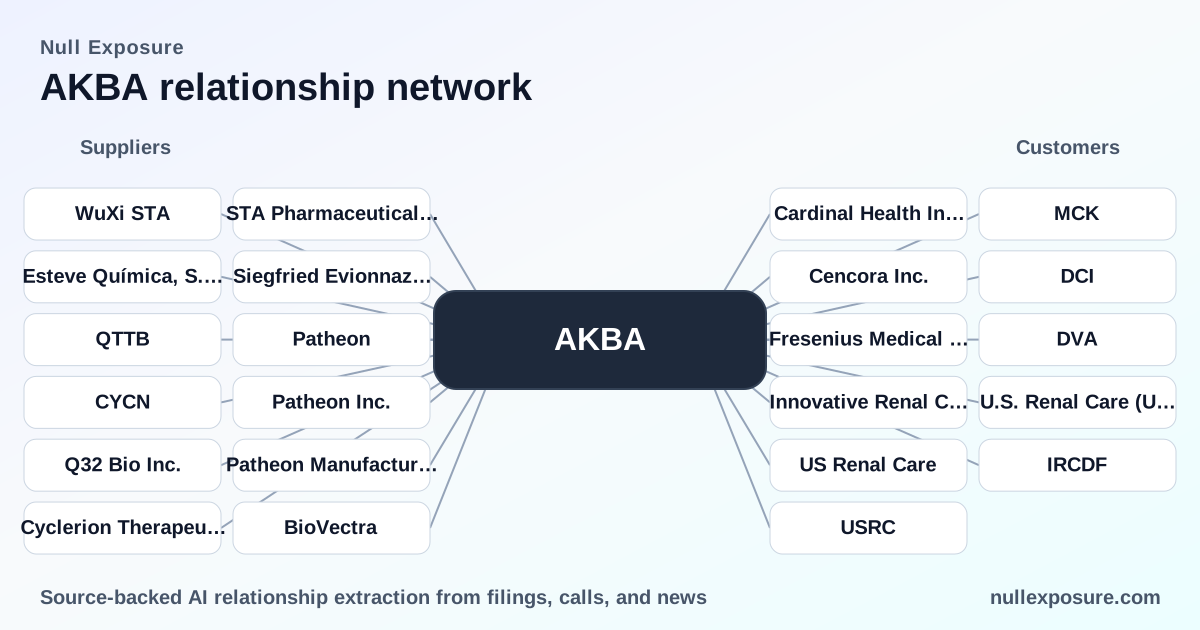
U.S. Renal Care / USRC / U.S. Renal Care (USRC) — Akebia identifies US Renal Care as the single largest source of early Vafseo revenue, noting that more than 85% of USRC physicians have written prescriptions and that USRC’s observed dosing protocol materially affected Q4 starts and dosing levels. Source: Akebia Q3 2025 earnings call and subsequent corporate updates (FY2025–FY2026 press releases and Q4 2025 call).
-
DCI (Dialysis Clinics, Inc.) — DCI has implemented a Vafseo protocol and is reported to have given prescribing access to approximately 290,000 patients, representing a material distribution channel for in-center dosing. Source: Akebia Q4 2025 earnings call and corroborating coverage (InsiderMonkey transcript, FY2026).
-
DaVita, Inc. / DaVita Clinics (DVA) — DaVita ran an operational pilot across ~100 clinics (nearly 10,000 patients) beginning mid‑August 2025; Akebia expects pilot completion to scale availability to DaVita patients and is conducting the VOCAL study at DaVita clinics to evaluate thrice-weekly dosing. Source: Akebia press release (GlobeNewswire, Nov 10, 2025) and Q3/Q4 2025 earnings commentary.
-
Innovative Renal Care (IRC / IRCDF) — IRC implemented a standardized Vafseo treatment protocol across ~230 centers in mid‑August 2025 and generated additional patient starts quoted by management as a source of incremental adoption. Source: Akebia Q3 2025 earnings call and GlobeNewswire (FY2025–FY2026).
-
McKesson Corporation (MCK) — Listed in Akebia’s FY2024 customer concentration disclosure as a named commercial counterparty, indicating McKesson functions in Akebia’s distribution or wholesaler channel. Source: Akebia 2024 Form 10‑K (Customer concentration risk, FY2024).
-
MCK (duplicate listing / shorthand for McKesson) — The filing also references MCK as a named customer/partner in the FY2024 disclosure. Source: Akebia 2024 Form 10‑K (FY2024).
-
Cardinal Health Inc. — Cardinal appears in Akebia’s customer concentration notes in the FY2023/2024 disclosures, signaling Cardinal’s role in distribution or large‑customer logistics. Source: Akebia 2024 Form 10‑K (citing Cardinal Health, FY2023 and FY2024).
-
Cencora Inc. — Named in the FY2024 customer concentration disclosures, positioning Cencora as a potential distribution or channel partner cited by Akebia in regulatory filings. Source: Akebia 2024 Form 10‑K (FY2024).
-
Fresenius Medical Care Rx — Included in Akebia’s FY2024 customer concentration language, indicating a commercial link to Fresenius’s pharmacy/distribution arm. Source: Akebia 2024 Form 10‑K (FY2024).
-
CYCN (Cyclerion Therapeutics / CYCN) — Cyclerion is listed in news coverage as licensed by Akebia to develop praliciguat and related products; this is a licensing/partner relationship rather than a purchaser of Vafseo, showing Akebia’s out-licensing activity in other programs. Source: news coverage (Finance/Yahoo and InsiderMonkey summaries, FY2026).
What the constraints say about Akebia’s operating model
Akebia’s relationship and contract signals collectively outline a commercial business that is:
-
Usage‑based and royalty‑sensitive: Akebia recognizes sales-based royalties and milestone payments tied to net sales levels, indicating that a material portion of certain revenues is directly linked to customer sales volumes and prescribing behavior, not fixed fees. (Company disclosure on sales-based royalties.)
-
Geographically concentrated in North America: Akebia maintains commercial supply agreements covering nearly 100% of U.S. dialysis patients prior to first shipments, and the company operates primarily in the U.S.; international revenue sources are largely royalty/licensing arrangements. This concentration means U.S. dialysis operator behavior dominates near-term revenue variability. (FY2024 disclosures.)
-
Distributor/reseller channel reliance: Product distribution depends on a limited number of dialysis organizations, wholesale distributors and specialty pharmacies; this creates channel concentration and forms the critical path for national rollout. (FY2024 disclosures.)
-
Active, core-product stage: Contracts for Vafseo were in place ahead of first ship in January 2025, and relationships are operational and active, reflecting that Vafseo is in the company’s core commercial segment rather than an early‑stage program. (FY2024 disclosures and earnings commentary.)
These signals combine into an operating posture where customer protocol changes, inventory management, and dosing policies inside a few large dialysis operators will be the primary near-term determinants of revenue and margin outcomes.
Investment implications: where the upside and downside live
- Upside derives from evidence and rollout inside large dialysis networks: positive VOCAL/VOICE results or broader protocol adoption at DaVita, DCI, IRC and USRC would materially accelerate reorder rates and reduce sales volatility.
- Downside centers on channel behavior: observed dosing protocols and deliberate inventory drawdowns by large operators have already depressed near-term revenue, and further conservative dosing or slower formulary uptake could compress top-line growth.
- Distribution concentration exposes Akebia to partner operational risk but also creates high-leverage commercial outcomes: a handful of wins or adverse protocol decisions will move the P&L substantially.
Bottom line and next milestones
For investors and operators evaluating Akebia, focus near term on: (1) VOCAL/VOICE trial readouts timeline (late 2026–early 2027) and (2) sequential prescribing and dosing metrics reported for DaVita, USRC, DCI and IRC. These are the tangible catalysts that will determine whether current adoption translates into durable product revenue.
For consolidated relationship data, detailed citations and ongoing tracking of protocol changes, visit https://nullexposure.com/ for the full dataset and periodic updates.