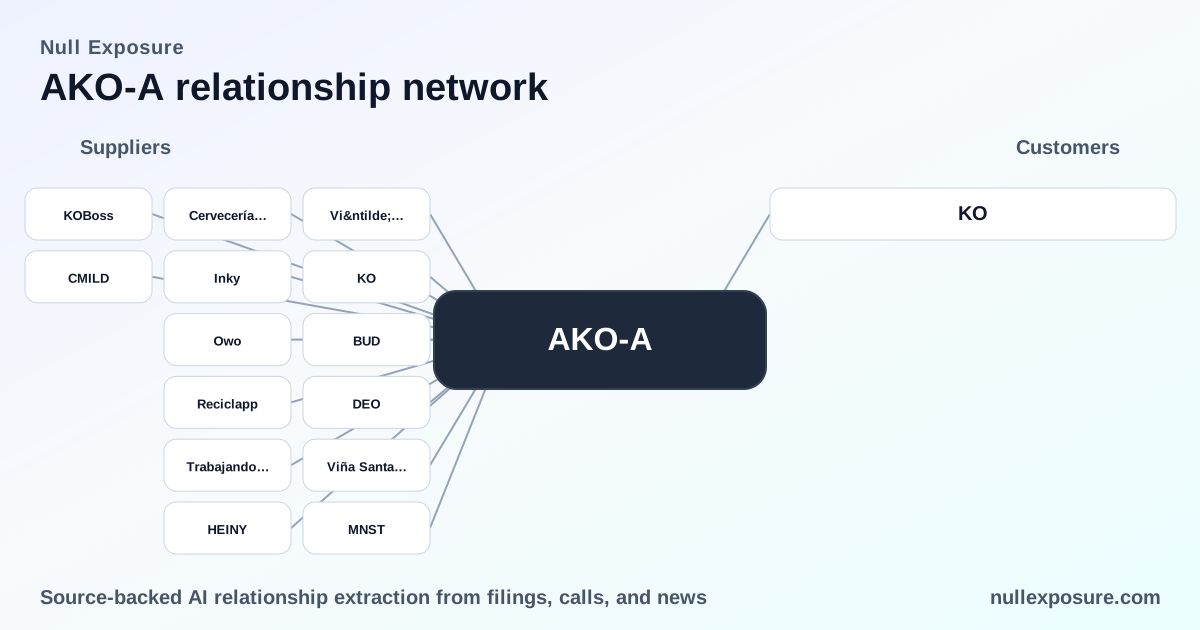
Embotelladora Andina (AKO-A): franchise economics anchored to Coca‑Cola, concentrated operating risk
Embotelladora Andina operates as a regional Coca‑Cola bottler that monetizes a branded manufacturing and distribution franchise: it produces, markets and distributes Coca‑Cola beverages across Chile, Brazil, Argentina and Paraguay and generates revenue through wholesale and retail beverage sales to grocery, convenience and foodservice channels. The company’s economics are driven by volume, local pricing power, and efficiency in packaging and distribution; investors should weigh stable cash flow characteristics against concentration risk tied to the Coca‑Cola relationship.
For an integrated view of customer relationships and strategic exposure, see NullExposure’s platform: https://nullexposure.com/
How Andina’s model translates into cash flow and valuation
Embotelladora Andina is a classic franchised bottler: it captures margin by executing production, marketing and distribution under the Coca‑Cola brand rather than owning the brand itself. Company-reported metrics show substantial scale (Revenue TTM listed at 3,406,912,553,000 and Market Capitalization approximately $3.64 billion), with profitability indicated by a trailing P/E of 11.9 and EV/EBITDA around 9.6. These numbers reflect a mature business with predictable unit economics and a high operational link to consumer beverage demand.
Given the capital intensity of bottling and distribution, the asset base and working capital cycles are material to returns; the company’s return on equity of ~23.5% signals effective deployment of capital within that model, supporting the notion that Andina extracts meaningful value from its Coca‑Cola franchise rights.
Customer relationships (exhaustive coverage of recorded relationships)
This section lists every customer-scope relationship captured in the source results and summarizes the connection in plain language.
Coca‑Cola / KO — LexLatin report (entry 1)
Embotelladora Andina is the regional bottler that produces and distributes Coca‑Cola branded products in Chile as part of its core operations, reinforcing Coca‑Cola as the primary brand under which Andina sells beverages to its customers. According to a LexLatin news report (March 9, 2026), the article notes Andina’s role in producing and distributing Coca‑Cola products in Chile.
KO (duplicate mention) — LexLatin report (entry 2)
A second indexed mention references the same LexLatin piece and repeats that Andina’s business is centered on producing and distributing Coca‑Cola brand beverages in Chile; the duplicate confirms consistent press recognition of the Coca‑Cola relationship. The citation is LexLatin, March 9, 2026.
Both entries reference the same underlying source and underscore the singular importance of Coca‑Cola as the anchor brand for Andina’s product portfolio.
Constraints, contracting posture and company‑level signals
The customer-scope data contains no explicit contractual constraints captured in the feed for AKO‑A. Treat this absence as a company-level signal that the available relationship inventory does not include specific contractual excerpts, termination clauses, exclusivity terms, or other binding constraints.
From a business-model perspective, Andina’s operating posture is clear and actionable:
- Contracting posture: Andina operates under long‑term franchised bottling and distribution arrangements typical of Coca‑Cola bottlers; the company executes production, marketing and distribution obligations rather than owning brand IP.
- Concentration: The business demonstrates high concentration around a single global brand, which creates predictable demand but also concentrates counterparty and reputational risk.
- Criticality: The Coca‑Cola relationship is mission‑critical to Andina’s revenue stream and distribution footprint across its markets.
- Maturity: The franchise model is mature and stable—bottling agreements are industry-standard long-term arrangements that underpin consistent cash flow but also create lock‑in to brand economics and strategic constraints on diversification.
These company-level signals should be read as structural characteristics of the operating model rather than discrete contractual findings, since no specific constraint language was provided in the source set.
Investment implications: what drives upside and where risk concentrates
- Upside drivers: Operational leverage from volume growth, cost efficiency in packaging and distribution, and modest valuation (trailing P/E ~11.9; EV/EBITDA ~9.6) support upside if local demand expands or cost discipline improves. Andina’s gross profit and return on equity figures indicate room for steady earnings conversion given stable volume.
- Key risks: Brand concentration is the dominant risk — a change in the bottling relationship, pricing squeeze from the franchisor, or material disruption in Coca‑Cola supply/brand strategy would have outsized impact. Currency, commodity and local regulatory exposures in Chile, Brazil, Argentina and Paraguay are additional operational hazards that affect pricing and input costs.
- Contract risk: Even though no contract clauses were captured, the nature of franchised bottling implies limited bargaining power on brand and marketing terms, constraining margin expansion potential independent of operational efficiency.
Practical takeaways for investors and operators
- Core exposure is to Coca‑Cola brand economics. Any investment thesis must treat the bottling relationship as the principal revenue engine and the main source of counterparty risk.
- Operational execution matters more than brand creation. Investors should prioritize checks on distribution efficiency, packaging cost control and working capital management.
- Valuation is compelling relative to cash‑flow characteristics. With a mid‑teens to low‑teens valuation multiple and stable cash generation, the stock offers a play on regional consumer staples growth subject to the brand concentration caveat.
For a deeper relationship map and to track how customer linkages evolve over time, review NullExposure’s coverage at https://nullexposure.com/
Bottom line
Embotelladora Andina is a structurally sound, cash‑generative bottler whose fortunes are tightly linked to the Coca‑Cola franchise. Investors gain exposure to predictable beverage demand and efficient distribution economics, but they assume concentrated counterparty and regional macro risk. Prioritize diligence on operational KPIs and any disclosed contractual terms with Coca‑Cola when sizing position risk.