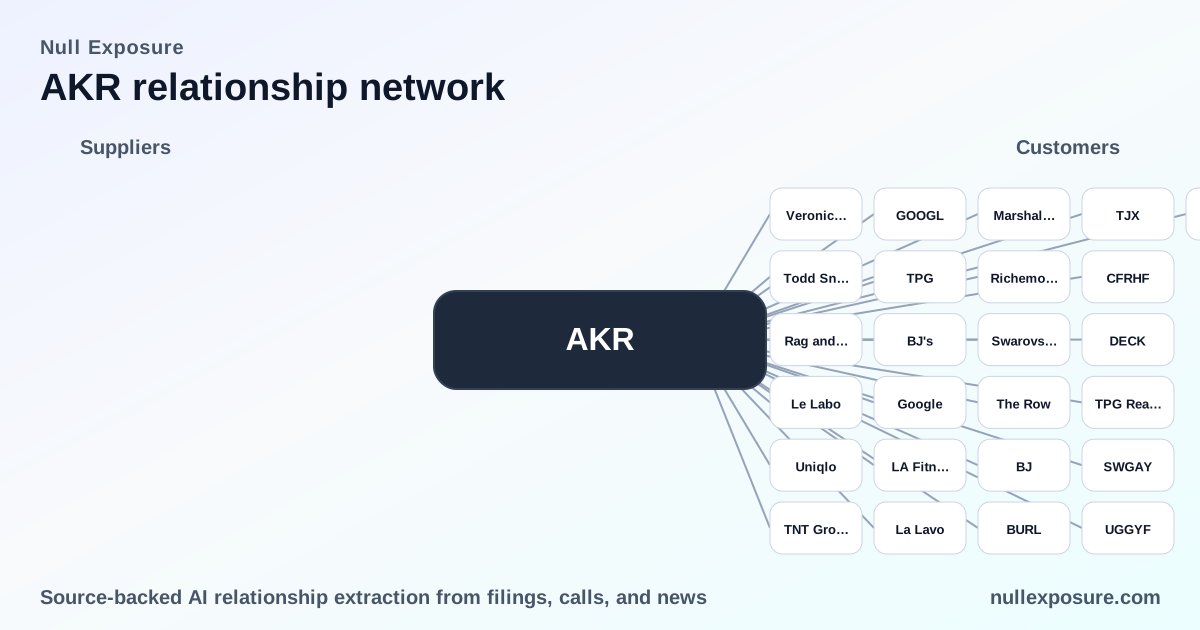
Acadia Realty Trust (AKR): Tenant map, joint-venture partners and what they mean for investors
Acadia Realty Trust operates and monetizes a portfolio of street‑retail and dense suburban shopping centers by leasing space to national and specialty retailers, managing properties directly and co‑investing through joint ventures that generate asset‑management fees and carried interest. The company’s cash flow comes principally from long‑term leases with national tenants, supplemented by property sales and fee income from investment‑management activities. For investors, AKR’s strategy is a hybrid of stabilized cash yield and portfolio rotation via JV-capital partnerships.
Learn more at https://nullexposure.com/ if you want the complete coverage and signal feed.
How to read AKR’s relationship map: operating constraints as signals, not stats
AKR’s public disclosures set the context for every tenant and partner relationship below. Key operating model signals: AKR leans on long‑term leases (weighted average lease term ~5.6 years) and a national‑tenant base, concentrated across about 20 key tenants that collectively contribute roughly 17.1% of consolidated revenue while no single tenant exceeds 10% of revenues. The portfolio is geographically focused in the United States — high‑barrier, supply‑constrained metros — and the company acts as both landlord/licensor (roughly 1,300 leases) and service provider through its investment‑management platform, earning asset‑management and property‑management fees. AKR is active: occupancy and leasing metrics show a high utilization profile and frequent new/renewal activity. These are company‑level signals that explain why AKR pursues JV transactions and selective property sales as part of yield optimization.
Transaction and capital partners: the JV that reshaped the 2026 portfolio
- TPG / TPG Real Estate / TPG Inc. — Acadia completed a $440 million portfolio transaction with TPG in February 2026, forming new joint ventures where TPG acquired the majority interest (reported as ~80%) while Acadia retained a minority stake and continues to earn management fees. Source: press coverage of the February 25, 2026 transaction (Bitget, Intellectia, and StockTitan reporting on AKR filings and press releases, FY2026).
High‑street and flagship tenants (tenant roster and recent acquisitions)
- Google (GOOGL) — AKR cited Google as a tenant on M Street in Washington, D.C., indicating the company’s access to large, creditworthy flagship occupiers for premium street retail. Source: AKR Q4 2025 earnings call transcript (March 2026).
- Veronica Beard — Listed among recent Soho additions, reinforcing AKR’s focus on fashion and lifestyle flagships in high‑value micromarkets. Source: AKR Q4 2025 earnings call (2025Q4).
- Rag and Bone — Named as a new tenant on Henderson Avenue in Dallas, underscoring AKR’s cross‑market fashion leasing. Source: AKR Q4 2025 earnings call (2025Q4).
- Le Labo — Identified as a tenant at recent Madison Avenue storefront acquisitions, signaling a luxury perfume/beauty presence in AKR’s Manhattan holdings. Source: AKR Q4 2025 earnings call (2025Q4).
- Todd Snyder — Cited alongside Le Labo at 1045/1165 Madison Avenue purchases, consistent with AKR’s premium Manhattan retail strategy. Source: AKR Q4 2025 earnings call (2025Q4) and related news reposts (InsiderMonkey, FY2026).
- Uniqlo — Named as a national tenant at the 550,000 sq ft Skyview center in Queens, illustrating AKR’s tenant mix that spans value and middle‑market national anchors. Source: AKR Q4 2025 earnings call (2025Q4) and InsiderMonkey coverage (FY2026).
- Marshalls — Included in Skyview’s national tenant roster, reflecting AKR’s use of discount anchors to stabilize shopping‑center cash flow. Source: AKR Q4 2025 earnings call (2025Q4).
- Burlington (BURL) — Identified as a Skyview tenant; part of the national-anchor set anchoring suburban and power‑center cash flow. Source: AKR Q4 2025 earnings call (2025Q4).
- BJ’s (BJ) — Listed at Skyview among national anchors, reinforcing diversified anchor exposure. Source: AKR Q4 2025 earnings call (2025Q4).
- TNT Grocery — Mentioned as a San Francisco addition, showing AKR’s inclusion of grocery/necessity retail in core markets. Source: AKR Q4 2025 earnings call (2025Q4) and InsiderMonkey reporting (FY2026).
- LA Fitness Club Studio — Cited as a tenant in San Francisco, indicating experiential and service‑oriented uses within AKR properties. Source: AKR Q4 2025 earnings call (2025Q4) and follow‑on news coverage (FY2026).
- Swarovski — Recorded on M Street in D.C. among notable high‑street signings, consistent with premium experiential retail. Source: AKR Q4 2025 earnings call (2025Q4).
- Richemont’s Watchfinder — Noted in Soho lease activity, another luxury specialty tenant on AKR’s urban retail roster. Source: AKR Q4 2025 earnings call (2025Q4).
- The Row — AKR referenced an expansion and extension of The Row on Melrose Place in Los Angeles, demonstrating landlord success in extracting rent premiums from blue‑chip luxury tenants. Source: AKR Q4 2025 earnings call (2025Q4).
- UGG (Deckers / DECK / UGGYF) — Highlighted as a high‑street tenant on North 6th Street in Williamsburg with standout deal economics (management cited spreads of 72% in select cases). Source: Company release and The Globe and Mail press release citing FY2026 disclosures.
- Marshalls / HomeGoods / T.J. Maxx (TJX group) — Appearing across Skyview and Pinewood Square tenant rosters; these TJX banners provide stable, lower‑volatility rent rolls. Source: AKR filings and The Real Deal coverage of Pinewood Square acquisition (March 2026).
- Ross Dress for Less — Included in the Pinewood Square tenant roster, part of the discount‑retail anchor mix. Source: The Real Deal (March 2026).
- Panera Bread — Listed among Pinewood Square tenants, representing stabilized quick‑service restaurant income. Source: The Real Deal (March 2026).
- AT&T (T) — Noted as a Pinewood Square tenant, representing service providers/telecom visibility in neighborhood centers. Source: The Real Deal (March 2026).
- Famous Footwear (CAL) — Named in Pinewood Square tenant list, part of national specialty anchors. Source: The Real Deal (March 2026).
- Gucci — Tenant at the 225 Worth Avenue acquisition in Palm Beach, representing AKR’s targeted luxury retail investments in resort markets. Source: The Real Deal (March 2026).
- G/FORE — Named as a tenant at 225 Worth Avenue, indicating a curated luxury/rent premium tenant mix in Palm Beach. Source: The Real Deal (March 2026).
- J.McLaughlin — Listed at the Worth Avenue acquisition alongside Gucci, part of small‑format luxury retail tenants. Source: The Real Deal (March 2026).
- La Lavo (La Lavo / La Lavo typo variants in coverage) — Mentioned in news recaps as a tenant at Madison Avenue storefronts; consistent with AKR’s boutique operator mix. Source: InsiderMonkey and AKR earnings call references (FY2026).
- Famous Footwear / Ross / T.J. Maxx duplicates — These repeat entries in news coverage confirm AKR’s mix of national discount anchors across neighborhood centers. Source: The Real Deal and earnings call materials (FY2026).
- Lululemon (LULU) — Management noted a replacement of Lululemon on North 6th Street with UGG after relocating and expanding Lululemon elsewhere on the street, showing AKR’s active leasing and tenant‑reshuffle capability. Source: InsiderMonkey coverage of Q4 2025 earnings call (FY2026).
What investors should take away from the relationship map
- Diversified tenant mix but focused concentration: AKR’s tenant roster spans luxury flagships, national anchors and service concepts; 20 key tenants account for material share (~17.1%) of revenue while no single tenant exceeds 10%, a controlled concentration that supports predictability without single‑counterparty dependence.
- Long‑term, lease‑driven cash flows with active capital recycling: The balance of long‑term leases (WALE ~5.6 years), frequent leasing activity and JV asset sales (e.g., the $440 million TPG transaction) demonstrates a repeatable model of stabilized cash yields plus opportunistic portfolio monetization.
- Geographic and market concentration in US high‑barrier metros gives AKR pricing power on rents for high‑street storefronts, but also exposes it to localized retail‑market cycles; AKR offsets that with suburban anchor sets that deliver steadier income.
- Multi‑role business model: AKR acts as landlord/licensor, seller and investment manager; fee income from co‑investment ventures is a recurring complement to rental revenue, reducing pure‑rent reliance.
If you want continuous signals and relationship monitoring for AKR, visit https://nullexposure.com/ for the full company feed.
Bottom line
AKR’s tenant and partner map is consistent with a landlord that targets premium street retail while stabilizing cash through national anchors and JV capital recycling. For investors, the combination of long‑term leases, diversified tenant classes and active JV transactions frames AKR as a REIT that blends yield with strategic capital markets execution.