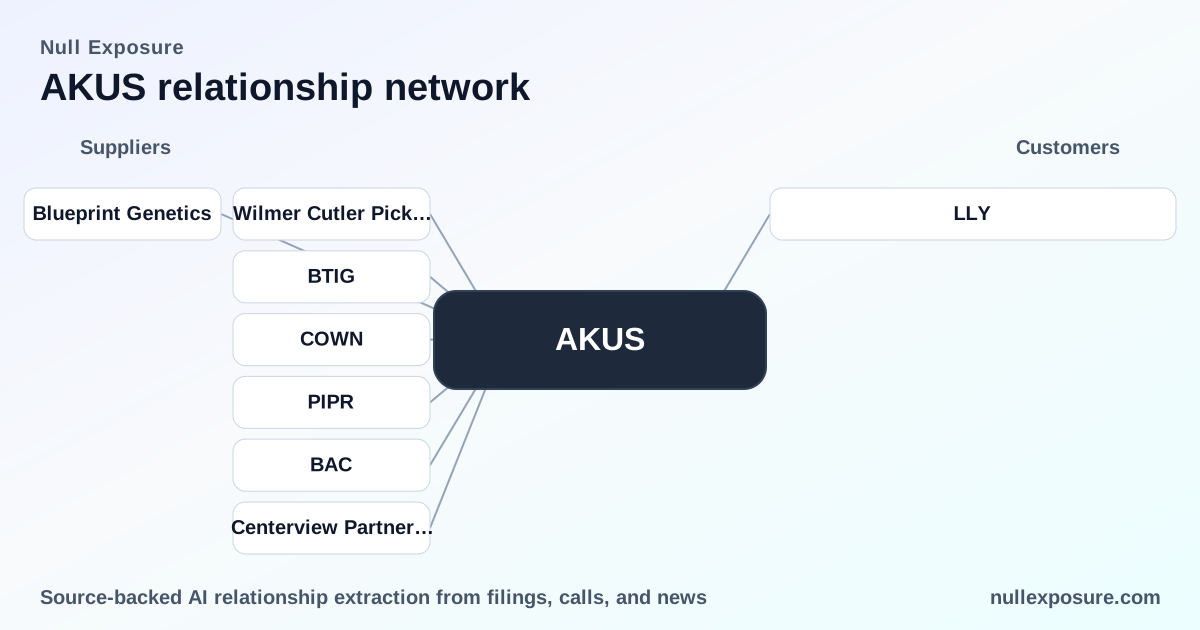
AKUS Customer Relationships: The Eli Lilly Exit and What Investors Need to Know
Akouos built a narrowly focused biotech business developing AAV-based gene therapies for inner-ear disorders and monetized that work through a strategic exit: Eli Lilly agreed to acquire Akouos in a deal valued at up to $610 million, delivering immediate value to shareholders and folding Akouos’ lead program into a large pharmaceutical platform. The company’s revenue model to date was transactional and event-driven—centered on licensing, partnerships and a definitive sale—rather than recurring commercial revenue.
For a quick view of the broader relationship intelligence underpinning this conclusion, visit https://nullexposure.com/.
The deal in plain terms: scope, price and tactical rationale
Akouos’ commercial reality was dominated by one counterparty outcome. Lilly’s transaction picks up Akouos’ lead candidate, AK-OTOF (a gene therapy targeting otoferlin mutations), and values the company at roughly $610 million in aggregate consideration. The acquisition structure and press coverage signal a classic early-stage biotech exit: strategic acquirer pays for platform and lead asset upside while removing execution and commercialization risk for Akouos’ investors.
Market reporting referenced different premium calculations to illustrate how the purchase was priced relative to recent trading: BiopharmaDive framed the purchase price as a 78% premium to the immediately preceding share price, while the Boston Business Journal characterized the headline premium as 121% in its coverage. Those figures are reporting-level comparisons and reflect different price baselines used by each outlet. The core commercial takeaway is consistent across outlets: Lilly committed a mid-hundreds-of-millions payment to secure Akouos’ hearing-loss franchise and platform.
Every reported relationship (source-by-source detail)
BioWorld — March 9, 2026
BioWorld reported that Lilly plans to pay about $610 million for the company to get AK-OTOF, Akouos’ lead candidate for treating hearing loss due to otoferlin gene mutations, emphasizing the strategic value of that single program. According to BioWorld (March 9, 2026): https://www.bioworld.com/articles/690750-lillys-message-is-loud-and-clear-akouos-aav-hearing-loss-therapy-is-worthwhile
LLY (duplicate BioWorld entry) — March 9, 2026
The same BioWorld item is reflected under a second record for LLY: the core report is identical—Lilly’s payment is centered on Akouos’ AK-OTOF program and is roughly $610 million in aggregate consideration. Source: BioWorld (March 9, 2026): https://www.bioworld.com/articles/690750-lillys-message-is-loud-and-clear-akouos-aav-hearing-loss-therapy-is-worthwhile
Yahoo Finance — May 2, 2026
Yahoo Finance summarized the announcement as a definitive agreement for Eli Lilly to acquire Akouos for up to approximately $610 million, noting the company’s Boston base and its focus on gene therapies for inner-ear conditions. Source: Yahoo Finance (May 2, 2026): https://finance.yahoo.com/news/eli-lilly-lly-buy-hearing-163804281.html
BioPharmaDive — May 2, 2026
BioPharmaDive reported that Lilly agreed to purchase all outstanding shares of Akouos for $12.50 apiece, reflecting a 78% premium to the company’s share price on the Monday afternoon before the announcement, highlighting the per-share economics investors received. Source: BioPharmaDive (May 2, 2026): https://www.biopharmadive.com/news/lilly-akouos-deal-gene-therapy-hearing-loss/634350/
Boston Business Journal — May 2, 2026 (article flagged from Oct 18, 2022 URL)
The Boston Business Journal framed the transaction as a takeover at a materially higher price, reporting a 121% premium in its coverage, underscoring how market baselines affect reported deal premium. Source: Boston Business Journal (May 2, 2026): https://www.bizjournals.com/boston/news/2022/10/18/eli-lilly-acquires-akouos.html
What the reported relationships reveal about Akouos’ operating model
- Concentration of counterparty exposure: The relationship set is singular and decisive—Akouos’ principal commercial outcome flowed through one strategic acquirer. That concentration reduced the company’s optionality as an independent commercial operator but provided a clean liquidity event for investors.
- Business criticality of a single asset: The transaction language and reporting repeatedly tie value to AK-OTOF, indicating high single-asset criticality. For investors, this is a high-conviction, binary-value profile: success or failure of a lead program determined enterprise value.
- Maturity and contracting posture: This was an early-stage biotech with a transactional contracting posture—Akouos’ pathway to monetization was through collaboration or outright sale rather than through diversified commercial contracts or recurring licensing streams.
- Absence of constraint disclosures in relationship feeds: The available relationship data does not list contractual constraints or complex counterparty obligations; that lack of reported constraints signals a clean acquisition target rather than a company encumbered by multiple long-term commercialization contracts.
Together, these signals paint a coherent business-model story: Akouos operated as a platform/asset incubator where investor return was likely to be realized by partnership or exit rather than by building commercial infrastructure.
Investor implications — risk, value capture and follow-through
Akouos’ outcome provides a compact case study in early-stage biotech investing:
- Upside realization through strategic M&A: Investors captured value via a single, completed strategic transaction—a definitive liquidity event that crystallized the company’s development value.
- Binary asset risk: The company’s value was highly dependent on AK-OTOF and the underlying platform; that concentration increases idiosyncratic risk for holders before exit.
- Limited recurring revenue exposure: Prior to acquisition, Akouos lacked diversified revenue streams; the return profile was therefore event-driven, not cash-flow-driven.
- Acquirer integration and program continuation: Lilly’s acquisition centralizes execution risk with a large pharmaceutical player that has the capacity to advance clinical development and commercialization, increasing the likelihood that AK-OTOF will progress under Lilly’s stewardship.
Key investor considerations: assess whether the acquirer is likely to integrate and accelerate development, and note how reported premiums and per-share consideration compare to the investor’s expected return profile at the time of investment.
For further relationship-level intelligence and comparison across biotech M&A events, explore https://nullexposure.com/.
Bottom line
Akouos’ customer/partner footprint, as reflected in the public reporting, was dominated by one decisive commercial relationship—the acquisition by Eli Lilly for up to $610 million. That outcome is emblematic of an early-stage biotech operating model that prioritizes program development and strategic monetization over prolonged independent commercialization. For investors and operators evaluating similar companies, the Akouos case reinforces the importance of single-asset criticality, counterparty concentration, and the transactional nature of value capture in this segment of the market.