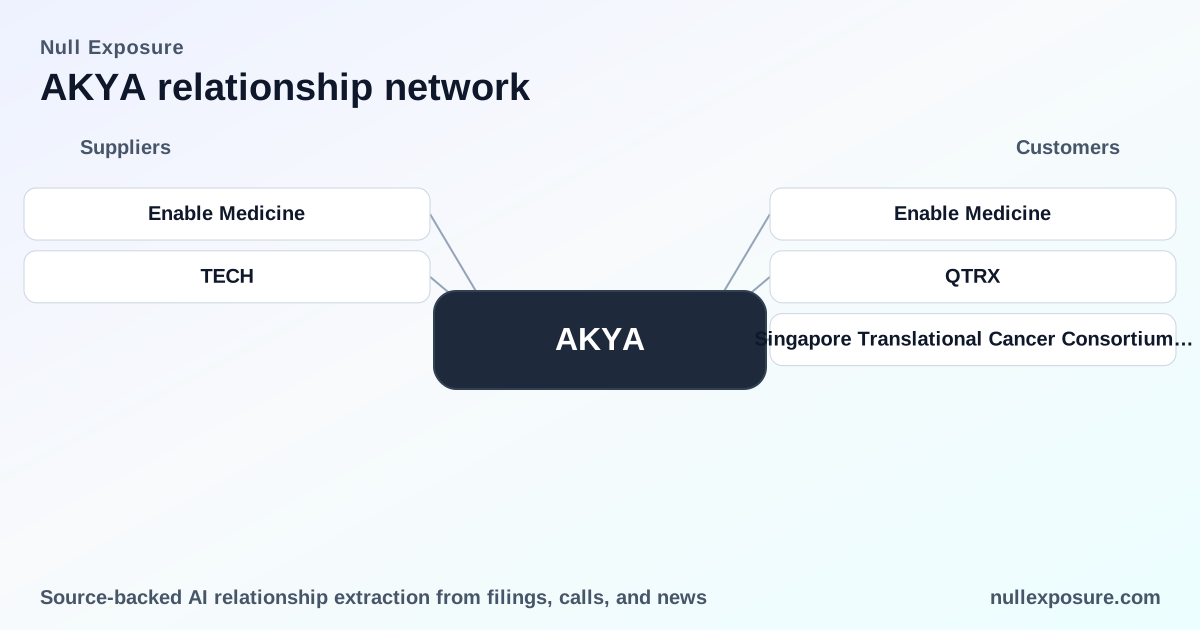
AKYA customer map: who Akoya sells to, partners with, and leverages for R&D
Akoya Biosciences builds and sells spatial biology instrumentation and branded reagent panels, monetizing through a mix of instrument sales, recurring consumables (PhenoCode and Phenoptics panels), and collaborative programs with pharma, CROs, and academic consortia that drive higher-margin services and long-term platform adoption. Investors should view Akoya as a platform vendor whose economics depend on converting strategic partnerships into recurring panel and service revenue while using selective collaborations and financial arrangements to accelerate commercial reach. Learn more at https://nullexposure.com/.
Why these customer relationships matter to valuation
Akoya’s growth profile is driven by three commercial dynamics: instrument placement, consumables attach rate, and strategic co-development with pharmaceutical and research partners that accelerate adoption of Akoya’s PhenoCode and PhenoCycler workflows. The customer list in market reporting shows a deliberate mix of large pharma collaborators, service-provider partners, academic consortia, and a small number of commercial contracts that also carry financing components. That mix supports recurring revenue upside but also concentrates business risk around a limited set of influential partners and co-development agreements.
The relationships in plain English — one-by-one
Below are every relationship surfaced in the results set, each summarized in one to two sentences with the primary source noted.
-
Enable Medicine — Akoya’s PhenoCycler-Fusion platform and PhenoCode panels are foundational to Enable Medicine’s Pan-Cancer Atlas, indicating Enable uses Akoya technology to generate large-scale spatial proteomics maps for discovery work (GlobeNewswire, April 24, 2025: Akoya and Enable Medicine press release).
-
Quanterix Corp. (stocktitan report) — Akoya entered a purchase agreement to provide up to $30 million of convertible notes to Quanterix, a financing arrangement that triggered activist investor scrutiny and questions about the terms of that convertible financing (StockTitan news citing Tikvah Management statement, March 2026).
-
QTRX (Quanterix AACR collaboration) — Quanterix publicly presents an integrated product called the Content Innovation Engine built on integration of Akoya’s spatial biology platform with Quanterix’s SIMOA immunoassay technology, signaling joint product development and cross-technology commercialization at AACR 2026 (SelectScience coverage of Quanterix at AACR, 2026).
-
Singapore Translational Cancer Consortium (STCC) — Akoya partnered with STCC on the SUPER study to apply its PhenoCode Discovery IO60 Panel for immunophenotyping matched patient cohorts in Singapore, showing Akoya’s penetration into national-level translational programs and clinical research networks (GlobeNewswire, April 23, 2025).
-
AstraZeneca (AZN) — Akoya has an established collaboration with AstraZeneca to develop multiplex immunofluorescence workflows and spatial biomarker signatures, representing a strategic pharma partnership to co-develop predictive spatial biomarkers (GenEngNews overview of spatial biology partnerships, 2021).
-
Invicro — Invicro secured early access to Akoya’s PhenoCode Signature Panels to accelerate biomarker discovery and validation, positioning Invicro as a commercial services partner that uses Akoya panels to deliver value to biopharma customers (SelectScience coverage, FY2024).
-
Acrivon Therapeutics (ACRV) — Acrivon terminated an Akoya companion diagnostic agreement, indicating at least one commercial diagnostic collaboration did not progress to completion and highlighting execution risk in CDx programs (TradingView news summary, FY2026).
-
QTRX (duplicate entry in dataset) — Several items in the coverage reiterate Akoya’s financial and product-level engagement with Quanterix, with documentation and investor scrutiny focused on the convertible note arrangement and continued technical integration publicized at conferences (StockTitan and SelectScience, March–May 2026).
What the relationship map implies about Akoya’s operating model
-
Contracting posture: Akoya operates primarily through a hybrid of product sales and collaborative agreements. Contracts are often co-development or research-use collaborations rather than pure, one-off equipment sales; this produces longer negotiation cycles but creates stickier revenue when panels and workflows are adopted.
-
Customer concentration: The mix shows concentration toward a handful of strategic partners (large pharma, national consortia, and leading service providers). That concentration increases revenue upside from a successful co-development but also creates single-counterparty risk if a program is delayed or terminated (as with the Acrivon termination).
-
Criticality: Akoya’s platforms are mission-critical for partners building spatial biomarker programs: Akoya supplies the core instrumentation and branded panels that underpin many workflows, which establishes leverage for recurring consumables sales and co-branded offerings.
-
Maturity of relationships: Partnerships range from mature, multi-year collaborations with global pharma (AstraZeneca) to early access and discovery-stage agreements (Invicro, Enable Medicine) and academic consortia studies (STCC). The presence of conference-integrated products (Quanterix Content Innovation Engine) indicates an evolving commercialization pipeline beyond discovery use.
Key investment implications — what to watch
-
Revenue mix shift is decisive. Instrument placement is only the opening move; panel attach rates and commercialized co-developed products will drive margin expansion. Monitor published adoption metrics and recurring revenue disclosures.
-
Partnership execution risk is real. The Acrivon termination and the scrutiny around the Quanterix convertible notes demonstrate that not all collaborations reach commercial fruition and that financial arrangements with partners can generate investor attention.
-
Strategic finance is part of the playbook. Akoya has used financing and structured arrangements to deepen relationships (the convertible notes to Quanterix), which accelerates collaboration but introduces counterparty and perception risk for shareholders.
-
Commercial services partnerships amplify reach. Collaboration with service providers like Invicro and resource-intensive consortia like STCC validate the platforms in translational and clinical contexts and expand total addressable market access.
Bottom line and near-term monitor list
Akoya’s customer relationships show a deliberate strategy: use high-profile pharma and service partners to validate and scale the PhenoCode/PhenoCycler platform, then monetize via recurring panels and integrated products. Investors should watch: disclosed recurring revenue growth, panel attach rates, the status and outcomes of co-development agreements, and any additional structured financing tied to customers.
For a consolidated view of how these dynamics affect other life-science platform companies and to track relationship-driven exposures across corporates, visit https://nullexposure.com/.
By focusing on execution of partnerships and conversion of co-development work into repeatable consumable revenue, Akoya will convert platform validation into durable cash flow; failure to do so keeps valuation tethered to proof-of-concept milestones and partnership risk.