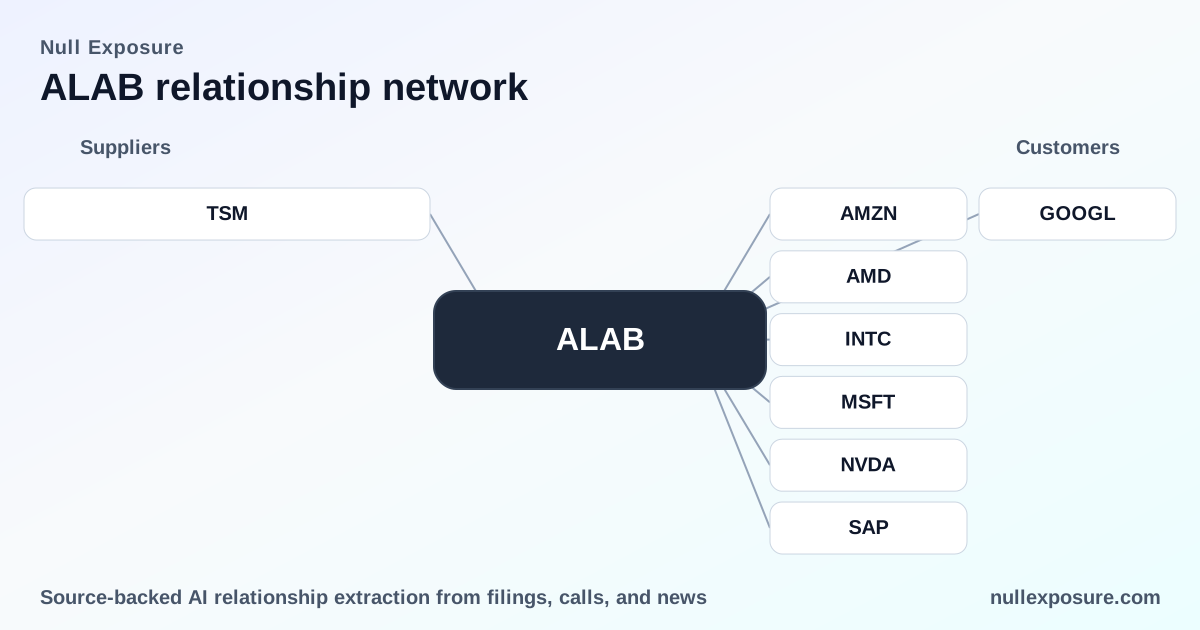
Astera Labs (ALAB): Hyperscaler traction, concentrated revenue, and what customers reveal about risk and runway
Astera Labs designs and sells semiconductor connectivity hardware and embedded software that enable scale-out AI and cloud infrastructure; it monetizes primarily through product sales of retimers, smart fabric switches, and modules, supplemented by a small stream of engineering services and embedded COSMOS software licensing. Management positions Astera as a supplier to hyperscalers, OEMs and AI accelerator vendors, translating high-capex cloud builds into multi-year hardware demand and optionality via performance‑linked warrants and purchase commitments. For investors assessing customer risk and upside, the key dynamics are rapid hyperscaler adoption, revenue concentration, short-term purchase order contracting, and a geographically broad manufacturing and end‑market footprint. For more structured signals on counterparties and contract terms, see NullExposure’s coverage at https://nullexposure.com/.
Big customers = big leverage: the hyperscaler and AI vendor roster
Astera’s 2025 commentary and follow‑on press name a tight set of very large enterprise customers and partners that anchor both near‑term revenue and strategic roadmap validation.
Amazon / AWS
Amazon (including AWS) is described as a core hyperscaler customer and strategic partner, with management noting Amazon among hyperscalers driving massive CapEx guidance for 2026 and press reporting a warrant arrangement tied to up to $6.5 billion of purchases, indicating both scale and multi‑year optional economics. This relationship is cited on Astera’s Q4 2025 earnings call (March 2026) and in May 2026 coverage from Tikr and other market outlets. (ALAB Q4 2025 earnings call; Tikr, May 2026)
Microsoft / Azure
Astera disclosed a partnership to enable evaluation of CXL memory expansion on Microsoft Azure M‑series VMs, with initial production volumes slated for H2 2026—representing the company’s first public CXL deployment with a major cloud provider. This was announced on the Q4 2025 earnings call and reiterated in March 2026 press coverage (StorageNewsletter, StockTitan). (ALAB Q4 2025 earnings call; StorageNewsletter, Feb 5, 2026)
Management explicitly grouped Google with AWS as hyperscalers anchoring Astera’s pipeline, highlighting the outsized impact of the two companies’ CapEx plans on Astera’s revenue trajectory as disclosed on the Q4 2025 earnings call and in May 2026 analyst write‑ups. (ALAB Q4 2025 earnings call; Tikr, May 2026)
NVIDIA
Astera named NVIDIA among select partners that have chosen its connectivity solutions for NVLink fusion opportunities, positioning Astera as a supplier into GPU‑centric AI stacks according to management on the Q4 2025 earnings call. (ALAB Q4 2025 earnings call, March 2026)
AMD
Management referenced AMD’s MI‑500 series support for UA Link (announced for 2027), which signals product roadmap alignment between Astera’s connectivity portfolio and AMD’s accelerator roadmap. This was noted on the Q4 2025 earnings call. (ALAB Q4 2025 earnings call, March 2026)
Intel
Astera cited collaboration with Intel in a multi‑party effort to enable customers to evaluate CXL memory expansion in Azure—Intel is named on the company’s Q4 2025 call as a technical partner supporting CXL demonstrations. (ALAB Q4 2025 earnings call, March 2026)
SAP
SAP is listed alongside Microsoft and Intel in the Azure CXL initiative, indicating systems and software ecosystem engagement that supports customer evaluation and potential procurement. (ALAB Q4 2025 earnings call, March 2026)
Anthropic
Independent coverage and market write‑ups highlight Anthropic as a named AI customer in press clusters linking Astera to large cloud/AI deployments; media referenced Anthropic alongside Amazon in May 2026 profiling Astera’s role in AI infrastructure. (SimplyWallSt / Marketbeat / Tikr coverage, May 2026)
What the customer list implies about Astera’s operating model
Astera’s customer mix and the company disclosures point to a business built on hardware volume sold into very large enterprises with short‑term purchase orders, anchored by a handful of hyperscalers. The constraints and disclosures should shape investor views as follows:
-
Contracting posture: short‑term, purchase‑order driven. Astera sells mainly via standard purchase orders that set price, quantity and delivery, and the company notes limited cancellation rights—this is a classical OEM/distributor fulfillment model that converts large capex cycles into transactional sales but with limited long‑term contractual revenue guarantees. (Company filings excerpts)
-
Counterparty profile: very large enterprises and hyperscalers. Management explicitly lists hyperscalers, GPU/accelerator vendors and system OEMs as core customers—this elevates strategic importance but also buyer leverage in pricing and volume negotiation. (Company filings excerpts)
-
Concentration is material and creates binary outcomes. The company reports its top three end customers represented roughly 80% of revenue in 2024, which makes Astera highly sensitive to order cadence from a small number of hyperscalers or OEMs. (Company filings excerpts)
-
Geographic footprint and supply chain orientation. Revenue concentration by geography shows heavy APAC manufacturing and shipment exposure (notably Taiwan and China) alongside global deployment of products—this is consistent with a semiconductor hardware supplier that ships components from Asia into global data centers. (Company filings excerpts)
-
Go‑to‑market mix blends direct sales, distributors, and field engineering. Astera sells through distributors for fulfillment while maintaining direct engagements and an FAE field team for on‑site technical support; engineering services are immaterial but important for onboarding complex hyperscaler deployments. (Company filings excerpts)
-
Segment mix: hardware first, software embedded. Revenue is predominantly from semiconductor hardware (ICs, boards, modules), with COSMOS embedded software as a value add that deepens technical lock‑in without creating a large recurring software revenue base today. (Company filings excerpts)
-
Relationship stage: active and increasingly mature with hyperscalers. Management frames several relationships as proven and production‑oriented (shipping millions of devices across hyperscalers), and the Azure CXL deployment indicates progression from evaluation to production planning. (Company filings excerpts; press)
Investment implications and risk checklist
-
Upside: Hyperscaler CapEx guides and large purchase commitment frameworks (e.g., Amazon warrants linked to purchase volume) create clear revenue runway and optionality into 2026–2033 if order milestones are met. (Tikr, May 2026)
-
Key risks: extreme customer concentration, transactional (PO) contracting, and APAC supply‑chain exposure; any shift in hyperscaler build cadence would materially affect revenue timing and margin leverage. (Company filings excerpts)
-
Operational levers to watch: fulfillment timelines under purchase orders, reported production ramp dates for Azure CXL volumes (H2 2026 guidance), and any expansion of negotiated committed purchase agreements beyond PO‑level terms.
For a structured, signal‑driven view of Astera’s counterparty exposures and the primary constraints that govern revenue durability, visit NullExposure’s investor portal at https://nullexposure.com/ for deeper relationship mapping and real‑time source linking.