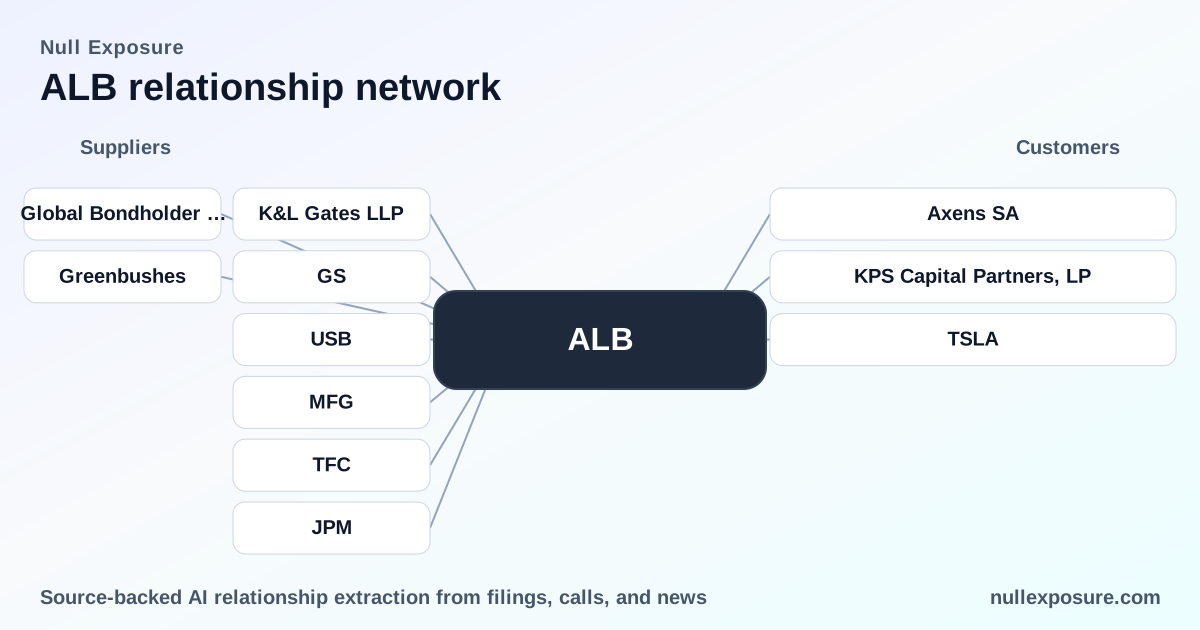
Albemarle’s customer map: long-term lithium contracts, selective divestitures, and evolving demand paths
Albemarle Corporation operates as a global manufacturer of specialty chemicals and lithium compounds, monetizing primarily through the sale of lithium carbonate, lithium hydroxide, and related downstream products plus technical and recycling services. The company combines long-term customer contracts and sizable prepayments with a diversified global account base—while selectively divesting non-core catalyst assets to refocus capital and cash flow on energy storage materials.
If you want a concise institutional view of customer exposures and strategic counterparty moves, visit https://nullexposure.com/ for further coverage.
How investors should read the customer signals
Albemarle’s customer relationships are defined by three persistent characteristics: contracted revenue visibility, global enterprise customers, and segment-level diversification between manufacturing and services. These traits explain why Albemarle can secure large prepayments and why its portfolio-level customer concentration is manageable most years, while also exposing the company to execution risk on multi-year supply commitments.
- Contracting posture: Albemarle secures multi-year, index- and fixed-priced agreements that produce upfront cash receipts and deferred revenue recognition.
- Customer profile: The firm serves large global customers via a strategic account program while maintaining broad geographic reach across roughly 70 countries.
- Materiality: Most years show no single customer >10% of consolidated sales, but historic exceptions exist, highlighting episodic concentration risk.
These operating characteristics shape revenue predictability, capital allocation, and the valuation premium investors ascribe to the company.
What the recent relationship signals tell us
Below I walk through every relationship flagged in the coverage set and summarize the implications for Albemarle’s customer footprint.
Axens SA — transaction for Eurecat JV interest
Albemarle completed the sale of its 50% interest in the Eurecat joint venture to Axens SA in January 2026, part of a broader program of portfolio simplification. Finviz covered the transaction in March 2026, noting the divestment as a step away from certain catalyst joint ventures and toward a tighter focus on lithium and energy-storage materials (Finviz, March 2026).
KPS Capital Partners, LP — controlling stake in Ketjen refining catalysts
Albemarle divested a controlling stake in Ketjen Corporation’s refining catalyst solutions business to affiliates of KPS Capital Partners as announced in early 2026, reducing exposure to refining catalysts and unlocking cash to redeploy into priority areas. The transaction was reported in company coverage in March 2026 (Finviz, March 2026).
Tesla — a potential new end-market pathway for lithium
Market commentary highlighted that Albemarle could capture incremental demand for lithium if companies such as Tesla expand into new product lines (for example, humanoid robots) that rely on lithium batteries, creating a new revenue vector beyond automotive and stationary storage. The Globe and Mail discussed this potential demand angle in March 2026 (The Globe and Mail, March 2026).
TSLA (separate mention) — reiteration of Tesla demand thesis
A parallel mention of TSLA in the same Globe and Mail coverage reiterates the same point: Albemarle’s lithium franchise benefits from any broadening of battery applications by large technology and EV players, which would lift long-term demand for battery-grade lithium (The Globe and Mail, March 2026).
KPS (Morningstar mention, KPSHF inference) — specific Ketjen stake economics
Morningstar reported that Albemarle will divest a 51% stake in Ketjen to KPS for approximately $660 million before taxes and fees, with the deal expected to close in 2026; this provides concrete proceeds and clarifies the economics of the catalyst carve-out (Morningstar, May 2026).
Operating constraints and business-model signals investors should price
The public disclosures and the relationship evidence produce several firm-level constraints and strategic signals:
- Long-term contracts and prepaid revenue: Albemarle received $350 million from a customer in 2025 for specified spodumene and lithium salt deliveries through 2029, demonstrating multi-year contracted revenue visibility and the ability to collect sizable prepayments that improve near-term cash flow.
- Large-enterprise counterparty focus: Albemarle runs an international strategic account program to serve large global customers, indicating a direct sales posture with enterprise-class counterparties rather than transactional spot-only buyers.
- Global footprint with broad client roster: The company serves roughly 1,900 customers in ~70 countries, providing geographic diversification that reduces single-country demand shocks.
- Mixed concentration profile: In 2024–25 no single customer exceeded 10% of consolidated sales, but a 2023 Energy Storage customer represented ~12% of sales—this shows that material customer concentration is possible and has occurred recently.
- Segment mix — manufacturing plus services: Albemarle’s business mixes manufacturing of lithium and organometallics with technical services and recycling offerings, producing both product and service revenue streams that change margin profiles and customer stickiness.
- Spend-band and prepayment scale: The existence of a $350M prepayment indicates Albemarle can secure large, >$100M commercial commitments from customers, which materially affects working capital and revenue timing.
None of these constraints is tied to a single named buyer in the disclosures; they function as company-level operating signals that investors should fold into valuation and risk scenarios.
Strategic implications: what to watch next
- Execution on deliveries tied to the $350M prepayment is the immediate operational KPI; missed delivery or quality issues would crystallize revenue deferrals and reputational risk with large buyers.
- Proceeds and capex redeployment from the Ketjen and Eurecat divestitures create optionality: management can accelerate lithium capacity build-out or de-lever the balance sheet—monitor use of proceeds in near-term filings (Finviz; Morningstar, 2026).
- Broader demand vectors such as industrial robotics would raise long-term lithium demand elasticity; track large end-market OEM announcements (The Globe and Mail, 2026).
For a deeper, transaction-level mapping and an institutional feed that consolidates these relationship dynamics, see the analysis hub at https://nullexposure.com/.
Bottom line for investors
Albemarle’s customer relationships combine high-visibility, long-term lithium contracts and global enterprise accounts with periodic asset sales that reshape exposure to refining catalysts. The company’s ability to secure large prepayments and to pivot capital from non-core assets into battery materials is a structural strength. At the same time, episodic customer concentration (the 12% customer in 2023) and execution risk on multi-year deliveries are the primary levers that will determine the reliability of future cash flow.
Sources referenced: Finviz reporting on Albemarle divestments (March 2026); The Globe and Mail press commentary on demand dynamics (March 2026); Morningstar coverage of the Ketjen stake sale ($660M) (May 2026).