Avalon GloboCare (ALBT): customer relationships that signal early commercial traction — and concentrated risk
Avalon GloboCare is a diversified, commercial-stage operator that monetizes through three distinct revenue streams: sales and distribution of the KetoAir handheld breathalyzer and paired “AI Nutritionist” app, laboratory testing services, and rental income from owned office real estate. The company sells hardware and software directly and through its newly formed distribution vehicle (Q&A Distribution), generates recurring lab-services revenue, and collects rental cash flow from its Freehold, NJ headquarters; these combined but small revenue streams explain the company’s early-stage commercial profile and high revenue concentration. For investors evaluating ALBT customer relationships, the current signal set points to active channel partnerships for first-responder wellness programs alongside meaningful customer concentration and long-term contracting exposures. Visit https://nullexposure.com/ for structured relationship intelligence on ALBT.
How Avalon actually operates and why that matters to revenue
Avalon runs as a hybrid business: consumer diagnostics hardware + software, a lab services arm, and real-estate income. The KetoAir device is the customer-facing growth engine — it is sold online, paired with mobile software, and distributed through a subsidiary created in 2024. At the same time, Avalon’s lab-services segment provides diagnostic testing and toxicology services that add recurring revenue, while Avalon RT 9’s ownership of its headquarters generates rental cash flows and ties working capital to a concentrated lessee base.
Key operating signals drawn from company disclosures and reporting:
- Contracting posture: The company discloses long-term lease arrangements (a related-party lease with a five-year term), indicating multi-year cash-flow commitments and embedded counterparty credit exposure within its real-estate segment.
- Concentration risk: Company filings show multiple customers accounted for 10%+ of revenue in 2023–2024 and a single third-party tenant represented 76.9% of outstanding rent receivable at year-end, creating a material counterparty concentration that amplifies downside risk.
- Role and go‑to‑market: Avalon functions as both seller (direct sales via KetoAir website and social media) and distributor (Q&A Distribution holds exclusive regional rights), which gives the company control of channel economics but concentrates execution risk in a small organizational footprint.
- Product mix and maturity: The business spans hardware, software, and services — the device launched U.S. sales in 2024 and the app is distributed through mobile stores, so the commercial model is nascent but active.
These characteristics imply a classic early-commercial-stage profile: high operational leverage and binary adoption outcomes, with upside if KetoAir adoption scales but elevated short-term revenue volatility tied to a few counterparties.
Customer relationships: first-responder programs reported in news
Avalon’s public relationship signals in early 2026 are concentrated in partnerships for first-responder wellness initiatives. The following relationships were explicitly reported in news coverage; each entry below is summarized in plain language and cites the public report.
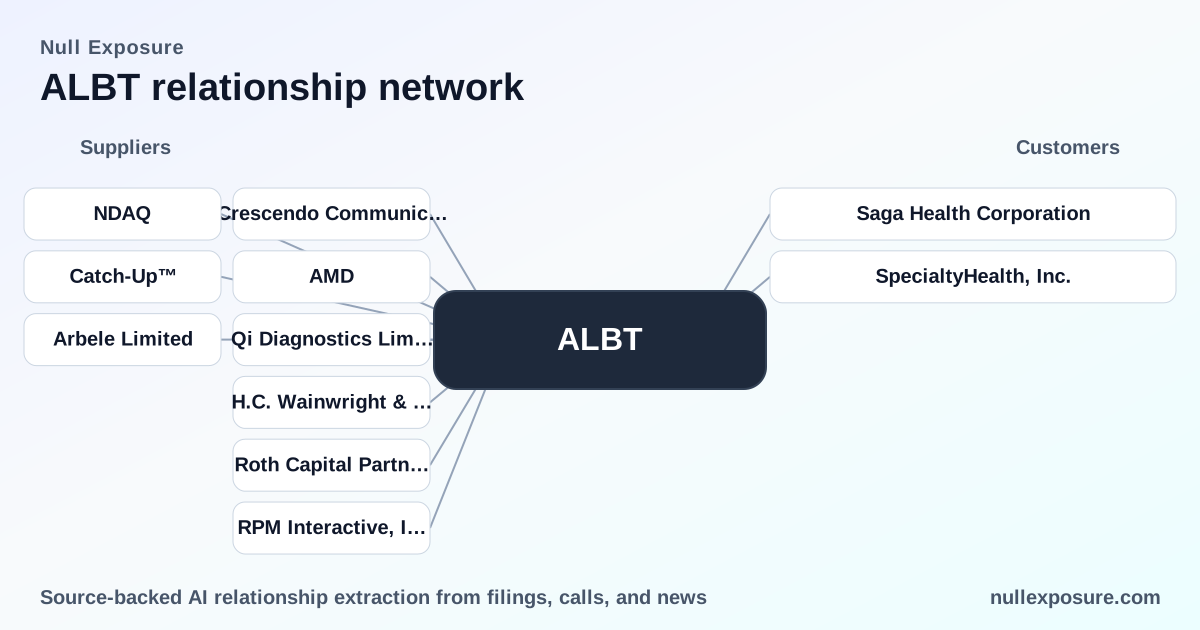
Saga Health Corporation
Avalon announced a collaboration with Saga Health Corporation to support first-responder wellness programs, positioning the KetoAir device as a wellness and monitoring tool for front-line personnel. This initiative signals a channel use-case for KetoAir outside direct consumer sales and could generate programmatic purchase orders from institutional buyers. (Source: StockTitan news aggregation, March 9, 2026.)
SpecialtyHealth, Inc.
Avalon similarly cited a collaboration with SpecialtyHealth, Inc. to implement first-responder wellness programs that incorporate KetoAir devices and associated services, indicating efforts to penetrate institutional wellness channels and broaden non-consumer revenue. (Source: StockTitan news aggregation, March 9, 2026.)
These two named partners are the only customer relationships surfaced in the available news coverage; both are described as collaborators in wellness programs rather than large, diversified retail channels, reinforcing the strategic focus on institutional and occupational use-cases for KetoAir.
Constraints and what they tell investors about operating risk
Company disclosures and supporting excerpts provide actionable signals about Avalon’s operating model that are company-level (not tied to the individual partners above unless explicitly named). Important constraints and their investor implications:
- Long-term contracting posture: A related-party lease with a five-year term (commencing May 1, 2021 and expiring April 30, 2026) demonstrates multi-year contractual commitments in the real-estate segment, which creates predictable rent revenue but concentrates receivable risk if a major tenant underperforms.
- Geographic footprint: Avalon holds exclusive distributorship rights for KetoAir across North America, South America, the EU, and the UK while currently focusing launch and marketing in the U.S., indicating global distribution rights but U.S.-centric execution for initial commercialization.
- Customer concentration and criticality: Filings show multiple customers represented 10%+ of revenue in 2023–2024 and one third-party accounted for 76.9% of outstanding rent receivable at year-end — material and critical counterparty concentration that makes cash collection and contract renewal events determinative for near-term liquidity.
- Commercial role and segmentation: The company operates as a distributor and direct seller for hardware, pairs devices with downloadable software (an “AI Nutritionist”), and concurrently provides laboratory testing services — a multi-segment model that can diversify revenue but requires execution across different go-to-market motions.
- Relationship maturity: The company reports active commercialization (KetoAir sales launched in 2024) and ongoing marketing activities, so relationships are early-stage but active, not legacy or dormant.
Taken together, these constraints paint a picture of a firm with proprietary distribution rights and an active institutional outreach program, yet one where concentration and contract-tenor risks dominate the short-term investor thesis.
What this means for investors and operators
- Growth levers: Institutional partnerships like Saga Health and SpecialtyHealth signal a path to recurring institutional purchases beyond direct consumer channels, which could materially expand average order size and channel stickiness if programs convert to recurring contracts.
- Material downside: High customer concentration and a dominant rent receivable exposure are the largest near-term risks — a loss or delayed payment from a major counterpart could pressure working capital and earnings given the company’s small revenue base (Revenue TTM ≈ $392.7k).
- Execution dependencies: The commercial rollout depends on distribution execution (Q&A Distribution), app availability across mobile stores, and adoption within occupational wellness programs; operational execution and contract renewals are the primary value drivers.
- Diversification potential: The three-segment model offers diversification if lab services scale and KetoAir reaches broader institutional customers across North America and EMEA, but that outcome requires consistent order flow and receivable management.
For more structured monitoring of ALBT’s counterparty and contract signals, see the full relationship tracking at https://nullexposure.com/.
Bottom line: what to watch next
Investors should prioritize updates and filings that confirm:
- Contract awards or purchase orders from Saga Health, SpecialtyHealth, or other institutional partners.
- Receivable aging and tenant payment performance for Avalon RT 9’s major tenant(s).
- Distribution metrics from Q&A Distribution and any geographic expansion beyond initial U.S. marketing.
- App-store availability and user-adoption indicators for the AI Nutritionist pairing.
- Quarterly revenue mix shifts between KetoAir sales, lab services, and rental income.
Keep a close eye on contract renewals and cash collection events; given the material concentration and long-term lease exposures, those items will determine whether Avalon’s early commercial traction converts into durable revenue growth or short-term cash strain.