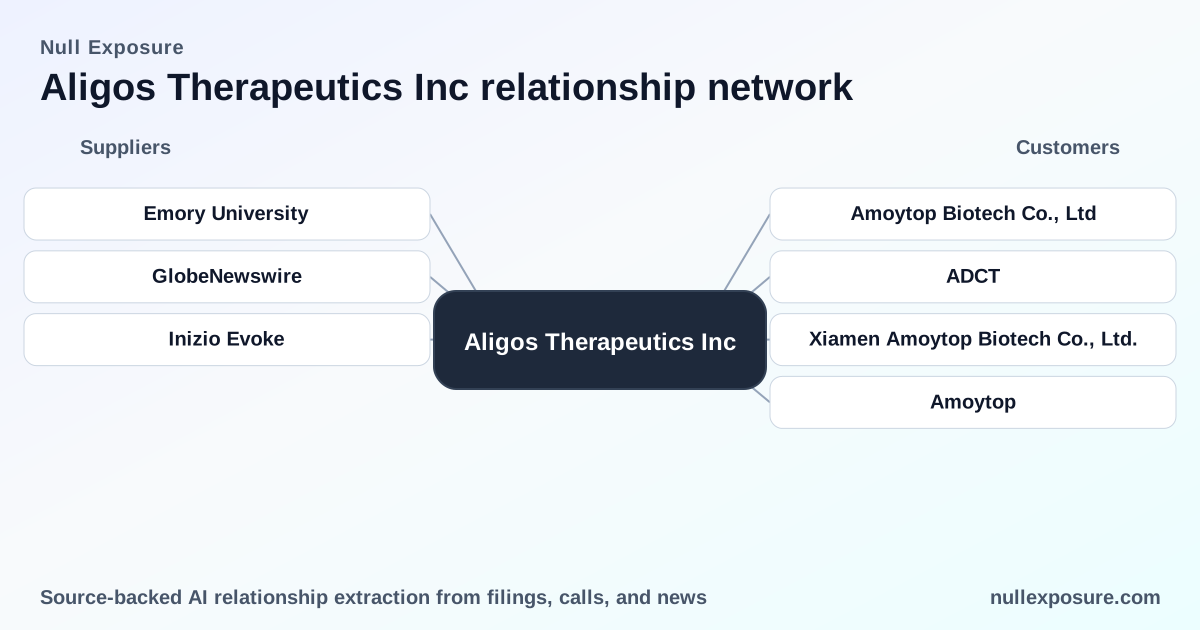
ALGS customer map: what Aligos sells, who pays, and why investors should care
Aligos Therapeutics operates as a clinical‑stage biopharma that monetizes through a combination of upfront license fees, funded R&D services, and government research contracts, while retaining the option to commercialize products in markets it can serve directly. The company recognizes contract revenue over time under ASC 606 for collaborations and licenses, collects milestone/upfront cash from strategic partners, and reduces internal development expenditures through licensing and third‑party funding — a model that converts scientific assets into near‑term non‑dilutive cash while preserving long‑term upside in proprietary indications.
For a concise dossier on counterparty exposures and revenue dynamics, visit https://nullexposure.com/.
Why counterparty relationships drive ALGS value today
Aligos is not a traditional product company — its economics are partnership driven. Two structural features determine investor outcomes:
- Contracting posture and revenue timing: Agreements with third parties are accounted for under ASC 606 rather than collaborative accounting (ASC 808), which signals that Aligos typically functions as a vendor delivering distinct R&D services and licenses rather than as a joint active participant. This produces upfront cash receipts and revenue recognized over time as work is performed, improving near‑term liquidity while keeping longer‑term clinical risk with Aligos or its licensees (Aligos 2024 Form 10‑K).
- Concentration and criticality: A significant portion of recent customer revenue is tied to a single partner (Amoytop), and government awards fund discrete programs; this creates concentration risk on a small number of counterparties but also isolates specific programs where third‑party funding materially reduces Aligos’ development spend (company filings and press releases, 2024–2026).
These company‑level signals — ASC 606 treatment of major agreements, recorded upfront payments, and federal funding for specific programs — define Aligos’ operating profile: service provider + licensor, with active partnerships that accelerate certain programs while leaving core clinical risk intact.
The counterparties and what each relationship means for investors
Xiamen Amoytop Biotech Co., Ltd. (Amoytop)
Aligos has a multi‑stage commercial and R&D relationship with Amoytop that began with an exclusive development and research collaboration in May 2023 and escalated to an exclusive Greater China license for pevifoscorvir sodium in April 2026; Amoytop provided an upfront payment (reported as $7.0 million) and is funding development activities in China, Taiwan, Hong Kong and Macau while Aligos recognizes related revenue over time under ASC 606. This arrangement also includes R&D services revenue tied to IND‑enabling work (Aligos 2024 Form 10‑K; company press release/8‑K April 16, 2026; InvestingNews April 2026).
A stream of press coverage through April–May 2026 confirms the license grant and market scope, and company disclosures show customer revenue tied to Amoytop (approximately $1.3 million YTD in reported commentary), underscoring both short‑term cash inflow and dependency on partner‑funded development (company 10‑K and subsequent press releases, March–May 2026).
ADC Therapeutics / ADCT
Aligos’ agreement with ADC Therapeutics is accounted for under ASC 606 with management identifying a single performance obligation and recognizing revenue over time using an input (cost‑incurred) method; the arrangement was explicitly assessed in the 2024 Form 10‑K as a vendor‑style contract rather than a joint arrangement under ASC 808. This places Aligos in the role of service provider, delivering specified R&D outputs in exchange for contractual consideration (Aligos 2024 Form 10‑K).
The ADC relationship is a working example of Aligos’ recurring contract framework: upfront or structured payments with revenue recognized as development effort progresses, which supports operational cash flows while leaving regulatory and commercial milestones externally contingent (2024 Form 10‑K).
What the constraints tell investors about execution risk and optionality
Aligos’ constraint signals distill into actionable investor intelligence:
- Contracting posture: Multiple excerpts in company filings tie large partner deals to ASC 606 accounting, indicating Aligos acts primarily as a contracted service provider/licensor rather than a JV partner. That reduces revenue accounting complexity but concentrates execution risk internally.
- Role duality: The company serves as both seller (licensor) and service provider, collecting upfront fees and providing R&D services — a hybrid that produces short‑term cash but links a portion of revenue to development costs and timelines.
- Government funding: Federal grants and contracts (NIAID/NIH) fund specific antiviral programs and are expected to provide meaningful non‑dilutive support (Aligos noted approximately $13.8 million across two NIH awards), which lowers near‑term cash burn on those programs and diversifies funding sources from purely commercial partners.
- Active stage: The firm reports active collaborations and revenue recognition in recent periods, reflecting ongoing partner engagement and funded development, but overall customer revenue remains modest relative to market cap and R&D spend — a concentration risk investors must monitor.
These characteristics create a profile of a small‑cap biotech that is capital‑efficient on program‑level spend where partners fund work, but highly levered to clinical outcomes and partner execution for value realization.
Risks investors should monitor now
- Revenue concentration: A meaningful share of customer revenue is linked to Amoytop; partner delays or termination would materially affect short‑term cash flows (company filings and market commentary, 2024–2026).
- Clinical dependency: License value and milestone upside are contingent on favorable clinical results and regulatory approvals; partners fund development in some territories but clinical risk remains central to valuation.
- Accounting recognition: ASC 606 treatment means revenue is recognized as costs are incurred; rising R&D costs without commensurate counterpart funding could stress margins and liquidity.
Bottom line: tactical opportunities and watch‑items
Aligos’ customer relationships convert scientific IP into near‑term non‑dilutive cash and funded development, while preserving downstream upside through retained rights in select markets. Amoytop is the single largest commercial R&D partner and licensee, funding China‑region development of pevifoscorvir sodium and supporting IND‑enabling work, while the ADC Therapeutics contract exemplifies Aligos’ service‑provider revenue model (10‑K and multiple press releases, 2024–2026). Government awards provide a secondary, meaningful source of program funding that reduces burn and extends runway.
For investors and operators evaluating counterparty exposure, Aligos is a case where strategic licensing plus targeted grant funding creates optionality but leaves the company exposed to concentrated partner and clinical execution risk. For more on how counterparties affect small‑cap biotech valuation and to review an expanded counterparty matrix, visit https://nullexposure.com/.