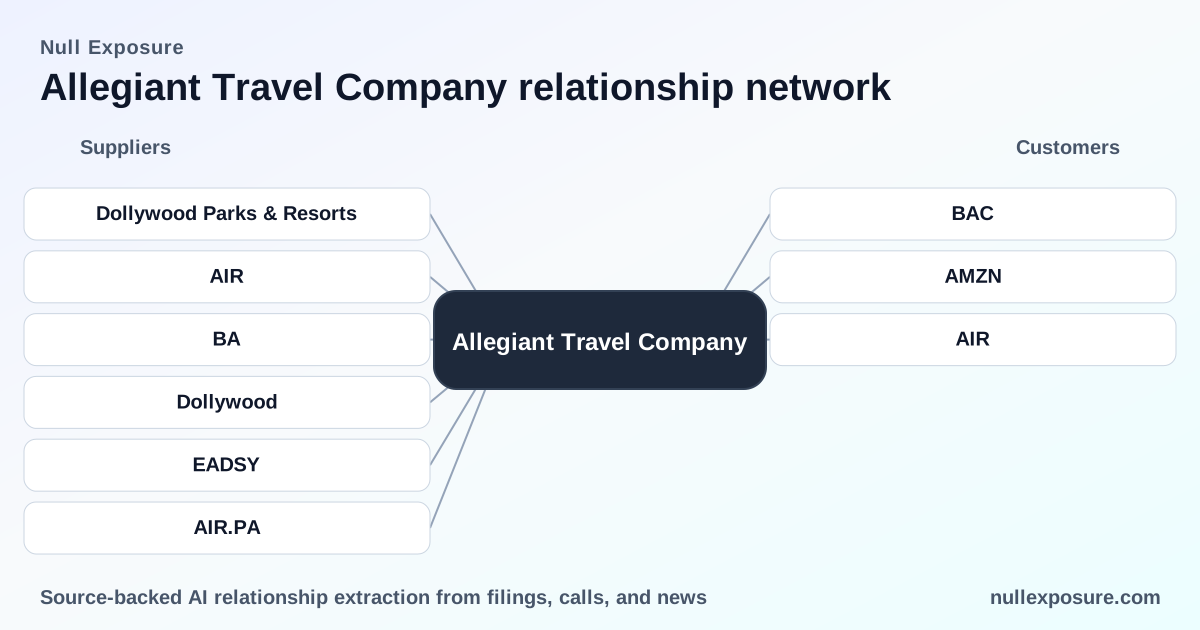
Allegiant Travel Company (ALGT): customer relationships that shape revenue and risk
Allegiant operates a focused leisure airline strategy: sell low-frequency nonstop flights from underserved U.S. cities, monetize aggressively through unbundled ancillaries and third‑party travel products, and supplement ticket revenue with fixed‑fee flying and co‑brand card remuneration. That hybrid monetization — core scheduled air service plus adjacent product sales and contract flying — produces a revenue mix sensitive to leisure demand, ancillary uptake, and a small number of material commercial partners.
If you want a concise feed of relationship intelligence for underwriting or counterparty assessment, visit https://nullexposure.com/ for a deeper enterprise view.
How Allegiant runs the commercial engine
Allegiant is a seller of transportation and a provider of ancillary travel services. Operating cash inflows are derived primarily from scheduled air transportation and related ancillaries, while the company also books fixed‑fee contract revenue (notably military charters) and co‑brand credit card remuneration. Company disclosures flag a distinct U.S. leisure geography focus and an operating posture that blends asset operation with third‑party product distribution. These characteristics define the firm’s counterparty profile:
- Contracting posture: Allegiant functions primarily as a seller/service provider — it sells seats directly to leisure travelers and provides contract flying under fixed‑fee arrangements.
- Concentration & geography: Revenue is concentrated on North American leisure travel and under‑served U.S. origin markets.
- Criticality: Certain partner flows (co‑brand card revenue, fixed‑fee military flying) are material to margins and cash generation.
- Maturity of segments: Core product is mature scheduled air transport; adjacent segments (hotel, ground transport, insurance and resort assets) are increasingly part of Allegiant’s revenue mix.
Company filings show fixed‑fee contract revenue rose substantially in 2024 driven by a large increase in military charters, underlining the importance of contract flying as a distinct revenue stream.
Customer and partner map — line by line
Below are every relationship flagged in the results, each described in plain English with a source reference.
-
Amazon / AMZN (CNBC, Jan 11, 2026) — Allegiant’s CEO told CNBC that Allegiant and Sun Country have little network overlap and confirmed that Sun Country’s contracted flying agreement with Amazon will continue, preserving an existing cargo/charter revenue channel tied to Amazon logistics. Source: CNBC article on the Allegiant–Sun Country deal (2026-01-11) https://www.cnbc.com/2026/01/11/allegiant-sun-country-deal.html
-
Bank of America / BAC (Yahoo Finance summary, FY2026) — Allegiant reported receiving $139.6 million in total co‑brand credit card remuneration from Bank of America in the period described, up 3.6% year‑over‑year, signaling a meaningful partnership that supports ancillary revenue and customer finance flows. Source: Q4/FY2026 financial summary on Yahoo Finance (summary referencing company results) https://sg.finance.yahoo.com/news/allegiant-travel-company-fourth-quarter-210100993.html
-
BAC (duplicate entry, Yahoo Finance, FY2026) — The same disclosure is recorded again in the coverage: Bank of America remains Allegiant’s co‑brand card partner and a recurring source of remuneration that contributes materially to non‑ticket revenue. Source: Yahoo Finance reporting of Allegiant FY2026 remarks https://sg.finance.yahoo.com/news/allegiant-travel-company-fourth-quarter-210100993.html
-
AMZN (duplicate entry, CNBC, FY2026) — CNBC coverage reiterates that the Amazon‑related contracted flying arrangement tied to Sun Country will continue after the transaction, preserving Allegiant’s exposure to Amazon‑sourced charter or cargo flows through partnership dynamics in the regional carrier market. Source: CNBC on Allegiant and Sun Country (2026-01-11) https://www.cnbc.com/2026/01/11/allegiant-sun-country-deal.html
-
Make‑A‑Wish (InsiderMonkey earnings call transcript, Q1 2026) — Allegiant highlighted a long‑standing national partnership with Make‑A‑Wish (since 2012), noting over $32 million in donations via in‑kind flights and sponsorship and more than 2,000 wish beneficiaries flown; this is a philanthropic customer relationship that also supports brand and community engagement. Source: Q1 2026 earnings call transcript published on InsiderMonkey (2026) https://www.insidermonkey.com/blog/allegiant-travel-company-nasdaqalgt-q1-2026-earnings-call-transcript-1752173/
-
Sunseeker Golf Owner LLC (SEC filing referenced via StockTitan, FY2026) — Allegiant and certain subsidiaries acted as sellers under an Agreement of Purchase and Sale dated July 3, 2025, transferring assets to Sunseeker Golf Owner LLC as part of a broader Sunseeker project sale referenced in the Form 10‑Q/10‑K‑A. Source: Amended Form 10‑K/A filing summarized on StockTitan (2026) https://www.stocktitan.net/sec-filings/ALGT/10-k-a-allegiant-travel-co-amends-annual-report-bb80149abd74.html
-
Sunseeker Resort Owner LLC (SEC filing via StockTitan, FY2026) — The same July 3, 2025 purchase and sale agreement names Sunseeker Resort Owner LLC as a buyer of Allegiant’s resort‑related assets, indicating Allegiant’s active role as a seller of hospitality assets in addition to airline operations. Source: 10‑K/A summary on StockTitan (2026) https://www.stocktitan.net/sec-filings/ALGT/10-k-a-allegiant-travel-co-amends-annual-report-bb80149abd74.html
-
Sunseeker Expansion Owner II LLC (SEC filing via StockTitan, FY2026) — One of the named buyer entities in the purchase and sale agreement; inclusion underscores transaction structuring using multiple special‑purpose buyers tied to the Sunseeker disposition. Source: 10‑K/A disclosure summarized on StockTitan (2026) https://www.stocktitan.net/sec-filings/ALGT/10-k-a-allegiant-travel-co-amends-annual-report-bb80149abd74.html
-
Sunseeker Expansion Owner I LLC (SEC filing via StockTitan, FY2026) — Another named buyer under the July 3, 2025 Agreement of Purchase and Sale, reflecting Allegiant’s strategy to monetize non‑airline assets through structured sales to related buyer entities. Source: 10‑K/A filing summary on StockTitan (2026) https://www.stocktitan.net/sec-filings/ALGT/10-k-a-allegiant-travel-co-amends-annual-report-bb80149abd74.html
-
Airbus / AIR (SimplyWallSt analysis, FY2026) — Industry coverage notes Allegiant’s fleet modernization that includes moving MAX aircraft into service and retiring older Airbus jets, a fleet plan that reduces fuel and maintenance cost exposure and shifts supplier dependence toward Boeing MAX deliveries over time. Source: SimplyWallSt fleet and valuation review (2026) https://simplywall.st/stocks/us/transportation/nasdaq-algt/allegiant-travel/news/a-look-at-allegiant-travel-algt-valuation-after-december-tra
-
AIR (duplicate Airbus entry, SimplyWallSt, FY2026) — The duplicated mention reinforces the fleet transition narrative: Allegiant is deliberately shifting aircraft types to improve operating economics and lower maintenance intensity. Source: SimplyWallSt commentary (2026) https://simplywall.st/stocks/us/transportation/nasdaq-algt/allegiant-travel/news/a-look-at-allegiant-travel-algt-valuation-after-december-tra
-
Amazon.com, Inc. / AMZN (TradingView/Zacks commentary, FY2026) — Independent analyst commentary suggests the combined carrier could diversify revenue through cargo and charter operations, potentially unlocking Amazon‑related cargo or charter opportunities as part of a broader commercial play. Source: TradingView summarizing Zacks commentary on Allegiant (2026) https://www.tradingview.com/news/zacks:c6988d8d5094b:0-here-s-why-investors-should-bet-on-allegiant-travel-company-stock-now/
-
AMZN (duplicate TradingView entry, FY2026) — The repeat mention underscores market commentary linking Allegiant’s strategy and industrial partnering to Amazon’s logistics ambitions and potential cargo/charter diversification. Source: TradingView / Zacks coverage (2026) https://www.tradingview.com/news/zacks:c6988d8d5094b:0-here-s-why-investors-should-bet-on-allegiant-travel-company-stock-now/
What this relationship map means for investors
- Revenue diversification is real but concentrated. Allegiant combines ticket sales and ancillaries with material non‑ticket channels: Bank of America co‑brand card remuneration and fixed‑fee military flying reported in filings. These lines support margins but create dependence on a few counterparty flows.
- Strategic asset actions are active. The Sunseeker sale entries show Allegiant executing hospitality asset dispositions as part of portfolio management and liquidity optimization.
- Fleet strategy reduces unit costs and supplier risk. The documented shift away from older Airbus types toward MAX aircraft is a cost and maintenance optimization that changes supplier concentration over time.
- Brand and non‑profit partnerships strengthen goodwill. The Make‑A‑Wish partnership is a persistent brand asset and operational commitment that supports corporate social responsibility and public relations.
Investment risks and monitoring checklist
- Monitor co‑brand revenue trends with Bank of America (quarterly disclosure of card remuneration). A material decline would pressure Allegiant’s non‑ticket margin.
- Track fixed‑fee contract flying and military charter volumes (company filings reflect outsized year‑over‑year swings).
- Watch fleet delivery cadence and retirements for realization of projected fuel/maintenance savings.
- Follow Amazon/Sun Country commercial developments for cargo/charter revenue implications and network overlap impacts.
For an operational risk model and relationship scoring you can act on, see the full platform coverage at https://nullexposure.com/.
Bold takeaways: Allegiant’s monetization is hybrid — scheduled leisure flying plus ancillaries and contract flying — which provides margin upside but concentrates risk in a handful of commercial partners and strategic asset moves.