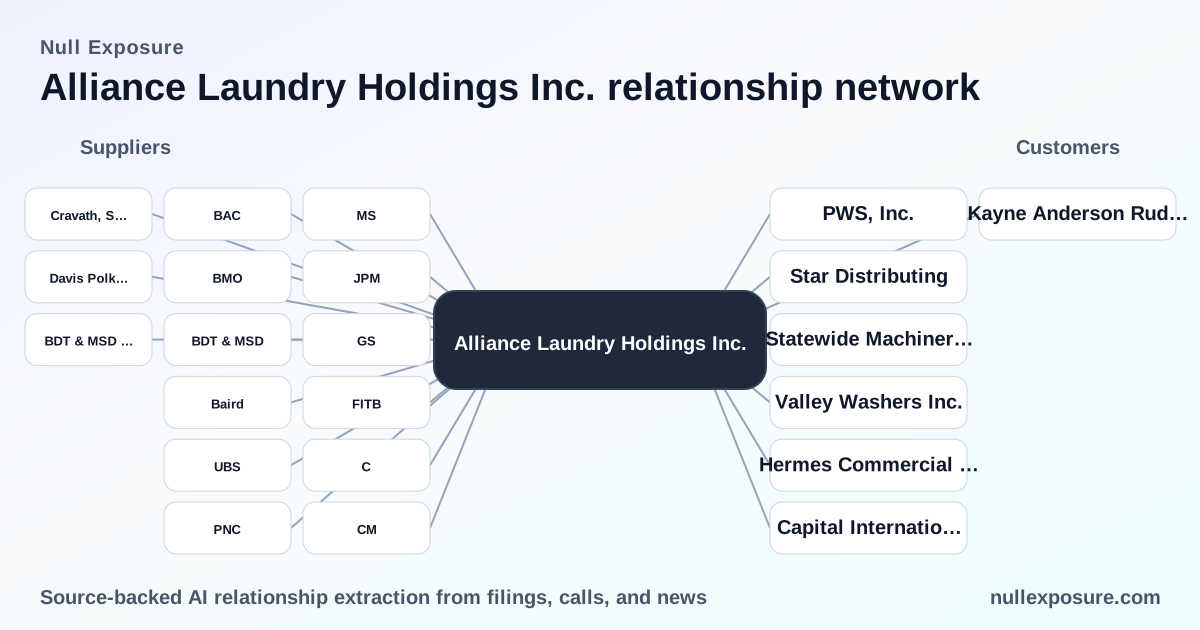
Alliance Laundry Holdings (ALH): Distributor control, aftermarket economics, and who matters to revenue
Alliance Laundry Holdings designs and manufactures commercial laundry equipment under the Speed Queen, UniMac, Huebsch, Primus and IPSO brands and monetizes through a mix of new-equipment sales, recurring parts & service, and channel-led distribution. With roughly $1.71 billion in trailing revenue and EBITDA north of $400 million, ALH’s economics are driven by brand-led pricing power in commercial channels and the durability of aftermarket demand for parts and service. For investors evaluating customer and partner exposures, the company’s strategic moves—especially acquisition of distribution assets and the composition of IPO anchor buyers—are the most actionable signals. Visit https://nullexposure.com/ for further relationship analytics.
How ALH’s operating model translates into cash flow
Alliance’s core operating model is manufacturing coupled with a hybrid distribution posture: it sells through an extended network of independent distributors while also owning and acquiring distribution assets where strategic. That posture delivers two structural advantages: higher-margin aftermarket revenue and the ability to compress channel costs through selective vertical integration. At the same time, reliance on distributor performance implies concentration risk in regions where a single distributor accounts for a material share of Speed Queen placements.
- Contracting posture: ALH operates as both manufacturer and, increasingly, direct distributor in targeted markets through acquisitions of local distributors.
- Concentration: national and regional distributors remain critical to go-to-market execution; awards and distributor performance are material to growth in core U.S. markets.
- Criticality: commercial customers (coin-op laundromats, on-premise laundries) face high switching costs around equipment uptime and parts availability, supporting recurring parts/service economics.
- Maturity: the business shows a mature margin profile and institutional investor interest consistent with a scaled, cash-generative industrial brand.
If you want a deep dive into the company’s counterparty map, see full roster coverage at https://nullexposure.com/.
Customer and partner roster: what the reporting shows
Below is a concise, relationship-by-relationship view drawn from public reporting; each entry is a plain-English summary with a source citation.
PWS, Inc.
ALH acquired the distribution assets of PWS, the largest Speed Queen distributor and parts supplier in North America, consolidating a high-performing regional channel into the company’s owned distribution footprint. According to a PR Newswire release (FY2021), ALH first announced the acquisition and later confirmed the transaction closed, indicating a strategic shift toward vertical integration in key markets (PR Newswire, March 2026).
Star Distributing
Star Distributing of Tennessee was named Speed Queen Distributor of the Year, signaling a top-performing independent channel partner that likely drives meaningful regional installations and aftermarket parts sales. The recognition was reported by American Coin-Op (FY2022) in coverage of Speed Queen’s distributor awards.
Statewide Machinery Inc.
Statewide Machinery (Batavia, N.Y.) was recognized as an “Outstanding Performer,” reflecting a strong independent distributor contributing to ALH’s sales and service reach in New York state. American Coin-Op’s FY2022 awards coverage lists Statewide among top performers.
Valley Washers Inc.
Valley Washers (Harrisonburg, Va.) earned “Outstanding Performer” status—another independent distributor highlighted for above-average execution in equipment placements and service, according to American Coin-Op (FY2022).
Hermes Commercial Laundry Equipment
Hermes Commercial Laundry Equipment (Bloomington, Ill.) received the “Outstanding Growth” award, a signal of rapid sales performance for a local Speed Queen distributor that fuels regional revenue growth. This award was reported by American Coin-Op in FY2022.
Capital International Investors
Capital International Investors was an anchor buyer in ALH’s IPO, indicating institutional confidence and providing a meaningful tranche of demand for the offering; Renaissance Capital noted the investor’s role in FY2025 IPO allocation, participating in an initial block representing a substantive portion of the deal (Renaissance Capital, FY2025).
Kayne Anderson Rudnick
Kayne Anderson Rudnick joined Capital International as a major buyer in the IPO, together taking roughly $200 million of the offering and providing an institutional backstop to the float and initial post-listing liquidity, as reported by Renaissance Capital (FY2025).
What these relationships imply for investors
- Vertical integration is now tactical: The PWS purchase converts a high-value distributor into an owned asset, reducing channel leakage and capturing a larger share of aftermarket margin. That directly improves visibility into replacement parts revenue and service profitability.
- Distributor quality matters: Awards to Star, Statewide, Valley Washers and Hermes are not PR fluff—these relationships represent the operational front line for ALH’s sales, installations and repeat parts business; variability in these partners’ performance will translate into regional revenue volatility.
- Institutional ownership supports valuation: Anchor allocations to Capital International Investors and Kayne Anderson Rudnick at IPO suggest a stable institutional base that can lengthen the company’s valuation multiple and support secondary stability in the near term.
Risks and monitoring priorities
- Channel concentration risk: Dependence on a small set of high-performing distributors in specific regions creates concentrated counterparty risk; ALH’s acquisition of PWS mitigates this risk in California but also increases exposure to integration execution.
- Aftermarket dependence: A large share of long-term profitability comes from parts and service; any disruption to distributor networks or inventory flows would pressure margins.
- Execution on integration: Converting distributors into owned operations requires operational discipline; watch working capital, inventory turns, and parts-service SLA performance as leading indicators.
Bottom line: where to focus due diligence
For investors and operators evaluating ALH customer relationships, prioritize two vectors: channel stability (distributor performance and consolidation) and aftermarket economics (parts/service margins and fulfillment capability). The PWS acquisition is a pivotal signal that ALH will selectively own distribution where it can drive margin uplift, while institutional IPO participation provides a valuation backstop.
For a structured view of ALH’s counterparty exposures and to benchmark distributor concentration across markets, explore more at https://nullexposure.com/.