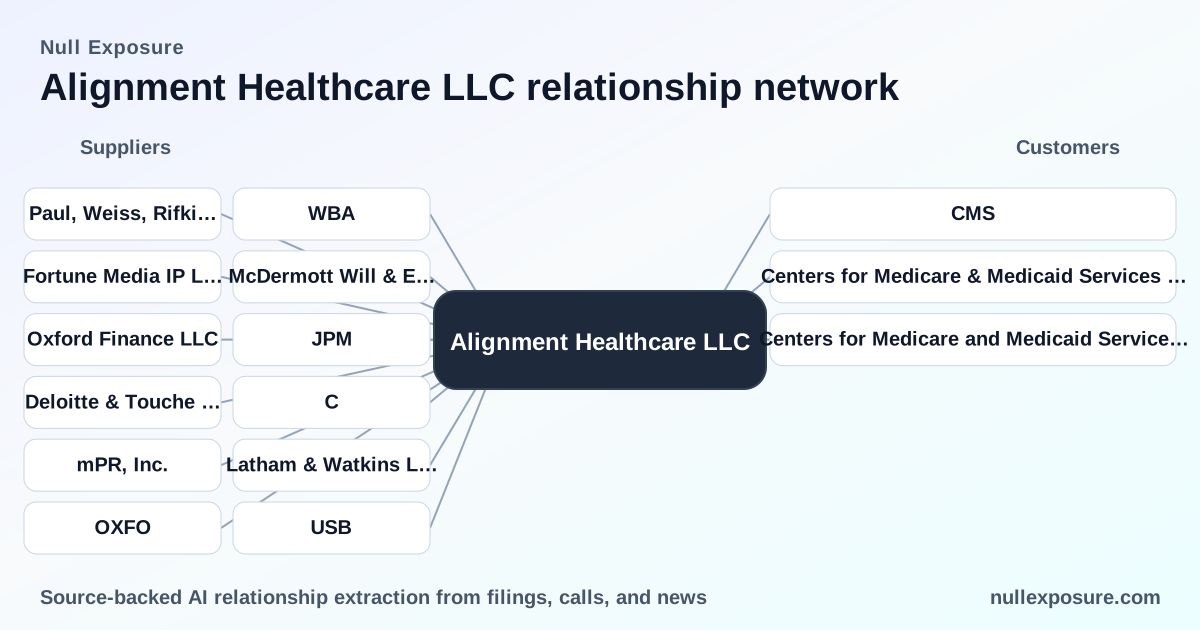
Alignment Healthcare (ALHC) — How the CMS Relationship Defines the Business
Alignment Healthcare operates a consumer-focused Medicare Advantage platform that monetizes through monthly government reimbursements: it enrolls Medicare-eligible seniors into its HMO/PPO plans, manages care through its provider network, and receives a per-member-per-month (PMPM) payment from the federal government under CMS contracts. This concentrated, subscription-style revenue stream and the one-year contracting rhythm with CMS are the central commercial facts investors must weigh. For a concise investor briefing and monitoring framework, visit https://nullexposure.com/.
The short investor thesis up front
Alignment’s economics are driven by scale and risk-bearing on Medicare Advantage membership: revenue is recurring PMPM from CMS and profitability depends on managing medical cost trends, risk adjustment capture, and retention. The CMS relationship is both the revenue engine and the principal operational constraint—policy shifts or payment proposals from CMS translate directly into ALHC’s top-line and market sensitivity.
Why the CMS link matters more than anything else
Alignment’s business model is effectively a government-subsidized subscription service: members enroll and Alignment receives a monthly, risk-adjusted payment for running their benefits. The company contracts directly with the Centers for Medicare & Medicaid Services (CMS) and recognizes premium revenue monthly. Those payments are fixed in cadence but variable by risk scores, so payment rate changes or unfavorable CMS proposals create immediate revenue pressure—as the market demonstrated when shares reacted to a preliminary CMS payment proposal. (See relationship inventory below for the specific sources.)
Contracting posture and operational constraints
- Short-term, annual contracts. CMS agreements have a one-year term expiring December 31 and are subject to annual renewal, which creates recurring repricing and policy exposure at a national program level.
- Subscription-style cash flow. Premiums are recognized monthly on a PMPM basis and adjusted for member risk factors, aligning cash receipts with membership dynamics and risk-capture performance.
- Government counterparty and concentration. Substantially all revenue derives from CMS contracts; that concentration is material to strategy and risk. The company’s role is as the payer-contracted health plan (a seller of coverage) and it bears the financial risk for members’ healthcare expenditures.
- Operational maturity and scale signal. Alignment reports expansion into dozens of markets and a six-state operational footprint, with roughly 209,900 health plan members reported as of January 1, 2025—evidence of a commercial-scale Medicare Advantage operator.
- Company-level immateriality note. Certain payables under specified provisions were immaterial at year-end 2024, which investors should treat as a small financial footnote rather than an operational lever.
These constraints together imply a company with a mature, active commercial relationship structure that is highly concentrated on a single government program, contractually short-dated, and operationally dependent on accurate risk adjustment and retention.
Relationship inventory: every CMS mention in the record
-
TradingView coverage (March 9, 2026) flagged that Alignment is heavily reliant on CMS contracts for its Medicare Advantage plans, and that changes to CMS rules or the Medicare Advantage program would materially affect revenue. Source: TradingView news summary of the company’s 10‑K (March 9, 2026).
-
StockTitan / 10‑K filing excerpt (FY2026) states that licensed Medicare Advantage plans contract directly with the Centers for Medicare & Medicaid Services and that Alignment “currently derives substantially all of our revenue from CMS contracts related to our Medicare Advantage health plans.” Source: FY2026 annual report filing referenced via StockTitan (filed March 2026).
-
A second StockTitan / 10‑K excerpt (FY2026) documents the revenue recognition mechanics: premium revenue is derived monthly from the federal government based on our contracts with CMS, and the monthly reimbursement is a fixed PMPM adjusted for risk factors. Source: FY2026 annual report filing referenced via StockTitan (filed March 2026).
-
Finviz market reaction (March 9, 2026) reported that ALHC shares fell sharply after a preliminary CMS Medicare Advantage payment proposal missed expectations, illustrating the stock’s sensitivity to CMS rate signals. Source: Finviz news coverage (March 9, 2026).
What investors should read into these relationships
- Concentration risk is first-order. Alignment’s economics are driven by a single counterparty class—federal CMS payments. Substantial revenue concentration heightens macro–policy exposure compared with diversified commercial insurers.
- Timing and renewal volatility are structural. One-year CMS contracts produce predictable monthly cash flows when rates are set, but the annual renegotiation rhythm creates recurring event risk that affects guidance and market multiples.
- Operational leverage sits in risk adjustment and care management. Since reimbursements are PMPM and adjusted for member diagnoses, the company’s margin improvement levers are accurate coding, preventative care to control utilization, and retention of higher-acuity members.
- Market sensitivity is visible in price action. The immediate share-price reaction to a preliminary CMS payment proposal demonstrates that investors price in CMS guidance in real time.
Geographic footprint and scale signals
Alignment reports operations across multiple U.S. states, with office locations in California, North Carolina, Nevada, Arizona, Florida, and Texas, and an expanded presence—53 markets and roughly 209,900 members as of January 1, 2025. That scale is a favorable structural input for spreading administrative costs and clinical infrastructure, but the company’s revenue concentration means geographic diversification does not materially dilute CMS program risk.
Risk checklist for evaluation
- Policy / rate risk: Annual CMS rate-setting and proposals directly influence revenue and valuation.
- Operational execution: Accuracy of risk adjustment and medical cost management determine margin sustainability.
- Retention and growth: Membership trends control PMPM revenue scale; growth converts fixed-cost leverage into improved margins.
- Regulatory compliance: As a principal payer under Medicare Advantage, regulatory scrutiny and audit risk are persistent.
For investors requiring ongoing signal tracking and deeper relationship-level intelligence, NullExposure provides structured monitoring and timely alerts on CMS and other counterparties—start here: https://nullexposure.com/.
Bottom line
Alignment Healthcare is a scaled Medicare Advantage operator whose value proposition and valuation are inseparable from its CMS contracting dynamics. The business model delivers subscription-like, risk-adjusted PMPM revenue on a short-term annual contracting cycle, producing both steady cash flow when rates are stable and concentrated vulnerability when policy or payment proposals change. Investors should prioritize CMS rate trajectories, risk-adjustment performance, and membership trends when assessing ALHC’s outlook.