ALIS: A SPAC That Converts into an AI Infrastructure Trade
Calisa Acquisition Corp (ALIS) is a Nasdaq-listed special purpose acquisition company that generates investor returns by effecting a business combination and capturing upside in the merged operating business. Today ALIS is a shell with no operating revenue; the investment case is entirely event-driven around the announced merger with GoodVision AI and the resulting exposure to high-performance GPU procurement and AI infrastructure economics. For a consolidated view of counterparties and customer exposure, visit NullExposure.
How the business actually monetizes — a short investor thesis
ALIS monetizes through the single-event conversion of sponsor capital and public equity into a post-merger operating company. Until the combination closes, ALIS reports zero revenue and negligible operating history, and its market value reflects investor expectations for the target’s growth trajectory and capital needs. After combination, value accrues through the merged company’s ability to scale cloud and on-premise inference clusters, secure vendor capacity, and convert enterprise AI contracts into recurring revenue streams.
Deal context: SPAC mechanics meet high-volume AI procurement
Calisa Acquisition’s public profile identifies it as a typical SPAC: no operating revenue, concentrated insider ownership (roughly 26%), and meaningful institutional ownership (about 61%), according to public market data through the quarter ending 2025-12-31. The material event for ALIS investors is the announced merger with GoodVision AI, which transforms the investment from a cash-and-sponsor play into an infrastructure-intensive AI operator. A FinancialContent MarketMinute article dated March 9, 2026 reported that GoodVision plans to scale multi-cloud GPU inference clusters, which directly increases demand for high-end NVIDIA chips. (FinancialContent, March 9, 2026: https://www.financialcontent.com/article/marketminute-2026-3-9-calisa-acquisition-corp-announces-180m-merger-with-goodvision-ai-to-scale-multi-cloud-gpu-infrastructure)
Operating model signals investors should internalize
ALIS’s operating and commercial profile today is shaped by SPAC economics and the target’s capital intensity once combined:
- Contracting posture: As a SPAC, ALIS has no material vendor or customer contracts; post-combination the acquirer will require long-lead commercial agreements with GPU suppliers and cloud partners to secure capacity. These will be largely procurement-focused rather than enterprise-sales-first contracts.
- Concentration risk: The economics of the merged entity will likely concentrate supply dependency on a small set of hardware vendors and cloud providers. That supplier concentration drives execution risk and negotiating leverage issues.
- Criticality: GPU supply is mission-critical to an inference-focused operator; shortages or price shifts in high-end accelerators directly affect margin and go-to-market timelines.
- Maturity: As a recently combined entity, the business will be in a rapid scale-up phase with immature recurring revenue; commercial maturity will depend on enterprise customer wins and infrastructure utilization.
These are company-level signals derived from ALIS’s SPAC status and the public deal narrative, not a constraint excerpt tied to any single vendor.
Operating constraints: what the record shows (and what it does not)
There are no constraint entries reported in the available relationship dataset for ALIS. The absence of explicit constraint disclosures in the record is itself a signal: ALIS’s public dataset does not report contractual encumbrances, customer-mandated SLAs, or reserve-backed procurement commitments. Investors should treat that absence as a gap to be filled by due diligence on GoodVision AI’s supplier agreements and forward purchase commitments once the combination documents are filed.
Relationship map: a single, high-impact supplier beneficiary
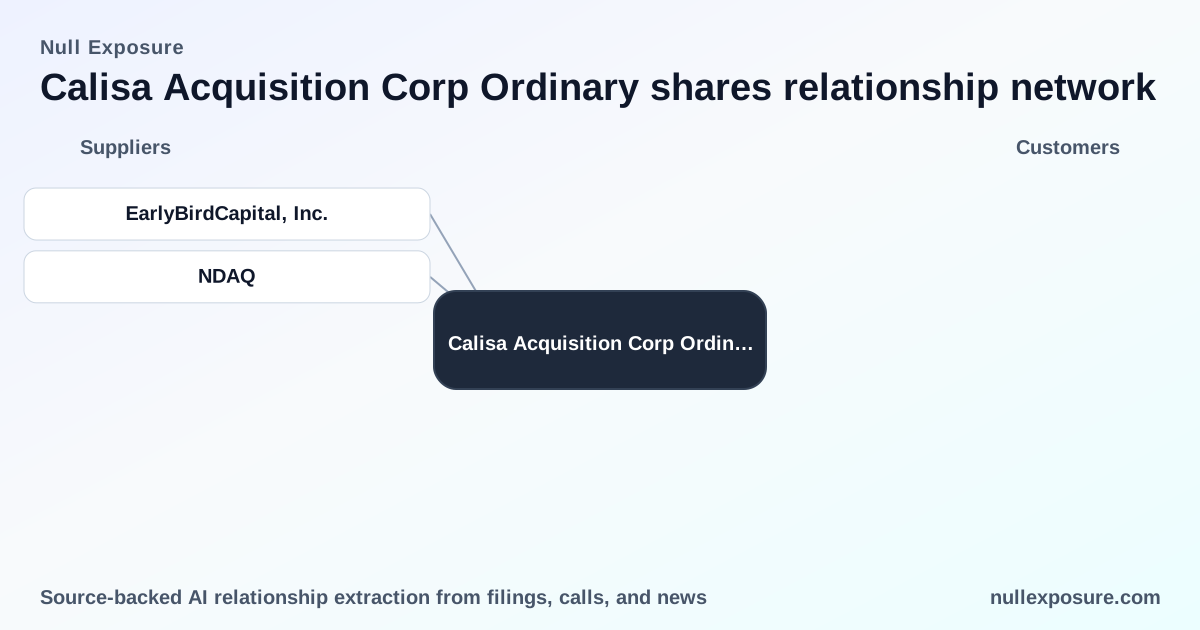
The relationship extraction for ALIS surfaces one prominent third party:
- NVIDIA Corporation (NVDA): GoodVision AI’s stated plan to scale multi-cloud GPU inference clusters positions NVIDIA as a high-volume supplier beneficiary, since the company expects to purchase H100 and B200 series accelerators as part of its expansion. FinancialContent’s MarketMinute reported this dynamic in the context of the ALIS–GoodVision deal on March 9, 2026 (FinancialContent, March 9, 2026: https://www.financialcontent.com/article/marketminute-2026-3-9-calisa-acquisition-corp-announces-180m-merger-with-goodvision-ai-to-scale-multi-cloud-gpu-infrastructure).
What the single relationship implies for investors and operators
With NVIDIA the only clearly surfaced counterparty, the combined company will inherit supplier-driven operational exposure. That has immediate investment implications:
- Upside concentration: Rapid, high-volume purchases of H100/B200 chips can accelerate model deployment and revenue ramp if enterprise demand and utilization follow.
- Execution risk: Heavy dependence on a single hardware supplier amplifies operational risk stemming from supply constraints, allocation policies, or pricing pressure.
- Capital intensity: A procurement-heavy scaling plan increases working capital and financing needs, which influences dilutive financing, margin profiles, and run-rate cash burn.
For ALIS equity holders, the trade is therefore event-driven with concentrated supplier risk and asymmetric upside tied to GoodVision’s ability to convert GPU capacity into predictable revenue.
Practical next steps for due diligence
Investors and operators evaluating ALIS should prioritize the following checks before taking a position:
- Confirm the detailed merger agreement and any disclosed forward purchase or allocation agreements with GPU vendors in the proxy or 8-K filings.
- Inspect customer contracts for the target (GoodVision AI) to establish the pace at which infrastructure utilization converts to recurring revenues.
- Model capital needs under various procurement and utilization scenarios to test dilution and cash runway.
For a consolidated view of counterparties and to monitor how relationship signals evolve as filings are published, visit NullExposure.
Final read: concentrated exposure, event-driven outcome
Calisa Acquisition (ALIS) is a classic SPAC equity whose value proposition is tied 100% to the success of a single transaction and the post-combination operator’s execution. The relationship evidence available today points to NVIDIA as the primary beneficiary of the merger-driven infrastructure buildout—this is a concentrated supplier story that creates both clear upside and clear single-supplier risk. Investors must treat ALIS as an event-driven instrument and underwrite supplier contracts, procurement commitments, and route-to-revenue for the combined company before relying on upside.