Alight Inc (ALIT): Customer relationships that drive recurring HCM revenue
Alight sells integrated, cloud-based human capital solutions and monetizes primarily through recurring fees charged per participant under multi-year contracts. Its business mixes subscription and services revenue, with a growing BPaaS (business-process-as-a-service) line that produces sizable multi-year bookings and high retention, turning large enterprise payroll and benefits administration engagements into predictable annuity-style cash flows.
What investors should know about how Alight contracts and where risk sits
Alight’s operating model is service-led, subscription-forward and contractually sticky. Company disclosures and filings indicate most client relationships are three- to five-year contracts with mutual renewal options, revenue largely recognized on a per-participant fee basis, and a portion recognized on a straight-line subscription schedule. The firm serves a spectrum of counterparties — from Fortune 500s and other very large enterprises down to mid-market and public institutions — but revenue geography is heavily U.S.-centric, even as operations maintain global licensing and regulatory exposure. Importantly, management reports no single client contributed more than 10% of revenue, which supports a conclusion that customer concentration is low even while large incumbents anchor the book.
- Contracting posture: predominantly long-term subscription/service agreements; transition arrangements exist that are short-dated (e.g., TSAs) for carve-outs or divestitures.
- Counterparty profile: skew to very large and large enterprises and public institutions; mid-market participation present.
- Materiality & criticality: revenue is highly recurring and strategic for clients, but the company-level signal is that no single counterparty is systemically material to consolidated revenue.
- Maturity & retention: relationships are generally mature and high-retention; Alight disclosed annual revenue retention in the mid-90s percent range in recent years.
For a concise corporate view and relationship analytics, see the firm profile at Null Exposure: https://nullexposure.com/
Customer wins and notable relationships (what was observed)
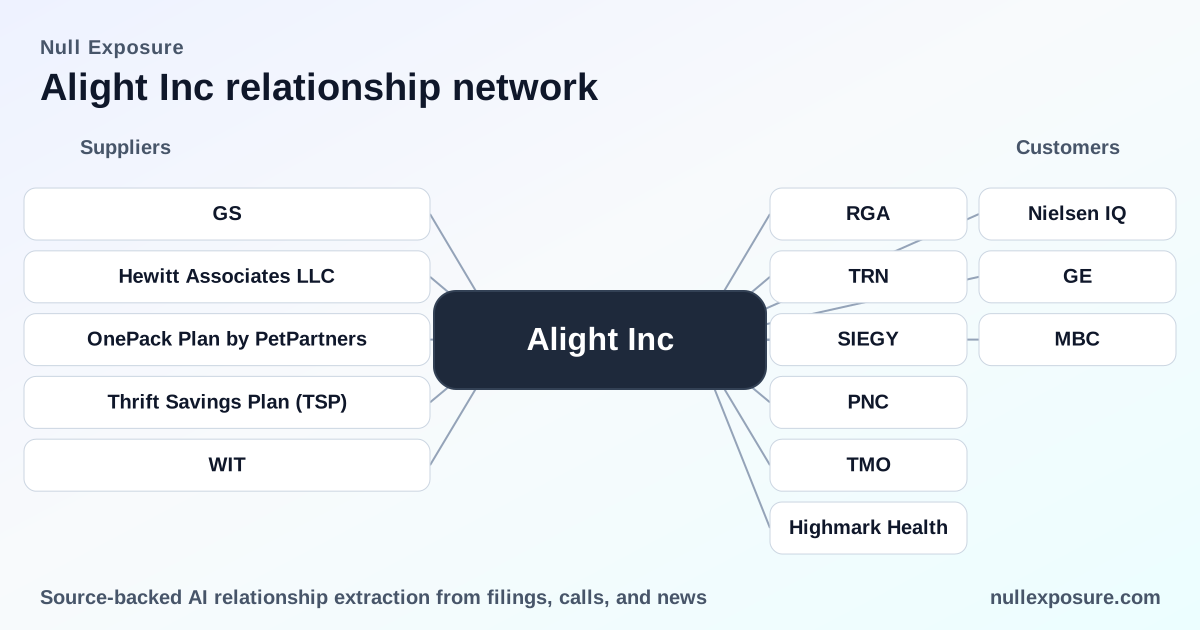
Below I list each relationship found in the reporting for ALIT, with a plain-English summary and the cited source.
Reinsurance Group of America, Incorporated (RGA)
Alight booked RGA as a client among its “key wins” highlighted in the company’s Q2 2025 results, signaling enterprise-level traction for its HCM and BPaaS offerings. Source: StockTitan recap of Alight’s Q2 2025 report (reported March 9, 2026).
Trinity Industries
Trinity Industries was listed alongside other corporate wins in Alight’s Q2 2025 disclosure, indicating a new or expanded engagement at the large-enterprise level. Source: StockTitan recap of Alight’s Q2 2025 report (reported March 9, 2026).
KEY-P-J (KeyCorp-related plan)
A PlanSponsor article recounts that, beginning in 2014, the KeyCorp plan used Alight as a recordkeeping intermediary, which in turn engaged Financial Engines as a sub-adviser; the note was made in the context of a fiduciary-fee legal matter covering FY2021 events. Source: PlanSponsor coverage of the KeyCorp excessive-fee litigation (document context FY2021).
PNC
Legal filings cited in PlanSponsor indicate PNC hired Alight Solutions as its recordkeeper in September 2007, a long-standing operational relationship that features in litigation discussions for FY2024-era reporting. Source: PlanSponsor article on the PNC ERISA 401(k) decision (reported March 2026).
PNC Financial Services Group Inc.
A duplicate line in reporting shows the same PNC entity referenced under its corporate name in the same legal-filing coverage; the substance is identical — Alight’s role as recordkeeper for PNC is longstanding and documented in court filings. Source: PlanSponsor article on the PNC ERISA matter (reported March 2026).
Thermo Fisher Scientific (TMO)
Thermo Fisher was called out as a key win in Q2 2025, reinforcing Alight’s ability to close large, complex HCM contracts with life-sciences and industrial clients. Source: StockTitan recap of Alight’s Q2 2025 report (reported March 9, 2026).
TMO (duplicate entry)
The reporting contains a repeated mention of Thermo Fisher under its ticker; the company was listed among the same Q2 2025 wins, underscoring the same enterprise-level client relationship. Source: StockTitan recap of Alight’s Q2 2025 report (reported March 9, 2026).
Siemens
Siemens has been an Alight client since 1996, according to management commentary in a Q4 2023 earnings call transcript, demonstrating a durable, multi-decade relationship with a major multinational industrial customer. Source: Q4 2023 earnings call transcript published on InsiderMonkey (FY2024 discussion).
SIEGY (Siemens duplicate)
A parallel entry under the ticker SIEGY restates Siemens’ long-tenured client status as described on the Q4 2023 call transcript, reinforcing that this engagement is mature and deeply embedded. Source: Q4 2023 earnings call transcript published on InsiderMonkey (FY2024 discussion).
Nielsen IQ
Nielsen IQ is cited as a BPaaS win contributing to over $2.2 billion of cumulative BPaaS bookings referenced by management, a sign that Alight’s higher-margin outsourced services business has landed marquee analytics and data clients. Source: Q4 2023 earnings call transcript published on InsiderMonkey (FY2024 discussion).
GE
Management cited an “extraordinary new win like GE” when discussing performance comparisons, indicating GE has been a meaningful reference customer in prior periods and a driver of comparatives in FY2024 commentary. Source: Q4 2023 earnings call transcript published on InsiderMonkey (FY2024 discussion).
Highmark Health
Highmark Health was listed among Q2 2025 key wins, showing Alight’s traction within large health-system and payer organizations for benefits and HR outsourcing work. Source: StockTitan recap of Alight’s Q2 2025 report (reported March 9, 2026).
MBC
Management included “MBC” (MasterBrand/related entity) among BPaaS wins that contributed to Alight’s three-year BPaaS CAGR, marking visibility into brand and manufacturing-sector client wins. Source: Q4 2023 earnings call transcript published on InsiderMonkey (FY2024 discussion).
MasterBrand
MasterBrand appears separately in the win list for the BPaaS booking narrative, reinforcing the same client-level example used to illustrate BPaaS momentum and growth. Source: Q4 2023 earnings call transcript published on InsiderMonkey (FY2024 discussion).
What the relationship map implies for valuation and operations
- Revenue durability is the central investment thesis. Recurring participant-fee economics and three- to five-year contracts convert new enterprise wins into predictable future cash flows.
- Low single-client concentration reduces tail risk. Management states no single client exceeds 10% of revenue, which is a structural positive for credit and valuation multiples.
- Customer mix amplifies scale advantages. The book skews toward very large enterprises and public institutions, enabling scale-dependent margin improvement in BPaaS and technology-enabled services.
- Geography is U.S.-weighted. Reported revenue is overwhelmingly North America, which focuses regulatory and macro exposure but limits diversification benefits.
- Mature, high-retention book supports upside but caps volatility. High retention and long-term contracting reduce churn-driven downside while making organic growth and new large wins the primary growth lever.
If you want a consolidated view of these customer relationships and structured signals for modeling revenue durability, explore Null Exposure’s ALIT page for investor-ready relationship analytics: https://nullexposure.com/
Bottom line
Alight’s customer map combines long-tenured enterprise incumbents and recent strategic wins to create a predictable, subscription-dominant revenue base complemented by higher-growth BPaaS bookings. For investors, the most important variables are continued annual retention in the mid-90s, ability to convert enterprise wins into BPaaS scale, and U.S. macro/employee-count trends that drive per-participant fees.