Alaska Air Group (ALK): who Alaska flies for and how those relationships shape the business
Alaska Air Group operates a full-service and regional passenger and cargo airline business that monetizes primarily through ticket and cargo carriage fees, loyalty and ancillary sales, and contract-flight services. The company runs passenger operations as its core product while selling discrete, fee-based cargo services under long-form contracts and corporate partnerships, providing fixed monthly and flight-hour fees for outsourced flight operations alongside reimbursable operating expenses. For investors evaluating counterparty risk and revenue durability, the Amazon air-transport agreement and a slate of corporate and institutional customers are the most consequential relationship signals. For a quick overview of our coverage and relationship mapping, see Null Exposure at https://nullexposure.com/.
Business model and operating posture: what the relationships reveal Alaska generates roughly $14.4 billion in trailing revenue while carrying a market capitalization around $4.2 billion, making business relationships commercially significant for margin capture and capacity utilization. The relationship evidence in public filings and news highlights three company-level operating characteristics:
- Contracting posture – fee-for-service with reimbursement mechanics. Management discloses contracts that pay fixed monthly fees per aircraft plus per-flight-hour and per-cycle fees, and which reimburse fuel, certain maintenance, and insurance premiums, creating predictable cash flows for contracted flying while shifting variable cost exposure to the contract counterparty.
- Concentration and criticality – a strategic, outsized cargo counterparty. Alaska operates 10 A330-300 freighters under an Air Transportation Services Agreement (ATSA) framework; that arrangement is a distinct revenue stream and operational commitment that materially differentiates cargo economics from passenger flying.
- Maturity and term structure – long-form agreements underpin service continuity. Public excerpts describe multi-year terms with renewal options, supporting revenue visibility and aircraft utilization planning.
For investors focused on counterparty concentration or contract risk, those three points are the dominant takeaways. For a deeper dive into the relationships themselves, read on.
Who Alaska sells to — relationship roster and what it means Below are the relationships identified in recent coverage. Each entry includes a concise, plain-English description and the source used for the signal.
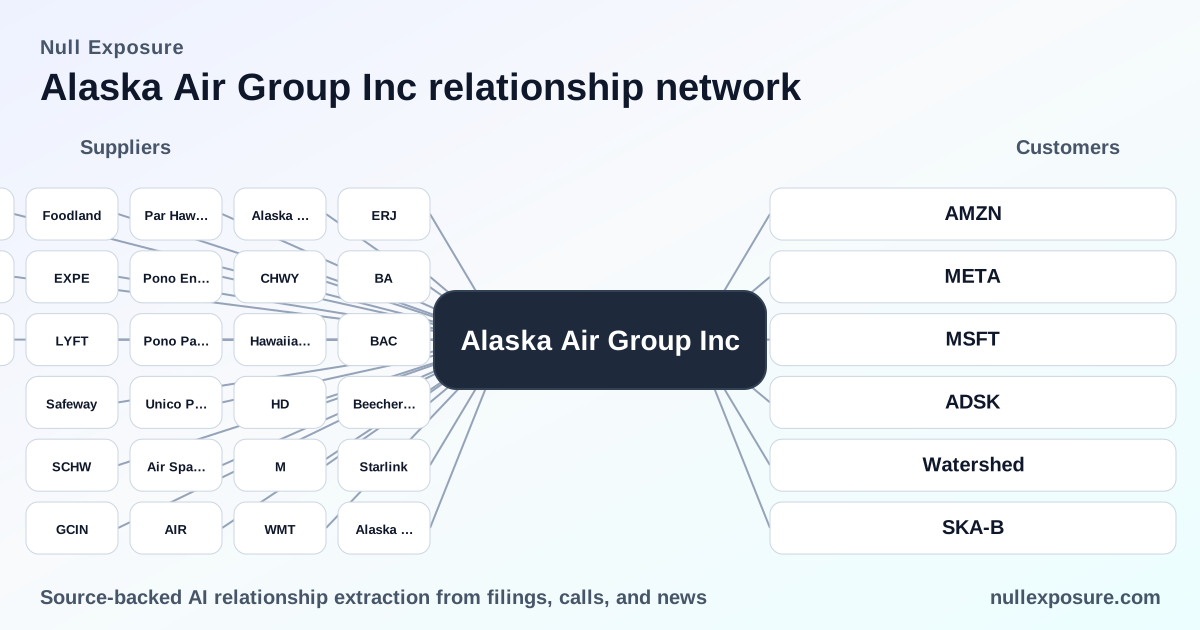
Amazon / AMZN — a contracted cargo operator
Alaska operates 10 A330-300 freighters under an Air Transportation Services Agreement (ATSA) and supplies crews, maintenance and insurance in exchange for a fixed monthly fee plus per-flight-hour and per-cycle fees while being reimbursed for certain operating expenses. According to Alaska’s disclosures cited in PR Newswire and quarterly filings, operations under the ATSA are explicitly excluded from certain consolidated operations reporting, underscoring the contract’s distinct accounting and operational treatment (PR Newswire, March 9, 2026; Morningstar April 20, 2026).
University of Washington — branded airline partnership
Alaska remains the University of Washington’s Official Airline and continues university-facing branding and athletics sponsorships, including visibility at Husky Stadium, reflecting a corporate-marketing and customer-acquisition relationship rather than a large-ticket contractual service. InsiderMonkey reported on this branding partnership and noted it in the context of Alaska’s broader marketing and revenue expansion efforts (InsiderMonkey, May 2, 2026).
Autodesk / ADSK — corporate sustainability and travel customer
Autodesk is listed among Alaska Airlines’ corporate customers engaged in the carrier’s sustainability initiatives, signaling corporate travel and ESG-aligned partnerships rather than a transportation contract with bespoke commercial terms. Trellis coverage profiling Alaska’s sustainability leadership lists Autodesk among corporate customers buying into Alaska’s environmental offerings (Trellis, March 9, 2026).
Meta / META — enterprise travel engagement
Meta appears in the same corporate-customer list tied to Alaska’s sustainability and corporate travel programs, indicating business-travel volume and corporate procurement of Alaska’s branded sustainability solutions. Trellis identified Meta as one of the corporate customers engaged with Alaska on sustainability-linked travel offerings (Trellis, March 9, 2026).
Microsoft / MSFT — large corporate account tied to sustainability
Microsoft is also cited as a corporate customer participating in Alaska’s sustainability-oriented corporate programs, representing a recurring source of corporate-ticket and program revenues rather than an outsourced aircraft-services contract. Trellis mentions Microsoft among the corporate customers aligned with Alaska’s sustainability mission (Trellis, March 9, 2026).
Watershed — corporate sustainability partner
Watershed is named as a corporate customer in coverage of Alaska’s sustainability work, suggesting a partnership model that supports corporate emissions accounting or offset programs connected to airline customers. Trellis includes Watershed in the list of corporate customers engaged with Alaska’s sustainability initiatives (Trellis, March 9, 2026).
Skanska / SKA-B — corporate customer in sustainability roster
Skanska is listed alongside other corporate accounts that are buying into Alaska’s sustainability mission, reflecting relationships built around corporate procurement of travel and sustainability services. Trellis names Skanska among those corporate customers (Trellis, March 9, 2026).
Contract details and what they imply for investors Two constraint excerpts describe how Alaska contracts and recognizes revenue and provide concrete operating implications:
- Company-level signal: long-term contract structure and revenue recognition for air travel are core to Alaska’s model. Management commentary shows ticket revenue is recognized when transportation is provided and reveals the business uses multi-year agreements to secure capacity and cash flow. The long-term contract evidence reports an eight-year term expiring in 2030 with renewal options, indicating multi-year revenue visibility for contracted operations.
- Relationship-level signal (Amazon): Alaska is the seller under the ATSA with Amazon and operates aircraft on a fee-and-reimbursement basis. That excerpt explicitly states Alaska supplies crews, performs maintenance, procures insurance and receives a fixed monthly fee plus flight-hour and flight-cycle fees while being reimbursed for fuel and certain maintenance and insurance premiums.
Operational interpretation for investors
- Predictable contracted cash flows: The fee-plus-reimbursement structure converts capital and labor into predictable service revenue with pass-through cost items, reducing unit-margin volatility for contracted flying.
- Concentration risk exists but is contractually managed: The Amazon ATSA is strategically large—10 freighters and specific fee mechanics—but its structure limits Alaska’s variable cost exposure and clarifies revenue recognition and accounting treatment.
- Corporate customers bolster premium demand and ESG positioning: Partnerships with major corporate accounts (Autodesk, Meta, Microsoft, Skanska, Watershed) and institutional branding deals (University of Washington) strengthen Alaska’s higher-yield corporate ticket base and position the airline as a provider of sustainability-oriented travel solutions.
Key risks and monitoring checklist
- Monitor disclosures and earnings commentary for changes to the ATSA scope (number of aircraft or term amendments) and for any shifts in reimbursement mechanics that could transfer cost volatility back to Alaska.
- Watch corporate travel demand and retention among the named corporate customers as an early indicator of premium-yield stability in non-leisure segments.
- Track whether any of the sustainability partnerships transition into material fee-based programs that would alter revenue composition.
If you want the relationship map in an investor-ready format or continuous monitoring for ALK counterparties, visit Null Exposure for ongoing coverage and alerts: https://nullexposure.com/.
Bottom line: Alaska combines a large, long-form outsourced cargo agreement with Amazon and a broad set of corporate sustainability and sponsorship relationships that together deliver fee-based, contract-stabilized revenue alongside core passenger ticket sales. That hybrid positioning reduces some operating variability while creating a concentration point to monitor in the ATSA relationship.