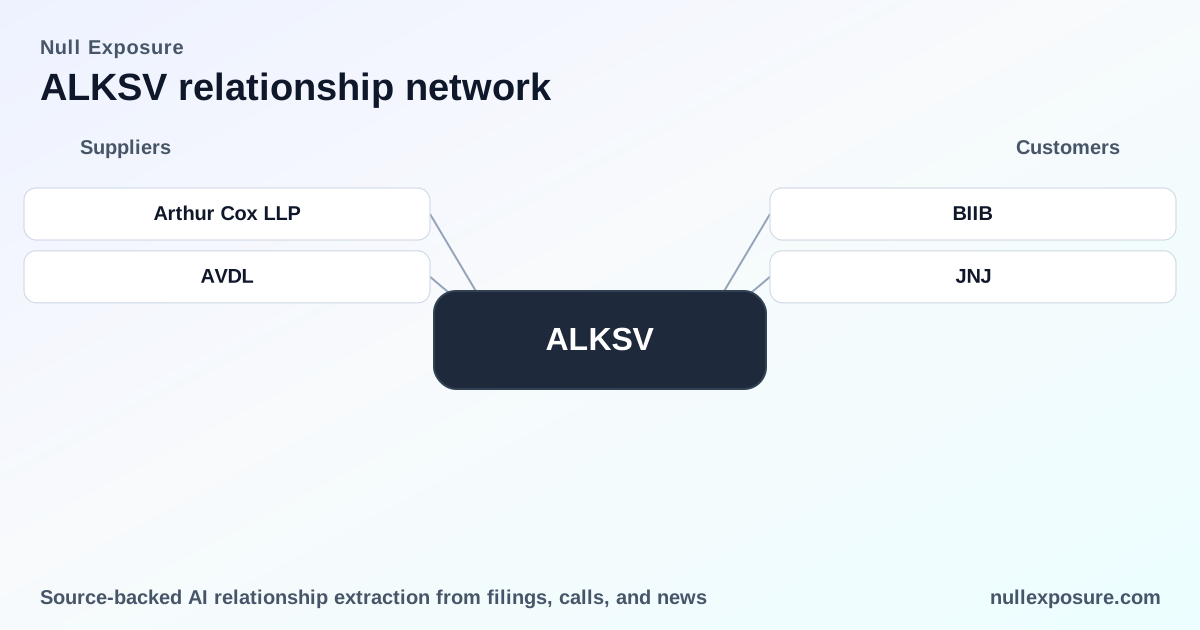
Alkermes (ALKSV) — Customer Relationships and Commercial Leverage
Alkermes monetizes through a hybrid commercial model: the company develops proprietary long‑acting injectable and drug‑delivery technologies, sells its own marketed products, and licenses its delivery platforms to large pharmaceutical partners in exchange for milestones, royalties and product supply revenues. This combination yields recurring revenue streams tied to partner commercialization and a high degree of exposure to a small set of large customers. For a consolidated view of partner-driven revenue signals, visit https://nullexposure.com/.
How Alkermes’ partner strategy drives value for investors
Alkermes operates as a technology and product house that commercializes select assets directly while leveraging partnerships to scale approved formulations. The operating model shows four practical characteristics investors must weigh:
- Contracting posture — collaborative licensing and supply: Alkermes routinely places its delivery technology inside third‑party products through licensing and supply agreements, so commercial upside depends on partner execution and contract terms.
- Concentration risk — revenue concentrated with large pharma partners: The company’s commercial footprint is amplified by a handful of named partners; partner performance materially affects Alkermes’ top‑line.
- Criticality — embedded technology in commercial products: Alkermes’ technology is a critical component of several marketed long‑acting and sustained‑release medicines, creating durable royalties when products remain on the market.
- Maturity — established, regulated product relationships: These are not early‑stage collaborations; they are commercial or late‑stage products in market, which produces visible royalty trajectories and regulatory documentation.
These signals position Alkermes as a partner‑dependent commercial growth story where visibility into partner product lifecycles equals visibility into Alkermes’ revenue durability.
Reported customer relationships: what’s on the record
The most recent public disclosures consolidate Alkermes’ role as a supplier and licensor to major pharmaceutical franchises. The following relationship summaries are drawn from Alkermes’ FY2026 disclosure as reported by TradingView on March 9, 2026.
Biogen — VUMERITY uses Alkermes technology
Alkermes’ delivery technology is used in VUMERITY, which is commercialized by Biogen, establishing a direct royalty or supply linkage between Alkermes and Biogen’s marketed multiple sclerosis therapy. TradingView’s summary of Alkermes’ FY2026 10‑K identifies VUMERITY as a third‑party product employing Alkermes technologies (TradingView, March 9, 2026).
Janssen — Multiple long‑acting antipsychotics incorporate Alkermes platforms
Alkermes technologies are integrated into several Janssen‑commercialized products, including RISPERDAL CONSTA, INVEGA SUSTENNA/XEPLION, INVEGA TRINZA/TREVICTA, and INVEGA HAFYERA/BYANNLI, signaling recurring commercial engagements tied to established neuropsychiatric franchises. TradingView’s report on Alkermes’ FY2026 10‑K lists these Janssen products as using Alkermes technology (TradingView, March 9, 2026).
JNJ — (Johnson & Johnson / Janssen connection)
The FY2026 disclosure also references JNJ in the same context as Janssen, reflecting Alkermes’ relationship with the Johnson & Johnson family through the Janssen commercial channel; the filing groups Janssen/JNJ‑commercialized products as third‑party uses of Alkermes technology (TradingView, March 9, 2026).
What each relationship means for Alkermes’ risk/reward profile
The documented partnerships are instructive in three investor‑relevant ways:
- Revenue predictability from established brands: Relationships with industry leaders such as Janssen/J&J and Biogen link Alkermes to products with deep market penetration and durable sales histories, improving royalty visibility.
- Exposure to partner commercialization and regulatory cycles: Because Alkermes’ income from these names depends on partner product lifecycle events — launches, label changes, patent expirations — earnings can shift with partner outcomes rather than Alkermes’ own sales force activity.
- Concentration creates both leverage and vulnerability: Major branded products deliver material upside if they retain market share, but downside if partners’ assets face competitive or regulatory setbacks.
Investment implications and a practical checklist for analysts
For investors and operators evaluating ALKSV, prioritize the following assessment areas:
- Contract terms and cash flow timing: Confirm whether arrangements are royalty‑based, include supply margins, or are milestone driven; cash flow timing differs markedly across contract types.
- Partner revenue concentration: Quantify the percent of partner‑linked revenue in recent periods and project sensitivity to partner volume declines or generic competition.
- Regulatory and patent life cycles on partner products: Track patent expiry calendars and pending label/regulatory activities for Janssen and Biogen products that use Alkermes technology.
- Operational delivery capacity: Ensure Alkermes’ manufacturing and supply agreements can sustain partner demand to avoid revenue disruption.
Key takeaway: Alkermes’ commercial trajectory rides on a small group of large partners — that is a source of leverage and a primary risk factor. For ongoing monitoring tools and signal feeds tailored to partner exposure, see https://nullexposure.com/.
Final read: positioning ALKSV in a portfolio
Alkermes offers investors exposure to a niche but valuable drug‑delivery franchise that compounds value through partnerships with top‑tier pharma. The company’s revenue is predictable when partner products are stable, and sensitive to partner execution and lifecycle events. Active investors should monitor partners’ sales trends, patent cliffs, and any shifts in supply or licensing arrangements to assess near‑term earnings risk and long‑term royalty sustainability.
Sources: Alkermes FY2026 10‑K as summarized by TradingView (reporting date March 9, 2026).