ALL-P-B: How Allstate’s customer ties shape credit and distribution risk
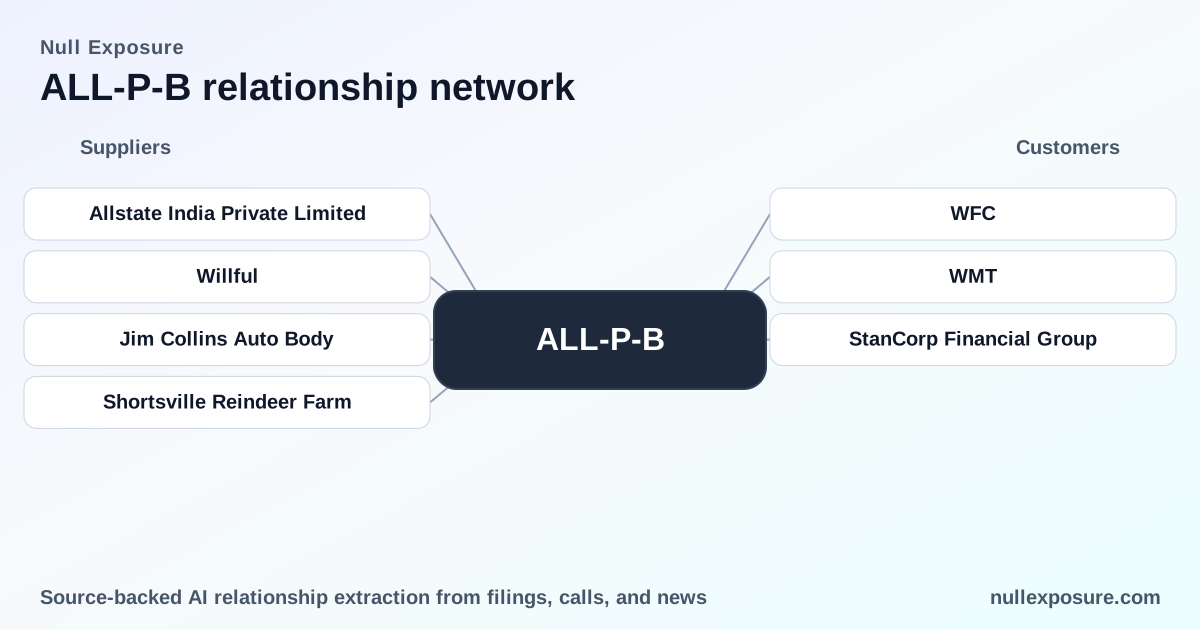
Allstate is a large, diversified personal-lines insurer that monetizes through insurance premiums, underwriting margin and investment income; its capital structure includes subordinated securities such as the 5.10% fixed-to-floating debentures due 2053 (ALL-P-B). For investors and operating executives evaluating customer relationships, the critical lens is how distribution partnerships, litigation linked to distribution practices, and strategic divestitures influence cash flow stability, reputational risk and the effective cost of capital. Explore the customer relationships below to connect distribution sources to credit and operational exposure. For a concise view of coverage and document links, visit https://nullexposure.com/.
Why customer relationships matter for a subordinated security holder
Allstate’s subordinated debentures sit behind senior creditors in the capital stack, so distribution integrity and brand risk directly affect underwriting results and long-term solvency metrics that matter to preferred and subordinated holders. Customer channels drive written premium and retention; litigation or partner disputes introduce non-linear downside through remediation costs, reserve strengthening and reputational erosion. Assessing counterparties therefore translates into a view on earnings volatility and the effective risk premium demanded by the market.
Operating-model characteristics investors should track
Treat these as company-level signals that frame Allstate’s customer exposure rather than relationship-specific attributions:
- Contracting posture: Allstate operates a mix of direct-to-consumer channels and third-party distribution agreements, indicating a negotiated, partner-oriented contracting posture that relies on shared marketing and co-branded offerings.
- Concentration: While distribution is broad, national partnerships with banks and large retailers create focal points where concentrated operational failures or legal disputes can have outsized effects.
- Criticality: Third-party channels are critical for scale in certain product lines (for example, point-of-sale protection plans and dealer-placed auto coverage), so partner disputes directly map to top-line sensitivity.
- Maturity: Relationships with established national players reflect mature, long-standing commercial arrangements; the value of these arrangements is in scale and predictability, but they also attract regulatory scrutiny.
These characteristics should be integrated into any credit or operational due diligence for ALL-P-B holders.
Relationship dossier: what the record shows
1) Wells Fargo (WFC) — DOJ litigation tied to dealer-placed product distribution
Allstate’s National General auto brand was named in a U.S. Department of Justice complaint alleging a scheme to place insurance on vehicles financed by Wells Fargo without customers’ valid consent, which raises regulatory and remediation exposure tied to dealer-placed distribution. According to Insurance Journal coverage (July 26, 2024), the complaint centers on practices in which dealer-placed insurance was sold on financed vehicles involving Wells Fargo.
2) WFC (duplicate entry) — distribution dispute reiterates channel risk
The same Insurance Journal report (July 26, 2024) is reflected again in the record, reinforcing that the DOJ action is a material channel-level issue that implicates National General’s dealer-placed insurance practices and relationships with auto financiers such as Wells Fargo.
3) Walmart (WMT) — mass-market protection plan distribution and brand visibility
Allstate underwrites and markets broad retail protection plans that appear in national retail campaigns; local reporting highlighted the ubiquitous presence of the Walmart Protection Plan by Allstate, demonstrating the company’s reliance on retail co-branded distribution for scale in ancillary product lines. The Democrat & Chronicle noted the prominence of those Walmart Protection Plan commercials in a December 3, 2024 feature.
4) WMT (duplicate entry) — repeated mention underscores retail-channel prominence
A second entry from the same Democrat & Chronicle item (December 3, 2024) underscores that retail partnerships like Walmart are not niche arrangements but central, visible channels that drive consumer awareness and incremental premium volumes.
5) StanCorp Financial Group — strategic divestiture of voluntary benefits business
Allstate completed a sale of its employer voluntary benefits business to StanCorp Financial Group in a roughly $2 billion cash transaction, generating an after-tax gain reported at $643 million for the year; the transaction reflects active portfolio management and reallocation away from that employer-voluntary segment. Insurance Journal coverage (July 31, 2025) reported the deal and the resulting one-time gain.
What these relationships imply for credit and operations
- Distribution concentration and regulatory risk: The DOJ matter tied to dealer-placed insurance and Wells Fargo highlights how a single regulatory action can force reserve adjustments, remediation payments and operational overhaul — all of which increase downside for subordinated creditors.
- Brand and retail channel scale: The Walmart relationship emphasizes that Allstate’s consumer-facing retail partnerships deliver scale and visibility; positive for growth and retention, but also a vector for systemic reputational exposure if product placement or marketing practices are challenged.
- Active portfolio pruning: The StanCorp divestiture shows Allstate executes strategic exits to crystallize gains and simplify exposures, which is credit-supportive when proceeds strengthen capital ratios or reduce operational complexity.
Key takeaways for investors and operators
- Legal and regulatory actions in distribution channels are high-impact for subordinated securities because remediation and litigation can compress capital cushions.
- Retail and bank partnerships supply scale but concentrate execution risk; vigilance on contracting terms and audit controls is warranted.
- Strategic divestitures can materially improve solvency metrics when proceeds are redeployed to core underwriting or capital buffers.
For a structured investor brief and the underlying article links, visit https://nullexposure.com/ for more on how these customer ties map to capital and risk.
Final assessment
Allstate’s customer relationships span high-visibility retail partnerships, bank-financed dealer channels and strategic exits. The credit profile for ALL-P-B is most sensitive to distribution-related litigation and the company’s discipline in converting sale proceeds into durable capital improvement. Investors should prioritize monitoring regulatory developments around dealer-placed insurance, the outcomes of any DOJ remedial actions, and the firm’s allocation of divestiture proceeds when evaluating subordinated exposure.