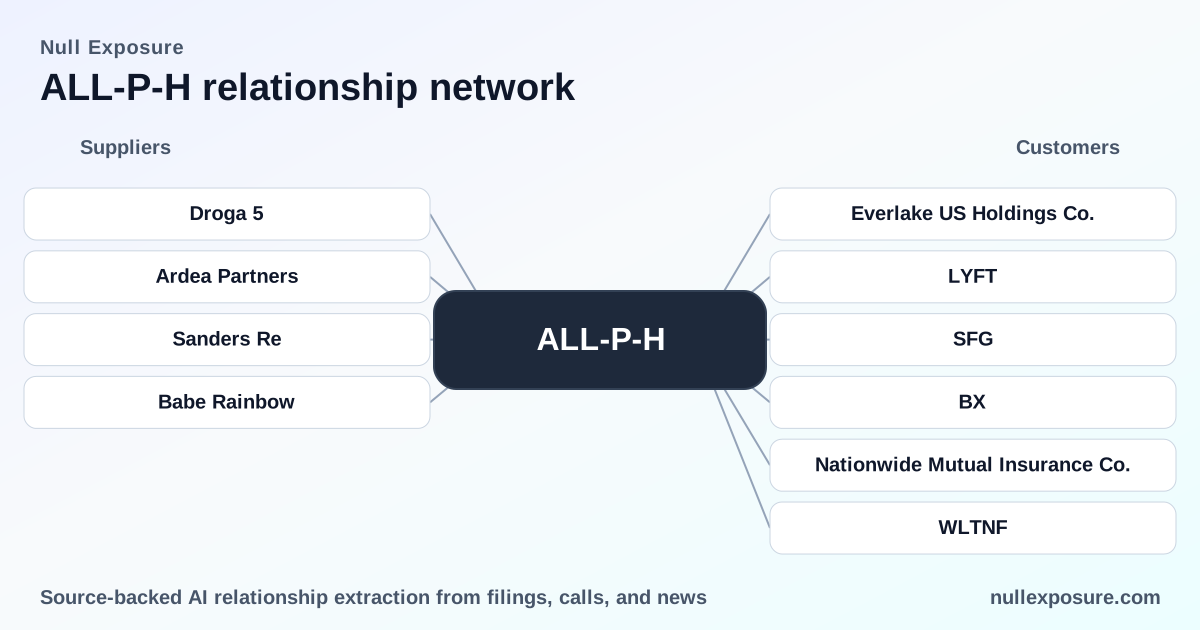
ALL-P-H (Allstate preferred): What counterparties and divestitures tell investors about counterparty risk and strategic focus
Allstate operates as a diversified insurance underwriter and asset manager that monetizes through premiums, underwriting margins and investment income; the preferred shares (ALL-P-H) sit on a capital structure exposed primarily to the parent’s insurance operations. Recent public filings and press reporting show a clear strategic pivot: Allstate is shedding non-core life and employee-benefits businesses while maintaining large commercial underwriting relationships, altering counterparty concentration and the company’s risk surface. For additional context on our coverage and signals, visit https://nullexposure.com/.
Divestitures and partnerships are reshaping the customer map
Investors should view the documented relationships as evidence of two near-term priorities: capital redeployment (through asset sales) and commercial underwriting partnerships that sustain core P&C revenue. The transactions and contracts listed below are executed, material, and concentrated among well-known financial and specialty insurers—useful signals for credit and counterparty exposure analysis.
Operating posture and business-model signals investors need to price in
No formal constraint flags are present in the record, but the relationship activity generates clear company-level signals:
- Contracting posture: Allstate is actively divesting life and employee-benefits units, indicating a deliberate move to simplify the balance sheet and reduce legacy liabilities.
- Concentration profile: Buyers are large financial sponsors and insurers (Blackstone, StanCorp, Nationwide, Wilton Re, Everlake), which reduces fragmentation but increases exposure to a small set of sophisticated counterparties during the transaction phase.
- Criticality of relationships: The divested units are non-core to Allstate’s P&C franchise, so these counterparties are important to executed exits but are not essential to ongoing premium flows.
- Maturity and execution risk: Transactions reported across FY2021–FY2025 are closed or near-closed, signaling executed strategy rather than exploratory talks.
For an operational deep-dive on counterparty tracking and to monitor future relationship shifts, see https://nullexposure.com/.
What each counterparty relationship implies for investors
Everlake US Holdings Co.
Allstate agreed to sell Allstate Life Insurance Co. (ALIC) to Everlake US Holdings Co., an entity managed by Blackstone, as part of its exit from life and annuity businesses for $2.8 billion; this transaction completes a strategic de-risking of legacy life assets. According to Insurance Journal’s FY2021 reporting, the Everlake agreement was presented as a closing step toward Allstate’s exit from life and annuity operations (https://www.insurancejournal.com/news/national/2021/10/04/634956.htm).
Blackstone / BX
Private-equity buyer Blackstone agreed to acquire a substantial portion of Allstate’s life operations for $2.8 billion, providing Allstate with significant proceeds and a rapid cleanup of life/annuity exposure. Multiple outlets including Fox Business and BizJournals reported the FY2021 sale terms and the strategic rationale for Allstate’s divestiture to Blackstone (Fox Business, BizJournals, FY2021).
Wilton Re / WLTNF
Allstate closed the sale of Allstate Life Insurance Company of New York to Wilton Re for approximately $400 million, representing a targeted carve-out of state-level life assets. The Post-Bulletin and Insurance Journal reported the FY2021 close as part of Allstate’s broader life-exit program (Post-Bulletin, Insurance Journal, FY2021).
Lyft (LYFT)
Allstate was selected to provide commercial auto coverage for Lyft drivers in eight states—California, Iowa, Indiana, Kansas, Kentucky, Missouri, Ohio and West Virginia—effective October 1, reinforcing Allstate’s role as a commercial auto underwriter for mobility platforms. The PR Newswire release from FY2020 documents the multi-state commercial coverage arrangement and its effective date (PR Newswire, FY2020).
Nationwide Mutual Insurance Co.
Allstate completed a $1.25 billion sale of its group health business to Nationwide Mutual Insurance Co., reflecting continued divestiture of employee-benefits lines and a shift away from group health operations. InsuranceBusinessMag covered the FY2025 sale as part of Allstate’s ongoing portfolio rationalization (Insurance Business Magazine, FY2025).
StanCorp Financial Group Inc. (The Standard) / SFG
Allstate completed the $2.0 billion sale of its employer benefits business to StanCorp Financial Group Inc. (The Standard), further reducing exposure to employer-sponsored benefit liabilities and freeing capital for core lines. InsuranceBusinessMag’s FY2025 reporting detailed the transaction and its expected impact on Allstate’s business mix (Insurance Business Magazine, FY2025).
Investment implications and risk checklist
- Capital reallocation upward: The suite of sales has generated material proceeds that strengthen capital flexibility for core P&C priorities and share-class obligations associated with preferred securities.
- Lower operational complexity: Exiting life and employee-benefits lines reduces actuarial and reserve complexity, improving earnings predictability for investors focused on P&C profitability.
- Counterparty concentration during execution: While buyers are well-capitalized, the concentration of several large transactions creates temporary execution and regulatory risk exposure tied to those counterparties’ ability to close and assume liabilities.
- Revenue-critical relationships retained: The Lyft commercial-auto arrangement underscores Allstate’s commitment to large-scale commercial underwriting partnerships that sustain earned premium streams in its core franchise.
Key takeaway: Allstate’s documented customer relationships show a company consciously pruning non-core liabilities while preserving and expanding core commercial underwriting, which reduces long-term complexity and reorients counterparty exposure toward large institutional buyers.
Final framing for portfolio managers
These relationships collectively tell a cohesive story: Allstate is simplifying and de-risking its portfolio, monetizing legacy life and benefits businesses to concentrate on core P&C underwriting. For investors assessing ALL-P-H, this reduces structural tail risk from legacy life reserves while introducing short-term counterparty concentration tied to strategic buyers. Monitor regulatory closings and any post-sale service agreements that could reintroduce residual counterparty exposure.
For continuous tracking of counterparty shifts and to integrate these relationship signals into a wider credit or underwriting model, visit https://nullexposure.com/.