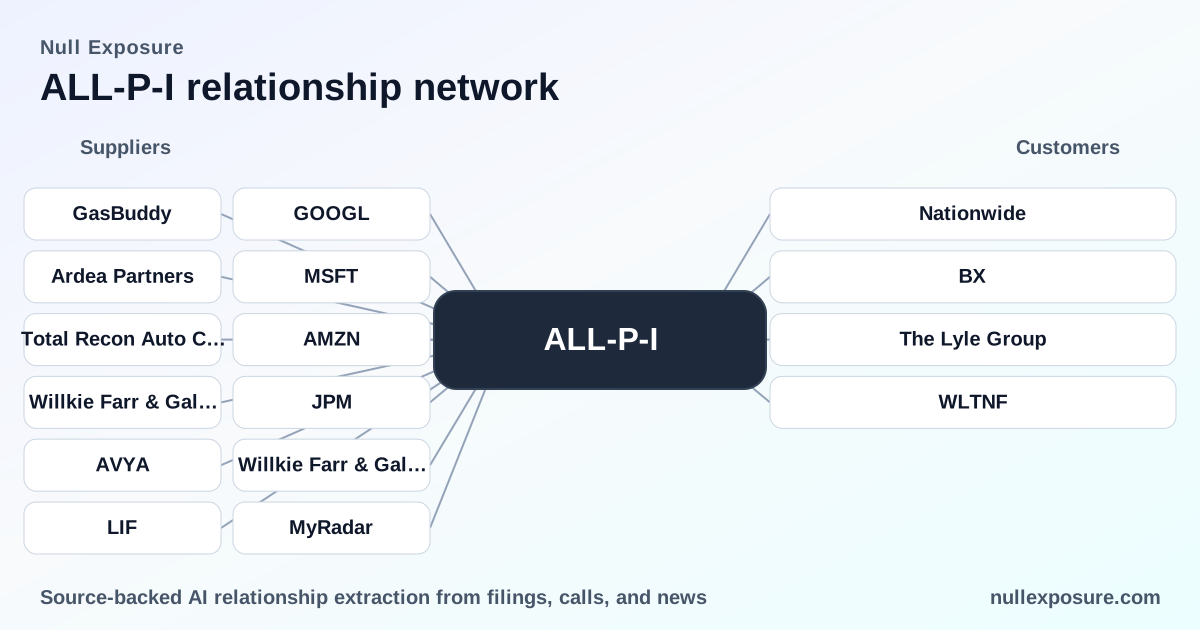
ALL-P-I: Customer relationships that redefine Allstate’s capital posture
Thesis — Allstate monetizes through underwriting and capital recycling: the company concentrates on property & casualty underwriting while selectively divesting non-core insurance and real-estate assets to free capital and sharpen its operating footprint. Recent customer- and counterparty-level transactions reflect a deliberate pivot away from life and annuity exposures, active monetization of real estate, and third-party takeovers of specialty employer stop‑loss lines — all actions that materially change cash flow timing and counterparty concentration for holders of ALL‑P‑I preferred claims. For a consolidated view of these relationship signals visit https://nullexposure.com/.
Why these moves matter to investors in ALL‑P‑I
Allstate’s preferred holders are first-order beneficiaries of the company’s capital allocation and counterparty risk profile. Divestitures reduce earnings volatility from legacy life and annuity businesses while accelerating one‑time capital inflows. Conversely, sales of operational assets (headquarters) and employer stop‑loss lines shift the risk map: real estate and specialty insurance customers transfer to external owners who then become counterparties for service, lease, or reinsurance arrangements. Those counterparty changes influence recovery profiles for preferred claims under stress and alter concentration risk in Allstate’s capital stack.
What the public relationships reveal about strategy and contracting posture
- Decisive portfolio simplification: Multiple sales of life and annuity operations to institutional buyers indicate an intentional exit strategy for non-core liabilities and related capital release.
- Capital recycling through non-core asset sales: Sale of headquarters and business units shows active balance-sheet engineering rather than passive liquidity management.
- Counterparty transition risk: As businesses transfer to parties such as Blackstone, Wilton Re, and Nationwide, Allstate becomes less the long‑term operator of those lines and more a capital allocator and contract originator.
These are company-level signals drawn from the observed transaction set rather than individual contractual excerpts.
Relationship-by-relationship read (each item in the record)
Nationwide — employer stop‑loss segment acquired for $1.25 billion
Nationwide completed the acquisition of Allstate’s employer stop‑loss business, a transaction that removes a specialty insurance line from Allstate’s operating perimeter and brings a substantive cash infusion to the company. According to PR Newswire (FY2025), the deal closed for $1.25 billion: https://www.prnewswire.com/news-releases/nationwide-completes-acquisition-of-allstate-employer-stop-loss-business-for-1-25-billion-302495836.html.
Dermody Properties — purchase of majority of Allstate headquarters for $232 million
Dermody Properties agreed to purchase the property comprising the majority of Allstate’s Northbrook headquarters for $232 million, converting a fixed asset into liquid capital while outsourcing campus ownership and related facilities responsibilities. The CommercialSearch report (FY2021) documents the transaction: https://www.commercialsearch.com/news/dermody-properties-to-pay-232m-for-allstate-campus/.
The Lyle Group — local agency consolidation in St. Cloud
The Lyle Group, an Allstate agency, announced the acquisition of the Toby Steinmetz Agency, underscoring active consolidation at the agent level that reshapes distribution relationships for Allstate-branded insurance products. The Saint Cloud Times covered the agency-level consolidation (FY2023): https://www.sctimes.com/story/money/business/2023/01/09/the-lyle-group-announces-acquisition-of-toby-steinmetz-agency/69775778007/.
BX (Blackstone) — $2.8 billion sale of life units and investment affiliates
Allstate executed a multi-asset sale that included Allstate Life Insurance Company of New York and related life operations to investment affiliates associated with Blackstone for $2.8 billion, completing a strategic exit from parts of its life and annuity business and delivering significant proceeds. Insurance Journal reported on the $2.8 billion transaction (FY2021): https://www.insurancejournal.com/news/national/2021/03/29/607467.htm.
Blackstone — institutional buyer completing life/annuity exit
The purchaser identified as Blackstone in public filings and media coverage underscores that Allstate relied on large private capital to take on legacy life and annuity blocks, redefining the company’s exposure to long‑duration insurance obligations. The same Insurance Journal article documents the terms and strategic rationale (FY2021): https://www.insurancejournal.com/news/national/2021/03/29/607467.htm.
Wilton Re — $220 million acquisition of Allstate New York life and annuity operations
Allstate sold its New York life insurance and annuity operation to Wilton Re for $220 million, closing a geographically specific exit and transferring localized regulatory and policy servicing responsibilities. The transaction is reported in Insurance Journal (FY2021): https://www.insurancejournal.com/news/national/2021/03/29/607467.htm.
WLTNF — security-level identification of the Wilton Re transaction
The record also identifies WLTNF as the ticker tied to Wilton Re’s purchase, effectively matching the counterparty security to the sale of the New York life operation and highlighting counterparty identity for capital providers and risk managers. Insurance Journal provides the underlying transaction detail (FY2021): https://www.insurancejournal.com/news/national/2021/03/29/607467.htm.
Operational constraints and company-level signals
There are no explicit constraint records attached to these relationship entries in the collection. At the company level, the absence of enumerated contractual constraints signals a public record emphasis on transactional disclosure rather than detailed operational covenants in media-sourced reporting. Practically, this indicates:
- Contracting posture: Allstate executes asset and business sales as bilateral commercial transactions with institutional buyers rather than through tranche-like constrained restructurings.
- Concentration: Proceeds-driven transactions reduce legacy business concentration on Allstate’s balance sheet while introducing third‑party concentration in the form of institutional counterparties (Blackstone, Nationwide, Wilton Re).
- Criticality and maturity: Sales of legacy and real‑estate assets suggest a shift to shorter-duration, higher-turnover capital strategies rather than long-term retention of non-core liabilities.
Investment implications and key takeaways
- Capital recycling strengthens near-term liquidity for preferred claims: The $1.25B stop‑loss sale and multi‑hundred‑million real‑estate and life‑business exits produce material one-time cash flows that support capital buffers relevant to ALL‑P‑I.
- Lower structural exposure to long-duration life and annuity liabilities: Exits to Blackstone and Wilton Re reduce Allstate’s earnings sensitivity to long-tail actuarial risk and regulatory capital variability.
- New counterparty concentration: Institutional buyers now hold businesses formerly operated by Allstate, transferring operational and counterparty risk outward and creating a different set of counterparty dependencies for service-level continuity and reinsurance dynamics.
- Distribution consolidation at agency level: Local agency M&A changes how premium is sourced and retained, altering rollover risk and regional market share drivers for Allstate-branded products.
For investors and analysts tracking preferred‑class exposure, these relationship signals clarify how Allstate is shaping its liability profile through active disposals and partner transactions. For additional context and a consolidated view of counterparties and transaction flow, visit https://nullexposure.com/.
Bold final takeaway: Allstate’s customer- and asset-sales program materially reduces legacy life/annuity duration risk while replacing internal operating exposure with concentrated external counterparties — a strategic pivot that improves near-term capital flexibility but increases counterparty tracking requirements for preferred security holders.