Allegion (ALLE): Retail Channels and Customer Relationships — What investors need to know
Allegion is a global designer and manufacturer of physical security products (locks, exit devices, door closers) that monetizes through two complementary streams: high‑margin hardware sales and recurring services/software (installation, maintenance and SaaS access control). The company drives reach through a mix of pro‑installer channels and mass‑retail partnerships that convert brand recognition (Schlage, CISA, Von Duprin) into volume sales while Interflex and other units grow subscription‑style revenue. For a concise primer on channel exposure and relationship risk, visit https://nullexposure.com/.
How Allegion’s operating model translates into financial levers
Allegion’s economics are anchored in hardware scale with an accelerating services/software layer. Hardware remains the cash engine — the company reports substantial mechanical product revenues — while recurring services and software deliver margin stability and aftermarket capture. The balance sheet and multiples reflect a mature industrial with steady cash flow: Revenue TTM ~$4.16B, Operating margin ~18.9%, EV/EBITDA ~13.3 and Forward P/E ~15.4. These figures underline a business with healthy core profitability and room for multiple expansion as recurring revenue increases.
Operational constraints that shape the customer story:
- Contracting posture: Allegion sells tangible products and also offers subscription/SaaS services (Interflex and other offerings), establishing a hybrid contracting model with some recurring revenue and lock‑in through software and maintenance contracts.
- Concentration profile: No single customer accounted for ≥10% of revenues in 2024, yet the top 10 customers represented ~27% of net revenues, signaling meaningful dependence on major distribution and commercial accounts without single‑counterparty dominance.
- Criticality: Products are safety and access solutions for buildings; end‑user demand is often mission‑critical for customers in education, healthcare, government and commercial real estate.
- Global footprint and maturity: Allegion operates across NA, EMEA and APAC, with a fully global manufacturing and distribution network — a mature industrial platform positioned to convert channel share into predictable aftermarket streams.
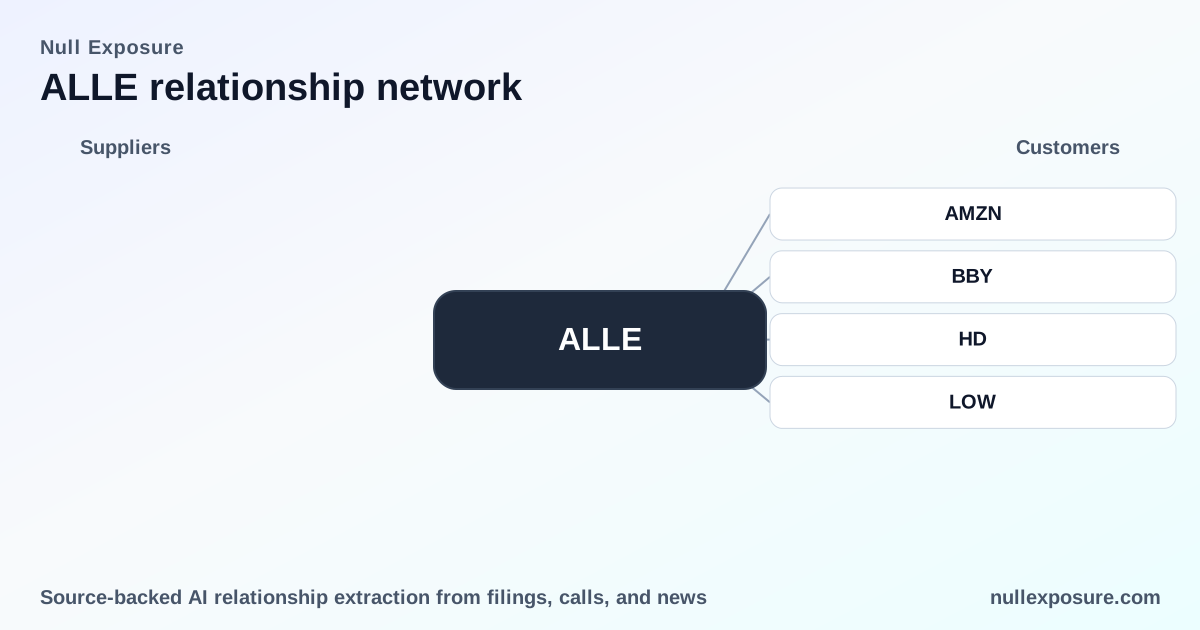
Channel partners and retail accounts (complete list from sourced reporting)
The following customer relationships were called out in media coverage; each entry below is a plain‑English summary with source attribution.
Amazon (AMZN)
Schlage smart deadbolts are a core retail SKU carried on Amazon, giving Allegion direct access to mass online consumers and shrink‑to‑fit distribution. According to an Ad‑Hoc News report on March 9, 2026, Schlage is described as “one of the go‑to brands for smart deadbolts sold at Home Depot, Lowe’s, Amazon, and pro installers.” (Ad‑Hoc News, 2026-03-09)
BBY (ticker listed as BBY)
Retail distribution includes Best Buy channels under the BBY identifier, where Allegion’s residential smart locks are broadly available to mainstream electronics buyers. An Ad‑Hoc News piece on March 9, 2026 notes Schlage’s wide availability at Amazon, Best Buy, Home Depot and Lowe’s. (Ad‑Hoc News, 2026-03-09)
Best Buy (BBY)
Best Buy’s store and online footprint provides a consumer electronics route for Schlage products that complements home improvement channels and reaches a different customer segment. Coverage from Ad‑Hoc News (March 9, 2026) lists Best Buy among the national retailers stocking Schlage smart locks. (Ad‑Hoc News, 2026-03-09)
HD (ticker listed as HD)
Home Depot is a primary mass‑retail partner for Allegion, positioning Schlage as a category leader in home improvement and professional installer purchases. Ad‑Hoc News singled out Home Depot as a go‑to retail presence for Schlage smart deadbolts (March 9, 2026). (Ad‑Hoc News, 2026-03-09)
Home Depot (HD)
Home Depot’s national retail platform supplies both DIY consumers and trade professionals, amplifying Allegion’s access to recurring replacement and upgrade cycles in residential and light commercial segments. The retailer is named explicitly in a March 9, 2026 Ad‑Hoc News article highlighting Schlage distribution. (Ad‑Hoc News, 2026-03-09)
Lowe’s (LOW)
Lowe’s, like Home Depot, is a strategic hardware partner that extends Allegion’s reach into home improvement shoppers and pro installers who drive larger‑ticket commercial conversions. Ad‑Hoc News listed Lowe’s alongside Home Depot and Amazon as a wide distribution point for Schlage smart locks (March 9, 2026). (Ad‑Hoc News, 2026-03-09)
What these relationships imply about revenue risk and upside
- Channel diversification is a strength. Allegion’s presence across Amazon, Home Depot, Lowe’s and Best Buy spreads retail risk and reduces single‑account vulnerability; this aligns with the disclosure that “no customer exceeded 10% of consolidated net revenues” while the top 10 customers still accounted for a meaningful share.
- Retail exposure is volume‑sensitive. Large retail partners drive scale but expose Allegion to promotional pressure and secular shifts in retail margins; hardware sales are inherently more cyclical than service contracts, so monitor same‑store demand trends and promotional cadence at national retailers.
- Recurring revenue offers margin resilience. The company explicitly lists SaaS and software maintenance (Interflex) and planned maintenance services as growth vectors, which increase customer lifetime value and reduce sensitivity to single purchase cycles.
- Geographic reach mitigates but does not eliminate macro risk. The company’s global distribution (NA, EMEA, APAC) lowers dependence on any one macro environment, but global supply chain and FX dynamics remain material to margins.
Actionable investor takeaways
- Track two metrics closely: growth in services/software revenue as a percentage of total (the firm reports distinct services and software lines) and top‑10 customer share evolution; both will indicate whether Allegion is successfully shifting toward higher‑quality recurring cash flows.
- Monitor retail partner performance and inventory cycles at Amazon, Home Depot and Lowe’s because these channels drive unit velocity for Schlage and associated aftermarket sales.
- Use valuation context: Forward P/E ~15.4 and EV/EBITDA ~13.3 reflect a mature industrial with solid margins; premium expansion is premised on accelerating recurring revenue and margin stability.
For deeper channel intelligence and trend monitoring, see more at https://nullexposure.com/.
Bold conclusion: Allegion’s combination of strong retail distribution and a growing recurring services stack creates a defensible cash engine, but investors must watch retail channel dynamics and the pace of SaaS/service growth to validate multiple expansion.