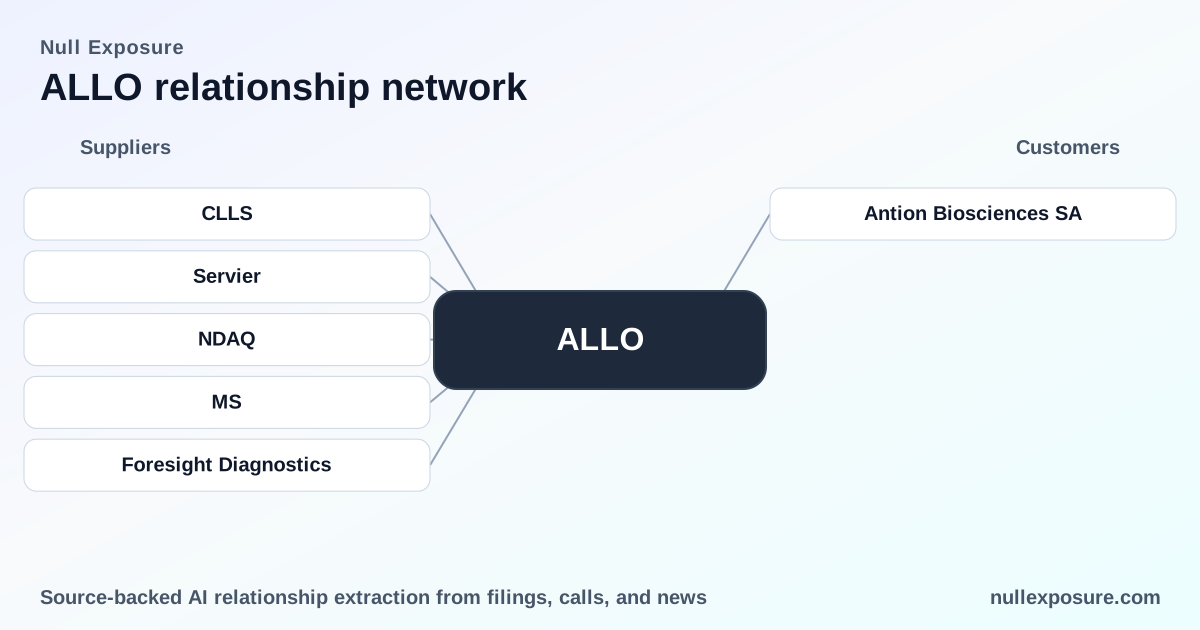
Allogene Therapeutics (ALLO): Customer relationships that define a clinical-stage commercial trajectory
Allogene develops and plans to commercialize off-the-shelf allogeneic CAR‑T therapies, generating value through licensing of platform technology, product commercialization (if approved), and capital markets activity that supports R&D and scale-up. The company’s operating model centers on a lead candidate, cemacabtagene ansegedleucel (cema‑cel), strategic technology licenses to broaden its engineering toolkit, and periodic equity issuances to fund clinical development and manufacturing. For investors, the key metric is how these partner relationships convert into durable technology advantages, commercial capacity, and balance‑sheet runway. Visit https://nullexposure.com/ to see comparative relationship histories if you want source-aligned screening.
What these relationships reveal in one line
- R&D depth through licensing: a targeted collaboration to add gene‑silencing tools to the CAR‑T platform.
- Capital markets dependence: a large public offering underwritten by major dealers that materially increases liquidity but dilutes equity.
- Institutional distribution: participation by full‑service banks and a private equity co‑manager shows access to both public and private investor channels.
How the company operates and why these ties matter
Allogene positions itself as a seller of advanced biologic therapeutics with a global distribution intent. The firm’s strategic posture combines inward licensing for platform enhancement and outward market access via capital markets and underwriting syndicates. These features translate into several structural characteristics investors should track:
- Contracting posture: the company uses exclusive licenses to acquire complementary technologies and underwriting agreements to refresh capital; that dual approach accelerates product development and funds scale‑up.
- Concentration risk: product concentration around cema‑cel creates binary commercial outcomes—success generates step-change value; failure concentrates downside.
- Criticality of partners: technology licensors and underwriters are operationally important—licensors expand technical capability; underwriters secure the financing runway.
- Maturity snapshot: Allogene is clinical‑stage with recent market transactions indicating active financing behavior rather than cash‑flowed commercialization. This positions the company as development‑heavy, funding‑dependent, and partner‑reliant.
Relationship roll call: what every partner contributes
Antion Biosciences SA — a targeted platform license for next‑gen CAR‑T engineering
Allogene entered an exclusive collaboration and global license with Antion for Antion’s miRNA technology (miCAR) to pursue multiplex gene silencing as an additional tool for next‑generation allogeneic CAR‑T products. This is a deliberate technology play to expand product durability and control immune interactions. According to Allogene’s 2024 Form 10‑K, the agreement was executed on January 5, 2022 and is framed as an exclusive collaboration and global license for miCAR technology (FY2024 10‑K).
Goldman Sachs & Co. LLC — lead underwriter on a material equity raise
On April 14, 2026 Allogene executed an underwriting agreement with Goldman Sachs (as a representative of the syndicate) and sold 100,200,000 shares to the underwriters on April 16, 2026, signalling a major capital injection and a consequential equity dilution event. The underwriting agreement and the sale are disclosed in the company’s April 2026 proxy/filing describing the offering (proxy filing, April 2026).
Jefferies LLC — syndicate representation and distribution reach
Jefferies acted alongside Goldman Sachs and TD Securities as a representative underwriter in the same April 2026 offering, supporting distribution to institutional investors and broader market placement of the issued shares. The underwriting arrangement including Jefferies is documented in the company’s April 2026 filing describing the public offering (proxy filing, April 2026).
TD Securities (USA) LLC — co‑lead in syndicate distribution
TD Securities participated as a representative underwriter in the April 2026 underwriting agreement, providing additional distribution muscle and balance‑sheet capacity for the offering that placed 100.2 million shares into the market on April 16, 2026. The company disclosed TD Securities’ role in its April 2026 proxy and related offering materials (proxy filing, April 2026).
TPG Capital BD, LLC — co‑manager and strategic buyer in the offering
TPG Capital BD acted as a co‑manager on the offering and purchased 3,807,600 shares at $1.88 per share, implying a measured strategic commitment and underwriting discount of $456,912 to TPG. This purchase and co‑manager role are disclosed in Allogene’s April 2026 filing covering the underwriting and share sale (proxy filing, April 2026).
Financial and commercial implications worth noting
- Immediate dilution and runway reset: The sale of 100.2 million shares is a material event that improves cash runway but dilutes existing shareholders; investors must model pro‑forma capitalization and cash runway post‑offering. The participation of blue‑chip underwriters confirms market access, while TPG’s direct purchase signals institutional appetite at the execution price.
- Platform risk and optionality: The Antion license represents technical optionality—multiplex gene silencing can materially change product differentiation and address safety/efficacy tradeoffs unique to allogeneic CAR‑T therapy.
- Commercial complexity from global intent: Allogene’s explicit goal to create an “inventory of off‑the‑shelf products” suggests an operational model that requires manufacturing scale, global regulatory strategy, and distribution agreements—each is capital and execution intensive.
- Concentration of value: With core product candidates such as cema‑cel central to the business case, any regulatory or clinical inflection is likely to drive outsized moves in equity value.
Risks investors should prioritize
- Execution risk on scaling manufacturing and global distribution given the off‑the‑shelf model and the need for tight supply‑chain coordination.
- Financing risk: reliance on episodic equity raises changes dilution dynamics and can compress per‑share upside if trials do not de‑risk on schedule.
- Partner dependency: technology licenses and underwriter relationships are critical to development and financing; disruption or adverse contract terms would materially affect the plan.
- Portfolio concentration: commercial and clinical outcomes are concentrated in a small number of product candidates, elevating binary event risk.
Bottom line for investors
Allogene is operating a classic biotech playbook: acquire platform capabilities through targeted licenses, advance a defined lead product through clinical development, and access capital markets to fund scale. The Antion collaboration strengthens technical capability, while the April 2026 underwriting syndicate materially resets the company’s financial runway. Investors should evaluate the interplay between clinical readouts for cema‑cel, the company’s ability to industrialize off‑the‑shelf manufacturing, and the long‑term dilution trajectory implied by periodic equity issuances.
If you want a consolidated view of partner relationships across similar clinical‑stage biotech names, review comparative profiles at https://nullexposure.com/.
For active investors, the next actionable milestones are: upcoming clinical data for lead programs, manufacturing scale indicators, and any follow‑on financing terms that would reveal institutional conviction and valuation trajectory.