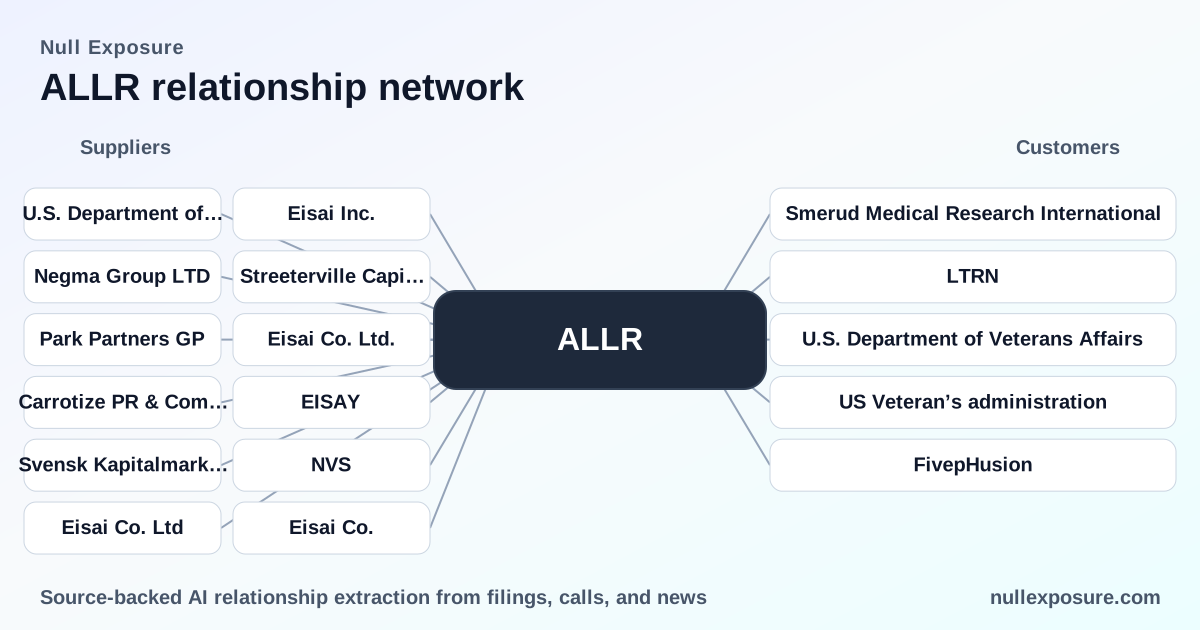
Allarity Therapeutics (ALLR): Customer relationships that drive a services-first commercialization push
Allarity operates as a clinical-stage oncology biotech that monetizes through two complementary channels: licensing and out-licensing of therapeutic assets, and fee-for-service diagnostic work using its DRP® drug response prediction and gene expression laboratory services. Recent public disclosures show a pivot toward commercial services revenue (down payments received and active lab preparations) combined with collaborative, grant-funded clinical trials that derisk development spend for the company and conserve capital. For investors and operators evaluating customer exposure, this profile suggests a hybrid biotech model where commercial services are increasingly material while asset-level transactions and collaborations continue to shape pipeline strategy. For a concise company overview and additional relationship context visit https://nullexposure.com/.
Why customers matter now: services revenue and funded studies change the risk profile
Allarity historically financed development through licensing and asset sales; the firm has pivoted to sell DRP® analysis and gene expression services to external biotech clients while simultaneously pursuing clinical collaborations that are externally funded. The net effect for investors: revenue diversification and lower near-term cash burn, but also a new set of counterparty and execution risks tied to laboratory ramp and contract performance.
- Services generation introduces concentration and execution risk because early revenue depends on a small number of contracted clients and the timely operationalization of laboratory workflows.
- Funded clinical collaborations convert R&D expense into partner-funded trials, improving cashflow stability when funders like government agencies underwrite trials.
The relationships — what they mean, one-by-one
Below I cover every customer relationship listed in the public results and provide a plain-English takeaway and the source reference for investors to follow.
Smerud Medical Research International
Allarity’s 2024 10‑K records an amendment to an out-license agreement involving Smerud, noting that Chosa ApS replaced Allarity as exclusive licensee to the LiPlaCis technology under the March 28, 2022 amendment; this describes prior licensing activity rather than an ongoing fee-for-service engagement. According to Allarity’s 2024 10‑K filing, the amendment reassigns exclusive licensee status for LiPlaCis to Chosa ApS (FY2024 10‑K).
U.S. Department of Veterans Affairs (VA) / US Veteran’s administration
Allarity is conducting a collaborative Phase 2 trial combining stenoparib with temozolomide in relapsed small‑cell lung cancer that is fully funded through the VA’s Special Emphasis Panel on Precision Oncology, converting trial costs into partner-funded activity and reducing the company’s direct cash outlay. The company described the collaboration and full VA funding in a GlobalNewswire release (Feb 3, 2026) and reiterated trial funding and exploration in its 2025 CEO year‑end letter (Dec 31, 2025); a TradingView news item (May 2, 2026) also reported the trial as fully VA funded (FY2025–FY2026 press coverage).
Lantern Pharma (LTRN)
Lantern Pharma executed an Asset Purchase Agreement to reacquire global development and commercialization rights to Irofulven (LP‑100) from Allarity (formerly Oncology Venture), effectively transferring that program back to Lantern and clarifying Allarity’s retained or relinquished rights for that asset. PR Newswire reported Lantern’s July 27, 2021 announcement of the asset reacquisition (FY2021 PRNewswire).
LTRN (duplicate entry)
The duplicate listing for LTRN references the same PR Newswire July 27, 2021 announcement that Lantern reclaimed global development and commercialization rights for Irofulven from Allarity; the commercial implication is the same as above — an asset transfer away from Allarity that reduces asset-side upside but also removes associated development obligations (PR Newswire, July 27, 2021).
FivepHusion
Allarity entered an agreement with Australian biotech FivepHusion to allow FivepHusion to use Allarity’s DRP companion diagnostic technology in their clinical trials and potential future commercialization of Deflexifol, establishing Allarity as a services and diagnostics partner to upstream drug developers. Coverage of this agreement appeared in a stocktitan.net report summarizing Allarity milestones (FY2023 press coverage).
Operational constraints and what they signal about the business model
Public excerpts and model signals indicate a services-led operating posture now complementing traditional licensing activity. These constraints should inform investor expectations for revenue cadence, concentration, and capital needs.
- Contracting posture — services-first, contract revenue with down payments. The company reported receiving approximately $0.2 million in down payments in 2024 to support DRP® and gene expression services and is actively preparing the lab to recognize this revenue starting in 2025 (2024 disclosures).
- Relationship maturity and ramp profile. Disclosures classify new external client engagements as ramping toward recognized revenue, with evidence of active preparations and initial advance payments.
- Spend and revenue scale. The company signals early services spend bands in the $100k–$1m range per the 2024 down payments; separately, capital markets activity generated $9.7m net proceeds from share sales in early 2025, which shifts the near‑term financing runway (Jan–Mar 2025 capital raise).
- Concentration and criticality. Early services revenue is concentrated and operationally critical because the laboratory must achieve readiness to convert down payments into recognized revenue; at the same time, externally funded clinical trials (VA) materially reduce Allarity’s direct R&D cash requirements.
These company-level constraints point to a transitioning business model where service contracts and funded collaborations stabilize cashflow but create execution risk around lab ramp and client concentration.
Investment implications — what to watch next
- Short-term upside: Recognized services revenue beginning in 2025 and the VA‑funded Phase 2 trial remove near-term cash drag and create de‑risked clinical proof points. If the laboratory scales to additional clients, services revenue can compound without commensurate R&D burn.
- Primary risks: Execution on laboratory readiness, client concentration, and the company's ability to expand the services pipeline beyond initial customers. Asset sales like the Irofulven transaction reduce blockbuster upside but also limit future cash obligations.
- Data points to monitor: lab revenue recognition in 2025 filings, progress updates on the VA trial, new service agreements or expansions (geographic or therapeutic), and subsequent capital raises or commercial partnerships.
If you want a consolidated intelligence view of Allarity’s customer relationships and constraints, explore the company page at https://nullexposure.com/ for deeper linkage and timelines.
Bold takeaways
- Allarity is actively shifting to fee-for-service diagnostic revenue while leveraging externally funded trials to reduce R&D cash burn.
- Early services revenue is modest but measurable ($0.2M down payments in 2024), and a VA-funded Phase 2 trial materially de-risks a near-term development program.
- Execution of the lab ramp and expansion of client count determine whether this pivot meaningfully improves long-term valuation.
For further relationship-level diligence and to monitor new customer disclosures, visit https://nullexposure.com/.