Ally Financial: the dealer-centric balance between deposit strength and concentrated OEM exposure
Ally Financial operates as an all-digital bank combined with one of the largest automotive finance and insurance platforms in North America. It monetizes through net interest margin on auto and consumer loans funded predominantly by retail deposits, recurring insurance and service revenue (VSCs, GAP, remarketing fees), and dealer-facing finance products and securitizations; dealer relationships and OEM channels generate a persistent share of originations and remarketing flow. For investors, Ally’s economic model is a blend of durable deposit funding and concentrated auto-channel exposure that drives both earnings leverage and idiosyncratic concentration risk. For a structured view of how Ally’s customer relationships map to that model, see Null Exposure for deeper relationship intelligence: https://nullexposure.com/
How Ally’s customer list reads in plain English
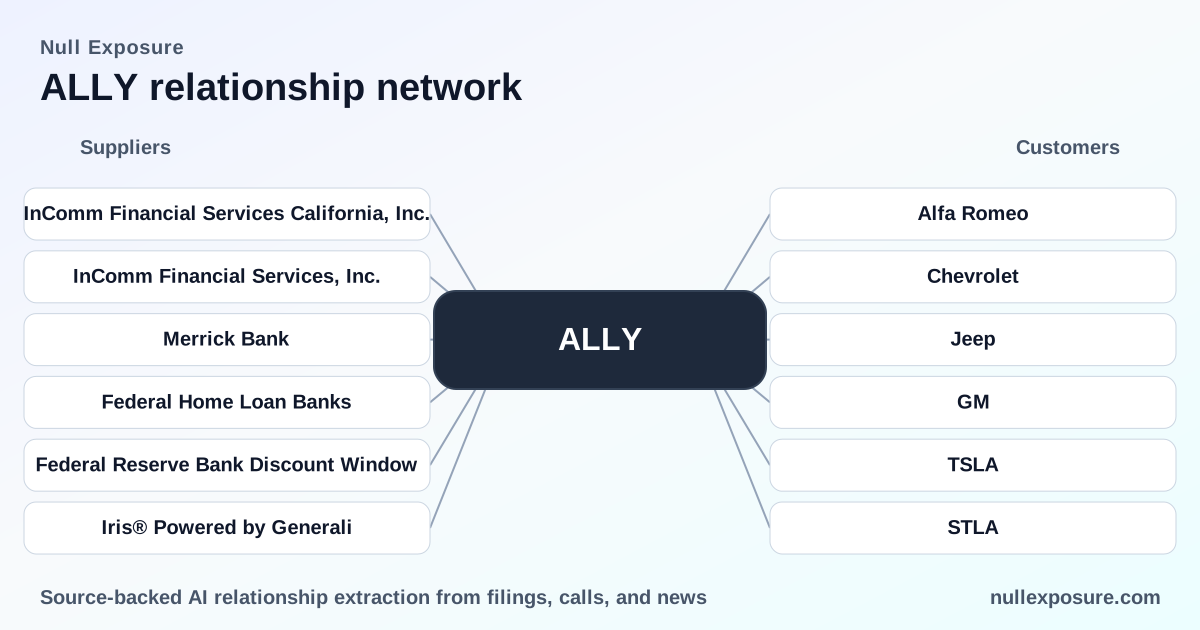
Ally’s disclosed customers and partners span OEMs, dealer networks, brand sponsorships and third-party lending platforms; the following sections summarize every named relationship surfaced in Ally’s filings and recent news, with the source noted for each item.
Alfa Romeo
Ally provides automobile financing for Alfa Romeo vehicles as part of its dealer and consumer auto financing portfolio, including battery-electric and plug-in hybrid models. This attribution comes from Ally’s 2024 Form 10‑K disclosure on the brands it finances (FY2024).
Chevrolet
Ally extends automobile financing for Chevrolet vehicles, counted among the brands for which Ally offers battery-electric and plug-in hybrid vehicle financing. Source: Ally 2024 Form 10‑K (FY2024).
Jeep
Ally provides vehicle financing that includes Jeep models, including battery-electric and plug-in hybrid vehicles, as disclosed in the company’s 2024 Form 10‑K. Source: Ally 2024 Form 10‑K (FY2024).
GM (General Motors)
In 2024, GM accounted for 30% of Ally’s new vehicle dealer inventory financing and 22% of its consumer automotive financing volume, signaling material concentration in an OEM relationship that feeds both inventory and retail loan flows. Source: Ally 2024 Form 10‑K (FY2024).
Onemain (OMF)
Onemain’s public commentary confirms a pass-through partnership with Ally now covering roughly 1,700 dealers, which offers Ally a scalable distribution channel to expand auto lending without building equivalent dealer infrastructure. Source: The Globe and Mail / Onemain earnings commentary and supporting press (FY2026); additional mentions in InsiderMonkey and Finviz coverage of Onemain’s Q1 2026 results (FY2026).
WNBA (Women’s National Basketball Association)
Ally is the official banking partner of the WNBA as part of its brand and community engagement strategy designed to support marketing, ESG goals and consumer visibility. Source: BuzzFeed Business coverage of Ally’s sponsorships and marketing initiatives (May 2026).
Women’s Sports Foundation
Ally partners with the Women’s Sports Foundation through marketing and donation programs that convert fan engagement into charitable contributions, underscoring Ally’s consumer-brand investments tied to growth and social impact. Source: BuzzFeed Business coverage (May 2026).
Tesla (TSLA)
Ally provides automobile financing for Tesla models, including battery-electric vehicles — explicitly listed among brands for which Ally offers financing in the 2024 10‑K. Source: Ally 2024 Form 10‑K (FY2024).
Unrivaled 3‑on‑3 basketball league
Ally has invested in the Unrivaled 3‑on‑3 basketball league as part of its experiential and community-facing sponsorships that prioritize brand activation over strict asset returns. Source: BuzzFeed Business summary of Ally’s marketing programs (May 2026).
Stellantis (STLA)
In 2024, Stellantis represented 46% of Ally’s new vehicle dealer inventory financing and 16% of consumer automotive financing volume, making the OEM relationship a major driver of Ally’s originations and inventory finance exposure. Source: Ally 2024 Form 10‑K (FY2024).
Notes on duplicate entries: Tesla/TSLA and Stellantis/STLA are each referenced multiple times in the source set; the above captures the disclosed relationship and source(s) that substantiate Ally’s financing exposure to those brands.
What the constraints reveal about how Ally operates
The company-level constraint signals in Ally’s filings frame several operational and risk characteristics that matter to investors:
- Funding posture and criticality: Retail deposits are Ally’s primary funding source, constituting 84% of on‑balance-sheet funding at December 31, 2024 — a structural advantage that supports margins and liquidity and is flagged as a critical dependency in the 10‑K. This is a core operating strength and concentration point for funding risk.
- Contract maturity: Ally’s business includes long‑term guarantee contracts in specialized areas (for certain nonconsolidated affordable housing entities), indicating pockets of extended contractual commitments beyond the typical auto-loan tenor; this is a company-level signal about contract duration and liability profile.
- Counterparty mix: Ally serves a mix of individual retail customers (large scale), municipal/government entities in its finance segments, and mid-market borrowers through corporate finance operations — a diversified counterparty set that still centers on retail and dealer channels.
- Geography: Operations and customer exposure are concentrated in North America (U.S. and Canada), defining regulatory and macroeconomic sensitivity for the portfolio.
- Materiality and concentration: GM and Stellantis dealers and retail customers continue to constitute a significant portion of Ally’s automotive volume — a material concentration that creates single-industry/ OEM channel risk for originations and inventory finance.
- Relationship roles and go‑to‑market: Ally acts as seller (insurance contracts and VSCs), service provider (SmartAuction remarketing, servicing of securitizations), and buyer in the sense of financing dealer inventory; these mixed roles embed recurring fee streams and cross-sell economics.
- Stage and scale: Ally reports roughly 21,400 active dealer relationships, confirming an active, large-scale dealer network that operationally underpins originations and remarketing.
Investment implications — what this network means for returns and risk
- Earnings leverage from deposits and scale: Ally’s deposit-funded model reduces wholesale funding costs and supports NIM stability; the bank’s scale in retail deposits is a clear positive for capital-light growth.
- Channel concentration risk: High dependence on GM and Stellantis for a large share of dealer inventory and retail volumes creates earnings and credit exposure tied to OEM health, production cycles and incentives.
- Diversified revenue engines: Insurance products (VSCs, GAP), remarketing fees (SmartAuction) and servicing fees provide non‑interest revenue that stabilizes earnings when loan yields compress.
- Distribution optionality via partnerships: Pass-through deals with platforms like Onemain expand Ally’s reach without commensurate fixed-cost investment, enabling growth without proportionate balance-sheet expansion.
- Brand and marketing investments are material: Sponsorships (WNBA, Women’s Sports Foundation, Unrivaled) signal a continued focus on consumer acquisition and ESG/brand positioning that supports deposit and retail customer growth but increases marketing expense.
For a deeper map of Ally’s dealer and OEM linkages and how those relationships translate to credit and revenue sensitivity, explore Null Exposure’s relationship analytics: https://nullexposure.com/
Final takeaway
Ally’s franchise is a hybrid: durable deposit funding and recurring insurance/service revenue balanced against concentrated OEM and dealer channel dependencies. That structure produces attractive operating leverage but requires active monitoring of OEM exposures, remarketing results and retail deposit trends to judge credit and earnings trajectory.