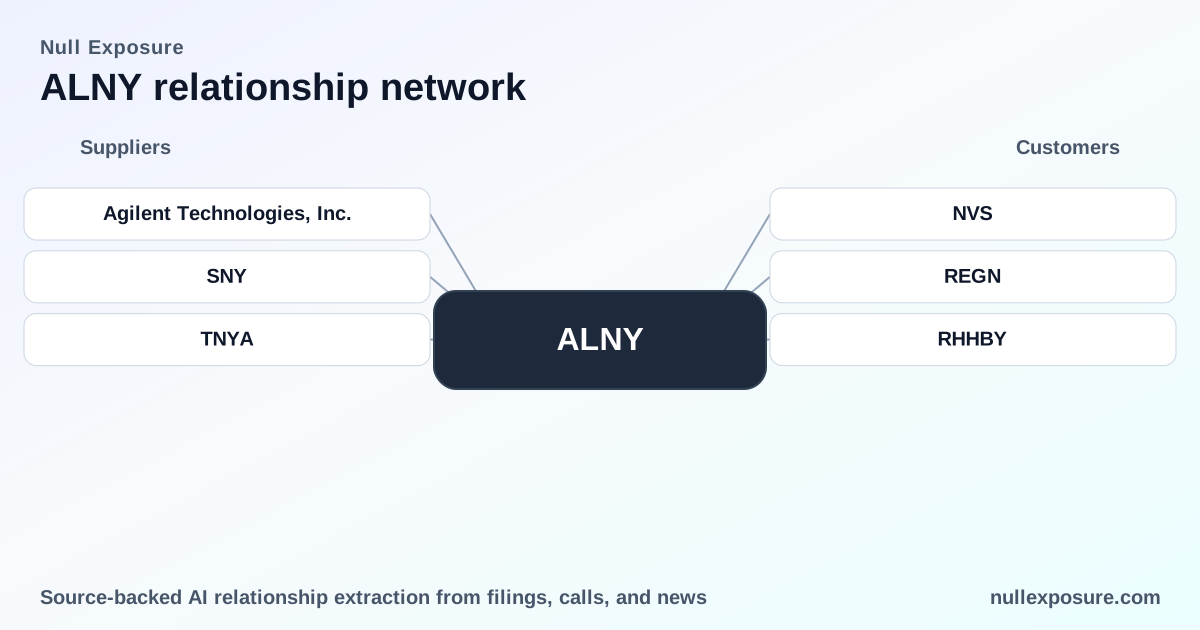
Alnylam’s customer map: who pays, who partners, and where revenue flows
Alnylam Pharmaceuticals discovers, develops and commercializes RNA interference (RNAi) therapies and monetizes through three clear channels: direct product sales of its commercial drugs, collaboration and license revenue from strategic pharma partners, and royalty streams tied to licensed programs. For investors, the core investment thesis is straightforward: Alnylam’s revenue growth and margin expansion are driven by its ability to commercialize core products globally while extracting value from partnerships and royalties tied to a small set of high-impact relationships.
Explore the full relationship dataset and document links at https://nullexposure.com/ for direct source access.
The partner roster that matters to revenue and valuation
Below I walk through every counterparty captured in the underlying signal set and explain how each relationship functions in plain English.
Vir Biotechnology (VIR) — licensed development relationship (FY2026 / FY2025)
Vir is developing elebsiran, an investigational siRNA for hepatitis B/delta, under a license agreement originally signed with Alnylam; Alnylam is the drug’s discoverer and licensor. According to corporate updates and news coverage in March 2026, elebsiran is explicitly licensed from Alnylam for Vir’s development and commercialization efforts (BioSpace, March 2026; GEN Eng News, FY2025).
Source: BioSpace press release and GEN Eng News coverage (March 2026).
Novartis (NVS) — royalty and milestone linkage (FY2026)
Novartis drives a material royalty stream to Alnylam through Leqvio (inclisiran) commercialization: higher Leqvio sales translated to a large year-over-year increase in Alnylam’s royalty revenue, and past milestone recognition tied to Novartis explains quarter-to-quarter revenue swings. Alnylam management highlighted a 90% increase in royalty revenue driven by Novartis Leqvio sales in the FY2026 commentary (InsiderMonkey Q4-2025 earnings transcript).
Source: Q4-2025 earnings transcript reporting on FY2026 results (InsiderMonkey, March 2026).
Regeneron (REGN) — collaboration revenue contributor (FY2026)
Regeneron is an active collaboration partner whose programs contribute to Alnylam’s reported collaboration revenue; management identifies the Regeneron partnership as a near-term revenue driver alongside Roche and Leqvio royalties. Alnylam’s FY2026 commentary lists Regeneron collaboration revenue as a primary element of collaboration income for the year (InsiderMonkey Q4-2025 earnings transcript).
Source: Q4-2025 earnings call reporting (InsiderMonkey, March 2026).
Roche (RHHBY) — ongoing collaboration recognition (FY2026)
Roche is an ongoing collaborator from which Alnylam recognizes periodic collaboration revenue; fourth-quarter disclosures explicitly note revenue recognition under the Roche agreement during the reported quarter. TradingView coverage of Alnylam’s Q4 results references recognition of revenue under the Roche collaboration in FY2026 (TradingView/Zacks, March 2026).
Source: TradingView summary of Q4 results (Zacks/TradingView, March 2026).
Royalty Pharma (RPRX) — royalty monetization arrangement (FY2025)
Royalty Pharma holds a purchased royalty tied to Amvuttra (one of Alnylam’s commercial products), and disclosure indicates a specific royalty payment event — a reported $310 million royalty on Amvuttra that factors into Royalty Pharma’s financials. TradingView coverage of Royalty Pharma’s results documents a royalty on Alnylam’s Amvuttra in FY2025 (TradingView, FY2025).
Source: TradingView coverage of Royalty Pharma Q3-2025 results (FY2025).
How these partnerships fit into Alnylam’s operating model
Alnylam runs a commercial-stage, product-led biotech model with an explicit licensing and collaboration playbook. Key operating characteristics from the record:
- Seller posture and direct commercialization: Alnylam sells its own products in major markets and builds commercial capability in-house while partnering in smaller markets, which signals a deliberate move to capture margin from product sales rather than fully outsourcing commercialization.
- Revenue concentration and critical partners: Collaboration and royalty income is concentrated among a few large counterparties — Novartis, Roche, Regeneron and single-licensees like Vir — which creates high-impact, binary revenue signals when milestones or external sales volumes (e.g., Leqvio uptake) move.
- Global commercial reach with regional concentration: The business generates the bulk of product revenues in the U.S. and Europe while maintaining availability in 70+ markets, signifying broad market access coupled with geographic revenue weight in NA/EMEA.
- Mature commercialization stage: Alnylam is a commercial-stage pharma company with multiple marketed products; that maturity shifts risk from discovery to execution, market access, and partner performance.
These are company-level signals drawn from public disclosures regarding market footprint, commercialization strategy, and partner-driven revenue dynamics (FY2025–FY2026 filings and earnings commentary).
Risk and opportunity drivers for investors
- Opportunity — scalable royalty leverage: Leqvio royalties from Novartis demonstrated the upside of successful third-party commercialization; when partner sales accelerate, Alnylam’s royalty receipts can jump materially, as occurred in FY2026 reporting (InsiderMonkey, March 2026).
- Risk — concentration of non-product revenue: Collaboration and royalty revenue is concentrated among a handful of partners, producing volatility tied to milestone timing and partner commercial execution. Management explicitly flagged collaboration revenue from Roche and Regeneron, and Leqvio royalties from Novartis, as key drivers for the year (InsiderMonkey, March 2026).
- Operational constraint — payer leverage in core markets: Industry consolidation among insurers and PBMs increases pricing leverage across commercial markets, which influences pricing and access for Alnylam’s high-value therapies; this represents a structural contracting constraint at the company level.
- Execution demand — global rollout complexity: While the company has established availability of its products in 70+ markets, scaling reimbursement and patient access outside the U.S. and Europe remains an execution focus and a source of near-term variability.
If you want the full relationship trace and source links assembled for diligence, review the public document set at https://nullexposure.com/.
Investor takeaway: what this means for valuation and monitoring
- Revenue mix is no longer a black box — product sales, royalties (notably from Novartis), and collaboration income (Roche, Regeneron) are the core levers. Monitor partner sales trajectories and milestone timing as primary drivers of quarter-to-quarter revenue volatility.
- Concentration is a double-edged sword — a small number of partners can generate outsized upside when commercial programs succeed but also amplify downside if milestones slip or partner sales weaken.
- Royalty monetization is substantive — third-party purchases of royalty streams (e.g., Royalty Pharma on Amvuttra) are a real cash-and-risk transfer mechanism that investors must track for capital allocation and long-term cashflow visibility.
For research teams and operating investors, focus due diligence on partner sales cadence (Novartis/Leqvio), milestone calendars under Roche/Regeneron agreements, and license execution timelines with licensees such as Vir. Comprehensive source documents and relationship links are available at https://nullexposure.com/ for deeper review.