AstroNova (ALOT): How a specialty-printer vendor monetizes aerospace and industrial customers
AstroNova sells specialty printers, data acquisition systems, supplies, software licenses, and maintenance contracts to a globally distributed set of industrial, OEM, small-business and government customers. Revenue streams are split across hardware sales, recurring supplies, software licensing and short-term service agreements, with the company leveraging a mix of direct sales, authorized dealers and independent resellers to reach approximately 100 countries. For investors, the commercial model is one of product-led sales with recurring consumables and services that together reduce revenue cyclicality while keeping single-customer concentration low.
If you want a quick look at the source material used for this note, visit the company summary at NullExposure: https://nullexposure.com/
What the new customer disclosure signals for commercial traction
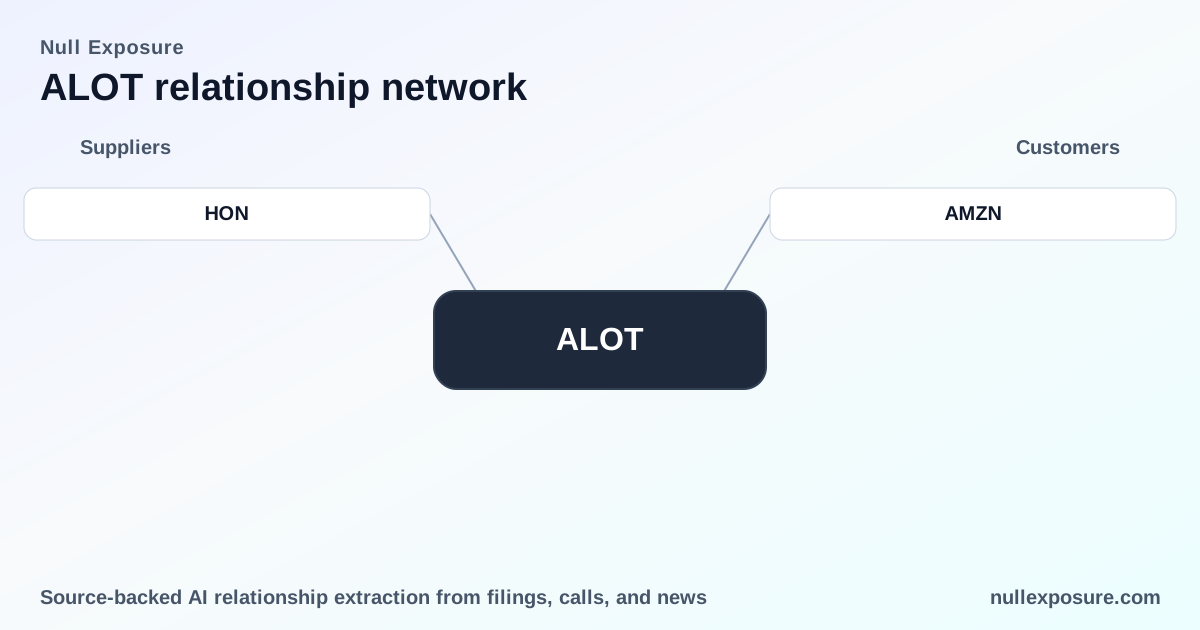
AstroNova disclosed a new order from Amazon Kuiper Systems for data acquisition systems to be used on a low-Earth-orbit satellite program. This is a clear example of the company expanding into high-growth, mission-critical aerospace applications beyond its traditional label- and aircraft-printing niches. The order demonstrates product relevance in avionics and space hardware markets, where reliability and certification pathways create attractive customer stickiness once systems are deployed.
According to the company’s 2026 Q1 earnings call (March 8, 2026), the Amazon Kuiper Systems order is a confirmed sale of data acquisition systems intended specifically for Kuiper’s LEO satellite program. The disclosure provides direct evidence of AstroNova winning program-level business with a large integrator that operates on multi-year platform timelines.
Disclosed customer relationships (documented mentions)
Amazon Kuiper Systems
AstroNova announced an order from Amazon Kuiper Systems for data acquisition systems to be installed on Kuiper’s low-Earth-orbit satellite program, marking a new customer win in a space program application. This was disclosed on the company’s 2026 Q1 earnings call on March 8, 2026.
AMZN
The same disclosure was logged again in our records under the ticker AMZN for Amazon Kuiper Systems, reflecting the identical March 8, 2026 earnings-call statement that AstroNova secured an order from Amazon Kuiper Systems for LEO satellite data acquisition systems.
Both items reference the same company-level earnings-call disclosure; investors should treat them as a single customer win documented twice in the results set.
Operating-model constraints and what they imply for risk and runway
AstroNova’s public disclosures and segment narrative create a coherent operating profile with several actionable implications for investors:
-
Contracting posture — Short-term orientation with modular extensions. The company explicitly states that service agreements are typically one to two years and that blanket order arrangements are “multi-period (but typically not multi-year).” That profile favors frequent renewal cycles and flexible customer commitments over multi-year, rigid contracts.
-
Revenue composition — Product plus recurring consumables and services. Financial breakdowns show substantial revenue from supplies in addition to hardware and services, which implies a business that monetizes hardware installs through ongoing consumable sales and support revenue. This mix stabilizes cash flow but leaves growth exposed to unit-sales cycles.
-
Customer concentration — Low single-customer risk. Company filings for fiscal 2025 confirm that no customer accounted for more than 10% of revenue in 2023–2025, a signal that customer concentration does not present a currently material counterparty risk.
-
Counterparty mix and criticality — A blend of small business, OEMs and government. Disclosures describe sales to brand owners, small print shops, OEMs, and government buyers; government procurement dynamics can produce material revenue volatility in the T&M segment, while aerospace and military applications increase product criticality and certification requirements.
-
Geographic footprint — Truly global with North America dominant. Fiscal disclosures show sales across North America, Europe, Asia, and Latin America, with North America representing the majority of reported revenue. Global distribution increases addressable market but raises complexity in logistics and support.
-
Maturity and stage — Active installed base and growing OEM/avionics penetration. The company reports furnishing printers and systems to aircraft OEMs and MROs (Airbus, Boeing, Gulfstream, Lockheed, Embraer), which indicates an active installed base that drives service and consumables revenue and supports cross-sell into adjacent programs like satellite avionics.
These constraints are presented as company-level characteristics drawn from filings and segment disclosures; they are not tied to any specific customer unless the disclosure explicitly names that customer.
For further context on how these characteristics affect modeling and exposure tracking, see the AstroNova company page at NullExposure: https://nullexposure.com/
How the Amazon Kuiper order fits into the strategic picture
- Strategic diversification: The Kuiper win extends AstroNova’s addressable market into satellite systems and spaceborne data acquisition, an adjacency to its avionics and mission-critical printing work.
- Commercial playbook remains unchanged: The transaction follows the same go-to-market model—sell hardware, then monetize supplies, licenses and service—so lifetime value economics should scale if the program expands.
- Financial magnitude: Given the company’s disclosure that no single customer exceeded 10% of revenue in recent years, the Kuiper order is strategically meaningful but not necessarily material at the company level unless followed by larger program awards.
Practical implications for investors and operators
- Operators: Prioritize supply-chain readiness and qualification timelines if you expect increased program business with aerospace integrators; mission programs demand documentation and rigorous support capabilities.
- Investors: Treat the Kuiper disclosure as a positive signal of product-market fit in high-value aerospace programs, but balance that with the company’s short-term contracting posture and historically low concentration—this implies upside is incremental unless the company secures multi-year program awards that change revenue visibility.
Key takeaways
- AstroNova monetizes through hardware sales, consumables, software licensing and short-term service contracts, delivering a diversified revenue base that reduces single-customer dependence.
- The April–March 2026 earnings call confirmed a new order from Amazon Kuiper Systems for LEO satellite data acquisition systems, adding a mission-critical customer vertical for the business.
- Company filings show global distribution, low customer concentration, and a mix of small-business, OEM and government buyers, which collectively shape both upside and variability in revenue.
- Operational focus should remain on certification, supportability and consumables penetration to convert program-level wins into durable recurring revenue.
For a structured view of the company’s counterparty relationships and how they influence credit and commercial exposure, visit NullExposure’s AstroNova profile: https://nullexposure.com/