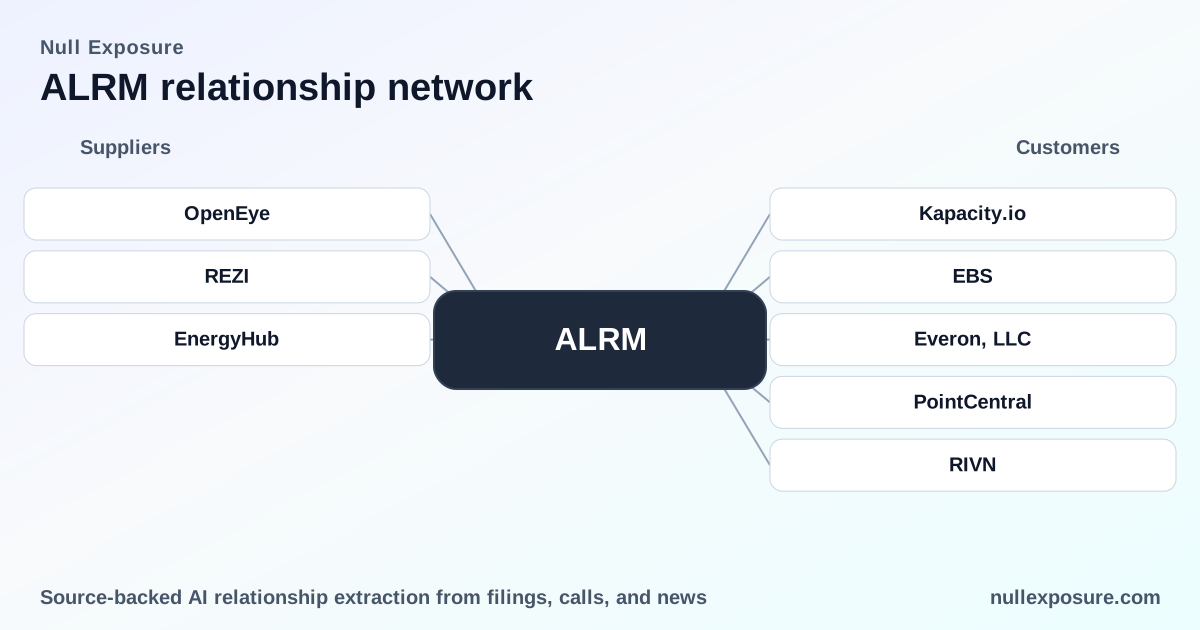
Alarm.com (ALRM) — customer relationships that drive recurring SaaS, licensing and energy services revenue
Alarm.com operates a cloud-first platform that connects security, access, video and energy services across residential, multi-family and commercial properties, and monetizes through recurring SaaS subscriptions, per-customer licensing and hardware sales to distributors and service providers. The company’s revenue mix combines subscription fees, usage-based license royalties and device sales routed through channel partners, with an energy-software arm (EnergyHub) that expands commercial relevance into utility programs. For a focused data-driven read on partner exposure, visit https://nullexposure.com/.
What investors need to know up front
Alarm.com’s go-to-market blends direct platform monetization with a channel-heavy distribution model. Revenue is concentrated in North America, collected through subscriptions, license fees and hardware sold to distributors and service providers, and the firm has selectively used acquisitions to accelerate international and demand-response capabilities. This structure creates durable recurring revenue but also concentration and channel dependency that investors must price into forecasts.
How ALRM contracts and customer mix shape risk and upside
Alarm.com’s operating model shows multiple revenue levers: recurring SaaS, per-customer licensing and usage-based royalties. The company explicitly recognizes usage-based royalties for licenses of intellectual property and also reports license revenue tied to the per-customer licensing of patents and technology. Contracts therefore combine fixed recurring payments with variable, volume-linked fees—an attractive mix for revenue resilience and upside during platform adoption.
Additional company-level signals from regulatory disclosures:
- North America dominant: Accounts receivable and the majority of revenue are derived from the United States and Canada, with international revenue representing low single-digits of total sales in recent years.
- Counterparty breadth: Customers range from individuals and small businesses through mid-market and large enterprise service providers, creating a broad TAM but also churn exposure at the small-business and residential level.
- Distributor channel: Hardware is sold to distributors and service-provider partners who resell devices, making go-to-market execution and channel terms strategically important.
- Concentration risk: The filings note that substantially all revenue for non-hosted software came from a single customer, identifying a critical customer dependency that could materially affect operating results if lost.
These signals point to an operating posture that is channel-dependent, North America-centric, and a hybrid licensing/subscription revenue model—factors that influence valuation multiples, customer-acquisition cost assumptions and churn sensitivity.
Portfolio of named customer and partner relationships
Below I cover each relationship called out in the results, with a plain-English summary and source reference.
Kapacity.io — an acquisition to accelerate EnergyHub internationalization
Alarm.com acquired certain assets of Finland-based Kapacity.io in 2024 to accelerate deployment of a cloud-based demand response platform internationally for its EnergyHub subsidiary. According to Alarm.com’s 2024 Form 10‑K, the Kapacity.io transaction was explicitly executed to speed international rollouts of EnergyHub capabilities (FY2024 10‑K).
EBS — hardware manufacturing and product integration via acquisition
Alarm.com acquired 100% of EBS Sp. ka in 2023, an international producer of universal smart communicator devices headquartered in Warsaw, Poland, strengthening its hardware supply and integration capabilities. The 2024 Form 10‑K records the EBS acquisition and positions it as part of Alarm.com’s hardware and device strategy (FY2024 10‑K).
Everon, LLC — commercial security integrator partnership for unified management
Alarm.com announced a strategic partnership with Everon to offer a unified console enabling integrated intrusion, access control, remote video monitoring and business management for Everon customers. A March 2026 press release reported the collaboration as a commercial go-to-market alliance to deepen Alarm.com’s penetration with enterprise integrators (StockTitan, Mar 9, 2026).
D.R. Horton (DHI) — platform integration in new-home smart offerings
D.R. Horton’s marketing materials indicate that its “D.R. Horton Smart Home” integrates Internet-connected devices under an automation platform hosted by Alarm.com, making Alarm.com the backend platform for certain new-home smart-home bundles. A Newswire release describing D.R. Horton’s product specifications referenced Alarm.com as the automation platform (Newswire, 2026).
PointCentral — multi-tenant video intercom and property management distribution
Alarm.com made the Video Intercom Mobile Directory available through Alarm.com and PointCentral service providers across North America and select international markets, extending its product set for multi-tenant building operators. The distribution and product availability were described in a March 2026 company release covered on Yahoo Finance and StockTitan (Yahoo Finance, Mar 2026; StockTitan, Mar 2026).
Rivian (RIVN) — EnergyHub partnership to expand EV program access
EnergyHub, a subsidiary of Alarm.com, partnered with Rivian to expand access to utility-managed EV programs for Rivian drivers across North America, positioning Alarm.com’s energy software in the EV and vehicle-grid integration space. This partnership was publicly reported in March 2026 as a strategic extension of EnergyHub’s utility program offerings (StockTitan, Mar 9, 2026).
How these relationships translate into strategic and financial implications
- Channel acceleration through M&A and partnerships: The EBS and Kapacity.io acquisitions reduced time-to-market for hardware and demand-response functionality respectively, while Everon and PointCentral partnerships embed Alarm.com deeper into integrator and property-management channels—a clear strategy to convert platform capability into recurring revenue.
- Monetization mixes widen TAM but increase operational complexity: Licensing and usage-based royalties alongside traditional SaaS create higher lifetime value potential, but also require careful billing controls and partner alignment. Investors should model a blended revenue curve with base subscriptions and variable license uplift from energy and large integrator programs.
- Concentration and geography are material risk factors: North America concentration and a noted single-customer dependency for non-hosted software create downside scenarios that can amplify revenue volatility; channel disruptions or distributor term shifts warrant close monitoring.
Investment takeaways and next steps
- Positive: Diverse monetization (SaaS + licensing + hardware), targeted acquisitions to accelerate product categories, and expanding energy partnerships (Rivian/EnergyHub) create multiple growth vectors that support premium valuation metrics relative to legacy security peers.
- Watchlist: Customer concentration on non-hosted software, the scale and terms of distributor agreements, and international expansion execution versus small reported international revenue. Model sensitivity to churn among small-business and residential subscribers is essential.
For a detailed partner exposure snapshot and to see how these relationships map to revenue and contract risk, visit https://nullexposure.com/.