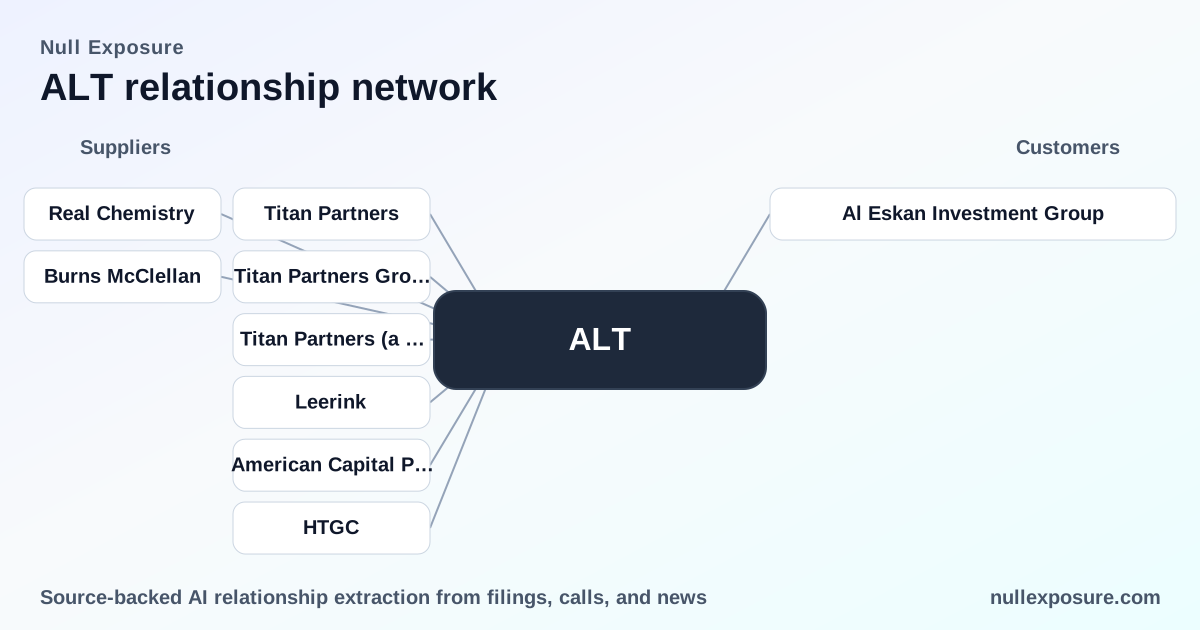
ALT — Capital partners and customer signals that drive the runway
Altimmune Inc (ALT) is a clinical-stage biopharmaceutical company that develops intranasal vaccines, immunomodulatory therapies and liver-disease treatments. The company currently monetizes primarily through capital markets and partner financing while commercial revenues remain negligible, with future monetization contingent on regulatory approvals, out‑licensing and product commercialization. For investors and operators evaluating ALT’s customer relationships, the most actionable signal in FY2026 is capital support from institutional backers that underwrite near-term clinical programs and extend the company’s cash runway. Learn more about how we surface partner signals at https://nullexposure.com/.
FY2026 financings: who put capital behind ALT’s programs
Altimmune executed a series of financings in early 2026 that reshaped its investor base and funded the MASH drug trial. The public records and press coverage identify five counterparties of interest—each summarized below with source context and the plain-English takeaway.
Deep Track Capital
Deep Track Capital led an oversubscribed public offering that closed in May 2026, anchoring a $225 million raise to support the company’s clinical program. A GlobeNewswire press release carried by The Globe and Mail noted Deep Track’s lead role in the transaction (May 2026).
RA Capital Management
RA Capital participated alongside other institutional investors in the $225 million financing, signaling continued engagement from life‑science–focused crossover investors. Investing.com covered the financing and listed RA Capital among participating firms (May 2026).
Viking Global Investors
Viking Global Investors was a participating investor in the same $225 million offering, indicating interest from large multi‑strategy hedge funds in funding ALT’s clinical pathway. Investing.com and a GlobeNewswire release reported Viking’s participation (May 2026).
TCGX
TCGX joined the syndicate for the $225 million raise, reflecting a mix of new and existing investors supporting ALT’s next-stage trials. Both Investing.com and GlobeNewswire referenced TCGX as a participant in the financing (May 2026).
Al Eskan Investment Group
Earlier in 2026 Altimmune completed a $75 million registered direct offering with Al Eskan Investment Group announced in January, a separate placement that contributed to near-term liquidity. An earnings call transcript and related press coverage documented the Al Eskan placement and the $75 million proceeds (Q4 2025 / March 2026).
Each of the above items is drawn from contemporaneous press coverage and filings disclosed in early 2026; the financing activity collectively underwrites ALT’s clinical commitments in FY2026 and materially changes the cap table composition.
What the counterparty mix tells investors about ALT’s operating model
These capital relationships are more than liquidity events; they provide insight into Altimmune’s contracting posture, concentration, criticality and maturity as a commercial entity.
- Contracting posture: Altimmune actively accesses public and registered‑direct equity channels to fund operations rather than relying on product revenue or recurring commercial contracts. Company filings documented an at‑the‑market (ATM) Equity Distribution Agreement established in 2023 and sales under that program through December 31, 2024 that generated roughly $96.6 million in net proceeds, demonstrating a repeatable financing posture oriented toward equity issuance.
- Concentration: The investor base for the FY2026 raises is a concentrated mix of specialist life‑science investors and large hedge funds (Deep Track, RA Capital, Viking, TCGX, Al Eskan). Concentration risk is material because a small group of institutional backers supplies the bulk of near‑term cash; institutional ownership is approximately 45% per public metrics, underscoring reliance on professional investors.
- Criticality: These capital partners are critical counterparties—their capital directly funds the MASH drug trial and other clinical activities. Without committed financing, ALT’s development timeline and regulatory milestones would decelerate. Filings also stress external dependencies such as third‑party payer reimbursement and market acceptance by physicians and patients, which are determinants of eventual commercial viability.
- Maturity: Altimmune remains pre‑commercial and development‑stage, with negligible revenue (RevenueTTM reported near $41k) and deeply negative operating margins. The business model currently reads as capital‑intensive R&D financed through markets and strategic placements until a regulatory inflection point or partnership monetization occurs.
The underwriting dynamic: what operators should watch
The FY2026 financings create a clearer runway but also concentrate execution risk around the company’s upcoming clinical readouts.
- Short-term runway improved. The May 2026 $225 million raise plus the January registered direct placement increase liquidity to fund near‑term trials and operating expenses. Press coverage in May 2026 framed the $225 million offering as oversubscribed and targeted at the MASH trial.
- Execution risk centered on clinical outcomes. With no meaningful commercial revenue, the value realization for these investors depends on positive clinical results and subsequent partnering or commercialization outcomes. Company filings emphasize dependence on government reimbursement frameworks and physician/patient adoption for eventual market success.
- Investor composition matters for exit pathways. A mix of life‑science investors and larger funds implies diversified strategic rationales—some investors seek clinical de‑risking and partner deals, others pursue valuation appreciation for public exits. That heterogeneity shapes governance expectations and potential follow‑on financing behavior.
Relationship-by-relationship takeaways for active diligence
- Deep Track Capital: Lead investor in the $225 million May 2026 public offering; their anchor position signals concentrated sponsor support for near‑term clinical spend. Reported in GlobeNewswire coverage via The Globe and Mail (May 2026).
- RA Capital Management: Participated in the $225 million offering alongside other specialist investors, demonstrating continued life‑science investor confidence in ALT’s development plan. Noted in Investing.com coverage (May 2026).
- Viking Global Investors: Participated in the same offering, bringing macro- and hedge‑fund capital into ALT’s cap table, which can influence liquidity dynamics and trading behavior. Documented by Investing.com and GlobeNewswire (May 2026).
- TCGX: Member of the investor syndicate for the $225 million raise; their participation rounds out a group of institutional backers providing the financing necessary for the MASH trial. Cited by Investing.com and GlobeNewswire (May 2026).
- Al Eskan Investment Group: Purchased $75 million in a registered direct offering announced in January 2026, representing an earlier tranche of committed capital for the company’s programs. Mentioned on the Q4 2025 earnings call transcript and related press coverage (reported March 2026).
Investment implications and final read
Altimmune’s FY2026 investor relationships transform the company’s balance of risk toward clinical execution rather than immediate liquidity. The financing package reduces short‑term default risk but raises the stakes on upcoming data readouts and regulatory milestones. For investors and operators, the critical questions are whether the company can convert capital into de‑risked clinical results and whether the current investor mix supports opportunistic strategic partnerships or will demand dilution through further equity issuance.
For more signal-driven diligence on counterparties and capital flows, visit https://nullexposure.com/ to see our approach to partner‑centric intelligence.
Bold takeaways:
- Capital-driven model today; commercial revenues are a future outcome.
- Investor concentration is material and underwrites near-term programs.
- Clinical milestones will determine whether these financing relationships translate into commercial value.