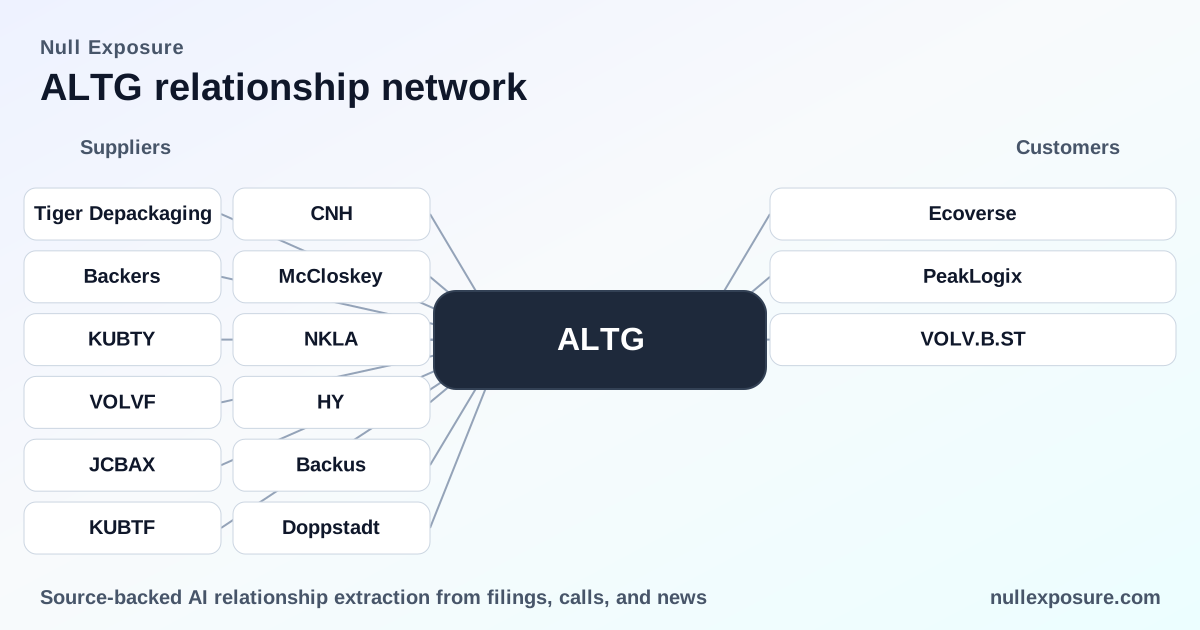
Alta Equipment Group (ALTG): Customer Relationships and Commercial Footprint
Alta Equipment Group operates a North American integrated equipment distribution platform that sells, rents, services and subleases heavy construction, material handling and environmental processing equipment. The company monetizes through three core channels: new equipment sales (distribution margins), short-term and long-term rentals (daily/weekly/monthly and operating leases), and recurring service/parts/maintenance contracts — with sublease income and guaranteed maintenance revenues contributing recurring cash flow. For a concise view of how we source and synthesize these customer signals, visit https://nullexposure.com/.
What investors need to know about Alta's operating posture
Alta combines transactional hardware sales with recurring service economics, producing a hybrid model that reduces volatility relative to pure retail equipment vendors while preserving cyclicality from construction end-markets. Key operating characteristics from company disclosures:
- Contracting posture: a dual model of short-term rentals and multi-year contracts. Alta records daily/weekly/monthly rental revenue while also recognizing guaranteed maintenance contract revenues over three-to-five-year terms and holds operating leases that extend through 2029.
- Customer mix: broad and geographically concentrated in North America. Customers span small businesses to very large enterprises—including municipal and government end-users—across U.S. states and Canadian provinces in Alta’s network.
- Materiality and concentration: low single-customer concentration. Management reports no single customer accounted for more than 1% of revenue in 2024, supporting a diversified revenue base.
- Revenue drivers: hardware sales, distribution channels, and service economics. Master Distribution, Material Handling, and Service segments provide complementary cash flow sources; services (parts, maintenance, subleases) underpin margin stability.
- Maturity and criticality: customer relationships are mature and service-critical. Business depends on uptime and technician capabilities, supporting longer-duration customer retention and predictable service revenue.
- Spend profile: lease and rental receivables consistent with mid-to-high single-digit millions. Management disclosures point to multi-year minimum rentals receivable and sublease income in the $1–10M and $10–100M bands.
These signals derive from Alta’s public filings and management commentary across FY2024–FY2026 disclosures and earnings calls.
Publicly cited customer relationships — what each mention means for investors
Ecoverse
Management listed Ecoverse as one of Alta’s scalable growth platforms during the Q4 2025 earnings call, indicating strategic investment in environmental processing and waste-management channels that feed the Master Distribution segment. (ALTG Q4 2025 earnings call transcript, March 2026)
PeakLogix
Alta described PeakLogix as a scalable growth platform and highlighted leadership upgrades strengthening execution across material handling and targeted construction geographies, signaling management is prioritizing operational discipline in growth plays. (ALTG Q4 2025 earnings call transcript, March 2026)
Ryangolf Corporation
A Volvo customer success story cites Ryangolf Corporation (an Alta Florida customer) running Volvo Construction Equipment in day-to-day operations, illustrating OEM-aligned end-user adoption in niche verticals like golf-course development. (Volvo Construction Equipment customer story, published May 2026)
Volvo (VOLV.B.ST) — Alta earnings call
Alta’s Michigan team sold the first two Volvo EC950F high-reach machines globally, which management used to demonstrate Alta’s differentiated value proposition with Volvo as a supplier partner. This highlights deep OEM relationships that enable exclusivity and large-ticket sales. (ALTG Q4 2025 earnings call transcript, March 2026)
VOLV.B.ST (duplicate entry)
The same Volvo example appears as a separate mention in the earnings-call coverage with identical substance: first two Volvo EC950F high-reach machines sold by the Michigan team and cited as evidence of Alta’s supplier collaboration. The duplication in sources reinforces the messaging emphasis on Volvo partnerships. (ALTG Q4 2025 earnings call transcript, March 2026)
ALTG-P-A (news coverage citing the earnings call)
A news aggregation piece referencing Alta’s Q4 2025 remarks repeated the Volvo EC950F sale example under the ticker-like heading ALTG-P-A, underscoring how the Volvo transaction was picked up by market commentators and secondary outlets. (InsiderMonkey coverage of Alta Q4 2025 earnings transcript, March 2026)
RYDER
Management called out Ryder in the context of defending share in Ryder-supplied forklifts — Alta is focused on protecting and regaining share in traditional material-handling channels where Ryder’s footprint creates competitive pressure. This signals active dealer/distribution competition in core lift-truck markets. (Alta Q4 2025 earnings transcript reprinted, The Globe and Mail, May 2026)
How these relationships map to risk and upside
- Upside: platform-led scalability and OEM leverage. PeakLogix and Ecoverse are presented as growth platforms that expand Alta’s TAM in environmental processing and specialized handling equipment; the Volvo EC950F sale demonstrates the ability to capture high-ticket, differentiated transactions with OEM partners.
- Risk: competitive share pressure in staple categories. Commentary on Ryder forklifts signals continued competition in Alta’s bread-and-butter material handling business, which can depress margins and utilization if not managed.
- Revenue stability: recurring service and lease income. Long-term maintenance contracts and multiyear lease agreements provide durability to cash flow, while daily/weekly rental inventory preserves upside during cyclical recovery.
- Concentration risk: low by customer but elevated by OEM dependency. No single end-customer drives revenue (>1% threshold), but Alta’s economics depend on supplier relationships and regional market share.
Investment checklist — what to watch next
- Monitor rental utilization and average rental rates for signal on near-term revenue momentum and pricing power.
- Track service revenues and sublease income, which indicate the health of recurring cash flow and technician capacity.
- Watch OEM partnership announcements and exclusive product sales (e.g., further Volvo transactions) as a proxy for Alta’s distribution clout.
- Observe market-share commentary vs. Ryder and other competitors to gauge success in defending material-handling core markets.
For institutional users who want assembled customer relationship signals and contemporaneous source links, visit https://nullexposure.com/ for our coverage and sourcing.
Bold takeaways: Alta is a diversified equipment distributor with a mixed short-term rental/long-term contract model, low customer concentration, and OEM-dependent opportunities and competitive pressures that define the company’s near-term margin trajectory and long-term platform value.