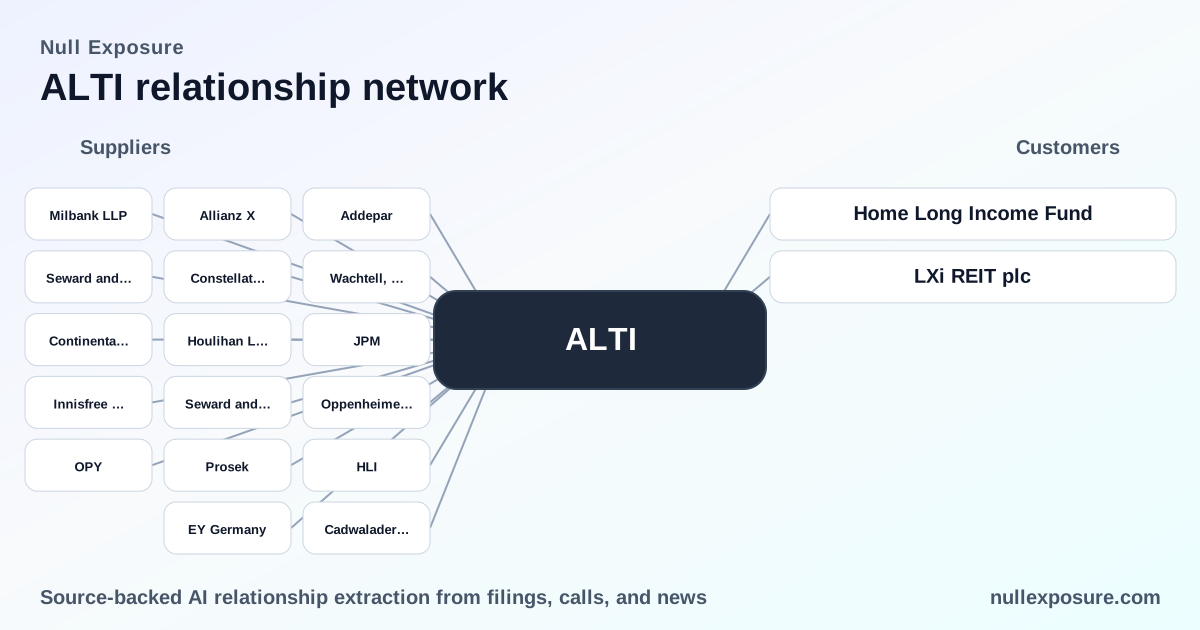
ALTI customer relationships: what investors need to know
Alvarium Tiedemann Holdings (ALTI) operates as a global wealth and asset manager that earns recurring management and advisory fees across private and public strategies, trusts, and family office services. The business monetizes through subscription-style fees (typically annual or quarterly) and fee‑based services tied to assets under management and advisory mandates; ALTI reported managing or advising approximately $75.7 billion as of December 31, 2024 and derives the vast majority of revenue from stable management/advisory fees. For investors and operators evaluating counterparties, the company’s contracting posture, geographic mix, and client composition drive both resilience and concentrated risk. Learn more at https://nullexposure.com/.
The core business model — simple to describe, nuanced to underwrite
ALTI is fundamentally a service provider: discretionary investment management, non‑discretionary advisory, trust and family office services, and administration. Management and advisory fees are the dominant cash engine—the company discloses that for the year ended December 31, 2024, 96% of revenue is generated from stable management or advisory fees. That structural reliance on recurring fees produces predictable cash flow but also concentrates commercial risk in client retention and AUM performance.
Two operating characteristics matter for counterparty assessment:
- Contracting posture: Advisory and management agreements contain termination provisions that give investors or independent fund directors significant latitude to terminate or remove the advisor with limited notice or penalty. This creates a short‑term contractual exposure in some mandates even though fees are recurring.
- Revenue predictability: Fees are subscription‑like (annual or quarterly) and historically more predictable than transaction or placement fees, which supports cash flow stability and valuation multiples that prioritize recurring revenue.
ALTI operates globally — approximately 430 professionals across 19 cities in 8 countries — with distribution concentrated in the United States, the United Kingdom, and Rest of World buckets. The company’s revenue by geography for December 31, 2024 lists United States $134,893; United Kingdom $33,163; Rest of World $38,879; Total $206,935 (figures as reported in the FY2024 filing).
What’s on the record: the customer relationships the company discloses
ALTI’s FY2024 10‑K discloses relationships and transactions that provide direct insight into how the firm interacts with third‑party funds and advisors. The filing highlights the following named entities.
Home Long Income Fund (HLIF)
ALTI’s FY2024 10‑K references Home Long Income Fund as an English open‑ended investment company launched in October 2018 whose objective is to deliver inflation‑protected income and capital growth by investing in a portfolio of UK homeless shelters; HLIF is advised by SHIA and AFM UK serves as its alternative investment fund manager. This mention situates ALTI within a network of specialist UK‑focused vehicles referenced in its advisory and investments discussion (FY2024 10‑K).
LXi REIT plc / LXi REIT Advisors Limited (LRA)
The 10‑K records that on January 9, 2024, AlTi RE Public Markets Limited entered into heads of terms to sell 100% of the equity of LXi REIT Advisors Limited (LRA), the advisor to the publicly traded fund LXi REIT plc. The transaction reflects ALTI’s corporate actions in the public markets advisory space and a strategic change in the ownership of an advisor to a listed REIT (FY2024 10‑K).
Constraints and company‑level signals that shape customer exposure
ALTI’s public disclosure provides constraint signals that are actionable when evaluating counterparties or underwriting revenue durability. Presenting these as company‑level signals:
- Contract type: short‑term termination risk. Advisory contracts allow termination or removal by investors or independent directors with limited notice, creating potential AUM and revenue volatility despite recurring fee mechanics (FY2024 10‑K).
- Contract type: subscription revenue profile. Management, advisory, trustee, and administration fees are recurring and predictable (annual or quarterly), supporting revenue visibility and valuation stability (FY2024 10‑K).
- Materiality: revenue highly concentrated in advisory fees. The company reports that 96% of revenue is generated from stable management/advisory fees, making advisory relationships critical to overall cash generation (FY2024 10‑K).
- Counterparty mix: diversified client types. Clients include ultra‑high‑net‑worth individuals, families, single‑family offices, foundations, endowments, institutional alternatives clients, and certain public pensions—implying heterogeneous counterparty credit and concentration profiles (FY2024 10‑K).
- Geography: global footprint with U.S. leadership. The U.S. is the largest revenue market, followed by the UK and Rest of World; ALTI maintains operations in the United Kingdom and Hong Kong and operates across three continents (FY2024 10‑K).
- Relationship stage and maturity: large AUM and high retention. ALTI manages/advises approximately $75.7 billion and cites a client retention rate of 96% since 2020, indicating mature, long‑tenured relationships that offset some contract termination risk (FY2024 10‑K).
- Relationship role: service provider across wealth & alternatives. The company operates as an advisor and manager across Wealth & Capital Solutions and Alternatives Platform, recognizing fees when services transfer and reflecting customary performance and management fee accounting (FY2024 10‑K).
Key takeaway: ALTI’s revenue model blends predictable subscription fees with short‑notice termination clauses; the result is high apparent stability but tangible downside if AUM or client confidence deteriorates.
Investment implications — what to watch and how to underwrite exposure
For investors and operational counterparties, ALTI’s disclosures point to a clear set of risks and mitigants:
- Watch AUM trajectories and client flows. Given the 96% concentration in advisory/management fees, AUM stability is the primary driver of revenue and valuation.
- Monitor contract renewals and governance events. Termination clauses permit removal with limited notice; activist or governance moves at sponsored funds (or independent director votes) can strip revenue quickly.
- Evaluate geographic and client diversification. ALTI’s global footprint and mixed client base provide revenue buffers, but U.S. concentration is significant by dollars.
- Consider profitability and balance‑sheet metrics. ALTI reported negative EBITDA and negative EPS in the most recent reported period, which underscores the importance of cash‑generating fee streams even as operating leverage compresses margins.
- Scrutinize transactions affecting advisor ownership. The LXi REIT Advisors Limited heads‑of‑terms sale is an example of corporate actions that change future fee flows tied to a publicly traded fund.
If you are modeling counterparty exposures or assessing ALTI as a service provider, prioritize scenario testing around AUM shocks, accelerated client terminations, and governance events at sponsored vehicles.
Final read — where ALTI sits in a portfolio
ALTI is a fee‑driven, asset‑management business with predictable recurring revenue that is tempered by contractual termination rights held by clients or fund boards. The firm’s global footprint and high retention are strong positives; the concentration of revenue in advisory fees and recent profitability metrics require active monitoring. For practical next steps, review the FY2024 10‑K disclosures on revenue by geography, contract terms, and AUM dynamics, and track any announced asset or advisor divestitures such as the LRA transaction. Further analysis and up‑to‑date relationship mapping are available at https://nullexposure.com/.
Bold points to remember: recurring fees drive value; termination clauses create exposure; AUM and client retention define downside.