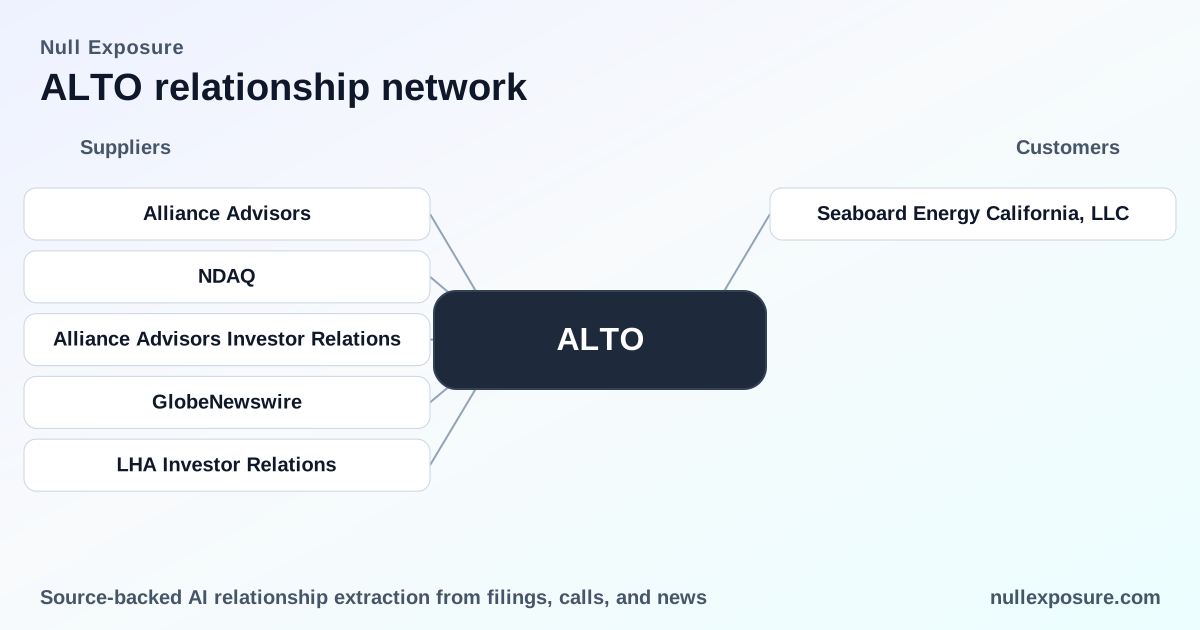
Alto Ingredients: customer relationships, contracts, and what investors should know
Alto Ingredients operates as a vertically integrated producer and marketer of specialty alcohols and essential ingredients, monetizing through the sale of fuel‑grade ethanol, beverage‑grade CO2, specialty alcohols and distribution services across North America and abroad. Revenue derives from production and third‑party distribution (Kinergy and Eagle Alcohol), a mix of indexed and fixed‑price sales contracts, and contractually committed offtake arrangements that underpin near‑term cash flow; the company reported approximately $918 million in revenue TTM with a thin operating margin (around 3.6%). For investors, the key read is not just volume but the contract structure and customer mix that determine margin resiliency and working‑capital swings. Explore more on the firm homepage.
How Alto gets paid: the operating and contracting posture
Alto’s business blends production economics with distribution and logistics services. The company sells alcohols produced at its five facilities and also markets and distributes third‑party product through subsidiaries such as Kinergy and Eagle Alcohol. Monetization is therefore twofold: manufacturing margin from owned plants and distribution margin from reselling and logistical services.
Company disclosures signal a mixed contracting posture:
- Long‑term offtake agreements exist with industrial gas suppliers and other counterparties, supporting predictable volumes and cash flows for specific facilities.
- Short‑term contracts and indexed‑price arrangements supplement long‑term coverage, exposing results to near‑term commodity price moves and basis risk.
- Contracts are both fixed‑price and indexed, with a material portion scheduled over the next 12 months under current open contracts (per the Dec 31, 2024 filing).
These characteristics create an operating model where production utilization, logistics reliability, and contract timing drive quarterly results more than short‑term market sentiment.
Customers, channels, and concentration: distribution plus large enterprise exposure
Alto’s customers include integrated oil companies, gasoline marketers (for fuel‑grade ethanol), beverage producers (for CO2), and industrial buyers for specialty alcohols. Evidence in company filings notes a North American concentration for renewable fuel customers while also maintaining international relationships for specialty products. The firm’s role alternates between principal seller and reseller: Kinergy purchases third‑party ethanol for resale, while the company also sells products produced at its own plants.
Key business model signals for investors:
- Counterparty mix skews toward large enterprises (integrated oil companies and gasoline marketers), increasing revenue visibility but also concentration risk.
- Distribution activity (Eagle Alcohol) provides an additional margin stream but requires operational scale and inventory management.
- Maturity of relationships is high—Alto reports long‑standing domestic and international customer ties—supporting repeat business and negotiated contract terms.
If investors prioritize cash‑flow stability, the presence of long‑term offtakes and large enterprise counterparties is a positive; if margin expansion is the objective, commodity price pass‑through and utilization will be determinative.
Contracts and quantifiable coverage (what the filing shows)
According to the company’s disclosures as of December 31, 2024, Alto had material open contracts for the next twelve months: indexed‑price alcohol contracts covering 74,375,000 gallons and fixed‑price alcohol sales contracts totaling $166.8 million, plus fixed‑price essential ingredient sales of roughly $5.95 million and indexed essential ingredient contracts for 47,000 tons. These figures highlight significant near‑term contracted volumes that support revenue visibility but also reflect exposure to indexed pricing and commodity swings.
Customer relationship: the Seaboard Energy California transaction
Seaboard Energy California, LLC — Madera ethanol plant transaction (FY2021): Alto sold its Madera ethanol plant to Seaboard Energy California; Seaboard paid $19.5 million in cash and assumed $8.8 million in Alto liabilities in that transaction, reflecting an asset carve‑out and balance‑sheet de‑risking for Alto at the time. This transaction was reported in a GV Wire article published May 17, 2021. (GV Wire, May 17, 2021)
What constraints tell investors about risk and runway
Company‑level signals drawn from disclosures shape how investors should think about revenue durability and operational risk:
- Contracting posture is mixed: long‑term offtakes anchor specific assets while short‑term contracts and indexed pricing introduce near‑term volatility.
- Customer concentration is meaningful but mitigated by product diversity: fuel customers are concentrated regionally (Western and Midwestern U.S.), but specialty alcohols and international buyers provide diversification.
- Relationships are generally mature and active, which supports renewals and negotiating leverage but also creates exposure if major counterparties consolidate or change purchasing strategy.
- Reseller and distribution activities add margin complexity: acting as a principal (reseller) requires working capital and inventory management; distribution is a margin enhancer but operationally intensive.
These constraints are not theoretical—Alto’s reported operating margin (~3.6%) and low profit margin (~1.45%) indicate limited buffer for adverse commodity moves or operational disruptions, making contract structure particularly important.
Investment implications: what moves the tape
For analysts and operators evaluating ALTO customer relationships, the decisive variables are:
- Contract tenor and price formulation: the split between fixed and indexed contracts determines sensitivity to ethanol and feedstock price swings.
- Utilization and logistics: distribution businesses and multiple plants require consistent flows and timely delivery; disruptions compress margins quickly.
- Customer mix and concentration: large enterprise counterparties reduce credit risk but increase dependence on a few buyers; product diversification (CO2, specialty alcohols) moderates that risk.
- Balance sheet flexibility: past asset sales (e.g., the Madera plant) demonstrate an operational playbook for de‑risking or redeploying capital.
If you want to review Alto’s customer posture in more depth and trace the underlying document evidence, visit the company page for curated signals and relationship excerpts. Visit the home page.
Bottom line
Alto is a production‑plus‑distribution business where contract structure is the primary determinant of cash‑flow stability. Long‑term offtakes and large enterprise customers provide a baseline of revenue visibility, while indexed contracts and distribution activities introduce volatility and working‑capital demands. The Seaboard transaction is a concrete example of asset reallocation used to manage balance‑sheet exposure. For investors, diligence should focus on the evolving mix of fixed vs. indexed contracts, counterparty concentration, and operational execution across Kinergy/Eagle Alcohol channels.