ALUR Customer Landscape: Distribution Partnerships, Revenue Mix, and Operational Constraints
Allurion (ALUR) monetizes primarily by selling the Allurion Balloon system (hardware) and connected patient devices to health‑care providers and third‑party distributors, while generating recurring revenue through paid upgrades to its Allurion Virtual Care Suite (VCS) software and clinic services. The firm's commercial model is a hardware‑led distribution engine augmented by tiered software services, with global reach and an emphasis on distributor channels to scale adoption. For investors, the key questions are how durable device sales are, how reliably distributors convert demand into placements, and how the VCS subscriptions migrate into meaningful recurring revenue. For a broader view of vendor and channel exposures, visit https://nullexposure.com/.
Quick thesis for investors
Allurion’s value rests on three linked drivers: proprietary, procedureless gastric balloon hardware that creates an on‑ramp for care, a software/monitoring upgrade path (VCS) that can introduce recurring revenue, and a predominantly distributor‑driven go‑to‑market that trades control for geographic coverage. The company has global distribution but still records material concentration by country and depends on short‑term, spot sales to health‑care customers. Recent strategic distribution moves target market expansion in Latin America.
The Brazil move investors should note
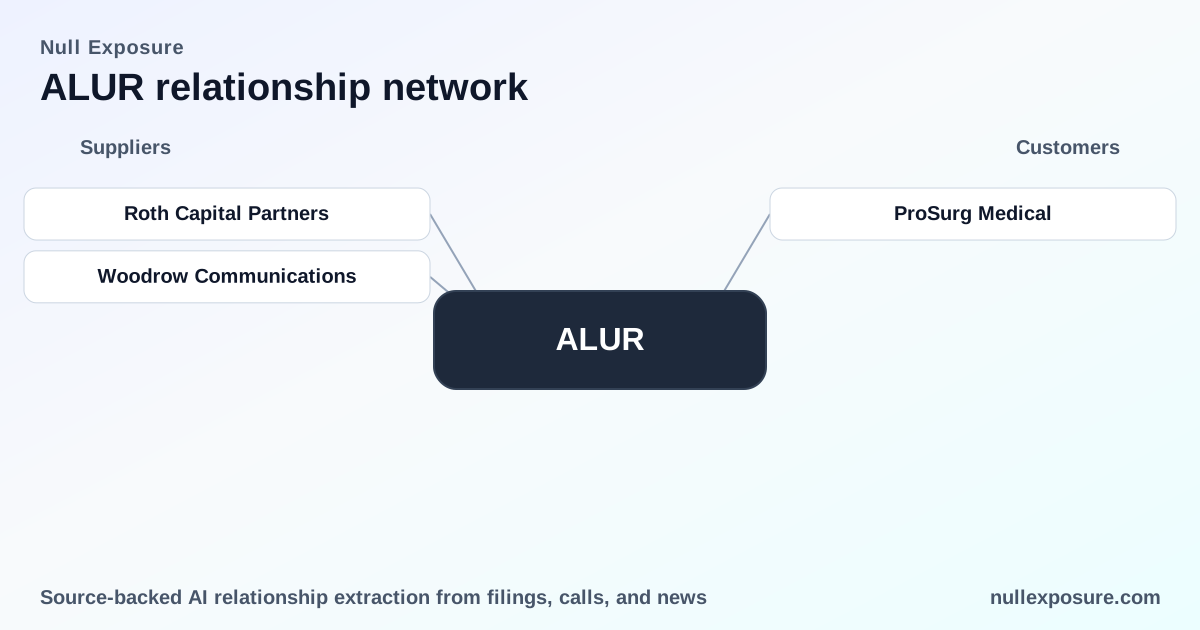
Allurion announced a strategic distribution partnership with ProSurg Medical to distribute its obesity‑care portfolio in Brazil. According to a press release published on StockTitan on March 9, 2026, ProSurg Medical — a leading Brazilian medical device company focused on bariatric and obesity care — will act as a distribution partner for Allurion’s products in that market. This partnership is a clear commercial step to scale placements in Latin America via local distribution expertise (StockTitan, March 9, 2026).
Complete list of relationships found in this review
- ProSurg Medical — Allurion announced a strategic distribution partnership to cover Brazil; the deal was disclosed in a March 9, 2026 news release on StockTitan and positions ProSurg as Allurion’s distribution channel in that market (StockTitan, March 9, 2026).
How Allurion contracts and sells — constraints that shape revenue durability
Company disclosures and filings provide a consistent operating picture that informs revenue risk, customer concentration, and collection dynamics:
- Mixed contract posture: spot sales plus subscription options. Allurion recognizes a large portion of revenue on shipment under FOB/Ex‑Works terms (control transfers on shipment), consistent with spot, product‑sale economics, while also offering subscription SaaS access to its VCS and tiered paid upgrades for providers. Company filings (FY2024–FY2025 disclosures) document both recognition on shipment and the expansion of VCS in a SaaS model (company filings, FY2024–FY2025).
- Short‑term receivables and trade credit. Trade credit is typically short term and receivables do not bear interest, which establishes a working‑capital profile where cash conversion depends on rapid invoicing and collection (company disclosures on receivables policy).
- Customer base includes individual patients via clinical channels. Over 150,000 patients have been treated commercially with the Allurion Balloon in more than 50 countries, which underscores end‑user adoption but also highlights that revenue is realized upstream from providers and distributors rather than from individual patients directly (company filings).
- Global footprint with regional concentration signals. The business operates subsidiaries across North America, Europe, the Middle East, Africa, Asia‑Pacific, and Latin America; filings show revenues from dozens of countries with several countries each contributing 4–8% of total revenues, indicating geographic diversification with meaningful country‑level concentrations (FY2024 revenue disclosures).
- Distributor dependence is material. The company reports that it receives the majority of revenue from sales to health‑care providers and third‑party distributors, and that a substantial proportion of sales flow through independent distributors — a structural tradeoff that expands reach but reduces direct control over sales execution (company disclosures).
- Manufacturing and IP posture. The Allurion Balloon is manufactured and assembled in‑house at the Natick, Massachusetts facility, which preserves quality control and manufacturing know‑how and reduces reliance on external contract manufacturers (company filing excerpt on manufacturing).
- Product segmentation: hardware first, services and software next. Most revenue to date has been generated from the Allurion Balloon hardware; the VCS (software) is offered in tiers with the base tier included with balloon purchases and paid upgrades available for clinics — a clear path to convert one‑time device buyers into recurring software customers (product disclosures).
Capital and spend context that shapes execution risk
Allurion has completed several small private placements and financing actions in the mid‑single to low‑double million dollar range during 2024–2025, including transactions with funds affiliated with RTW and Leavitt Equity Partners, which collectively illustrate ongoing reliance on equity and structured financings to support growth and working capital (company filings, Jan–Feb 2025). The company‑level signal here is serial small financings rather than large strategic cash injections, consistent with a growth company managing cash tightly.
What this means for investors — risks and upside vectors
- Upside: The hardware‑first model creates a physical barrier to entry and an installed base that can be monetized through VCS upgrades and clinic services; strategic distributor deals like ProSurg accelerate market access in important emerging markets such as Brazil. Global distribution plus in‑house manufacturing supports quality control and international scaling.
- Risks: Heavy reliance on third‑party distributors introduces execution and collection risk; the point‑of‑sale recognition (shipment) exposes revenue figures to variable placement and reorder cycles; country‑level concentrations create sensitivity to local reimbursement, regulatory changes, and competitive dynamics. The short‑term nature of receivables and limited long‑term contracts reduce revenue visibility quarter‑to‑quarter.
- Operational signals to monitor: growth in VCS upgrade uptake (recurring revenue conversion), distributor performance in newly opened markets (Brazil via ProSurg), per‑country revenue shifts, and any move to longer‑term subscription contracts with clinics.
Bottom line for portfolio considerations
Allurion’s commercial engine is hardware sales amplified by distributor partnerships and an emerging software subscription pathway. The ProSurg relationship is a targeted distribution expansion into Brazil that supports revenue growth in Latin America, but the broader model remains dependent on spot device sales and distributor execution. Investors should prioritize metrics that show recurring revenue traction and consistent distributor conversion before assigning a premium multiple.
For ongoing monitoring of channel‑level exposures and partner performance, explore additional company relationship intelligence at https://nullexposure.com/.