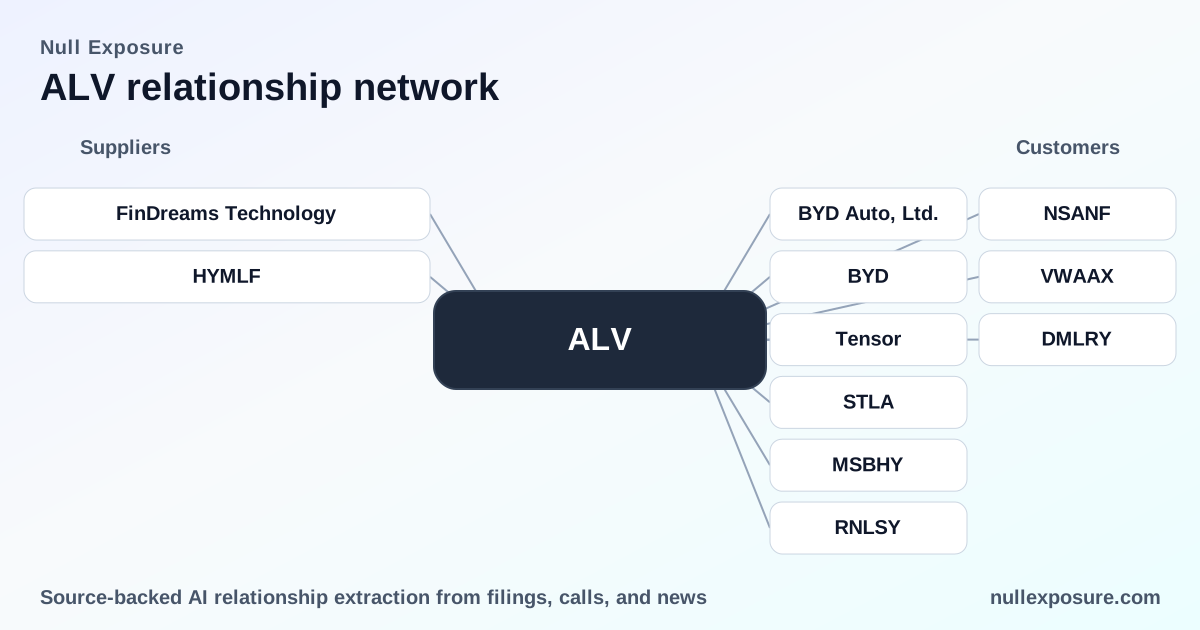
Autoliv’s OEM Footprint: durable revenue from safety hardware sold into a concentrated, global OEM base
Autoliv designs, manufactures and sells passive automotive safety systems — principally airbags, inflators, steering wheels and seatbelts — to the world’s vehicle manufacturers and monetizes through long lead-time supply contracts and parts sales to OEMs and their subsidiaries. The company’s revenue mix is driven by a relatively small set of very large customers, multi-year framework contracts that lock in program production, and recurring reimbursements for engineering and tooling, creating predictable, manufacturing-backed cash flows attractive to investors focused on durable industrial exposure. For a concise toolkit of Autoliv customer analytics, visit https://nullexposure.com/.
What investors need to understand about how Autoliv sells
Autoliv operates as a manufacturing seller to large OEMs under a contracting posture dominated by framework and long‑term agreements. Its 10‑K describes frame contracts negotiated up to three years before production and covering product lifecycles, while the company also capitalizes certain long‑term engineering spend where contractual reimbursement exists. Top‑client concentration is material (five largest customers ≈ 44% of sales; ten largest ≈ 71% in 2024) and the business is global, with balanced regional sales across Europe, the Americas and Asia (including China). Autoliv records meaningful customer reimbursements — $213 million in 2024 — and contract asset balances around $20 million, signaling capital intensity and program financing from OEMs. All of these dynamics create durable revenue but concentrated counterparty risk.
Catalog: every customer/partner mention in the source set
Below I list each relationship referenced in the available results with a one‑to‑two sentence plain‑English summary and the source context.
- BYD Auto, Ltd. — Autoliv supplies components, particularly inflators, through a BYD subsidiary (FinDreams Technology), reflecting direct component supply into BYD’s vertically integrated production chain. This is documented in Autoliv’s 2024 Form 10‑K (FY2024).
- BYD — Autoliv’s filings recognize BYD as a fast‑growing Chinese OEM and an important customer the company is working with. See Autoliv’s 2024 Form 10‑K (FY2024) and FY2026 earnings commentary.
- Yamaha Motor Co. — Autoliv co‑developed an integrated airbag for Yamaha’s Tricity 300 scooter, showing product diversification into two‑wheeler safety; reported in news coverage of Autoliv partnerships (FY2026).
- ALTI (AlTi Global) — Mentioned in press about a joint venture with Allianz Global Investors; the connection in the source set is through Allianz investment activity rather than a direct Autoliv commercial relationship (news coverage, FY2025).
- TZOO (Travelzoo) — Appears in news excerpts via a partnership with Allianz (first Travel Enthusiast Hotline); this mention is peripheral to Autoliv and reflects investor news collection (news coverage, FY2026).
- ACGL (Arch Capital Group Ltd.) — Referenced in news items about Arch’s acquisition of Allianz’s US MidCorp and Entertainment insurance businesses (FY2026 reporting).
- VOYA‑P‑B (Voya Financial preferred) — Cited in reporting on Allianz selling parts of its asset management business to Voya after regulatory actions (FY2022 background reported in FY2026 news items).
- ADNT (Adtant?) — A joint development agreement with Autoliv is referenced in an earnings call excerpt, indicating collaborative technology or supplier arrangements conveyed via ADNT’s Q4 2025 earnings call transcript.
- OAK‑P‑A (Oaktree / Brookfield) — News reports reference Oaktree’s investment in insurance risks underwritten by Allianz; this is part of the news corpus aggregated alongside Autoliv mentions (FY2025).
- ACGLN (Arch Capital North America deal reference) — Press coverage notes regulatory approval and expected close of the Arch transaction with Allianz’s US businesses (FY2024 reporting).
- OAK‑P‑B — Further reporting describes Oaktree receiving a share of Allianz reinsurance programs and funding syndicates (FY2025).
- Tensor — Autoliv announced an alliance with Tensor to supply a foldable steering wheel with integrated airbag for Tensor’s Robocar, targeted for volume production in late 2026; reported in Autoliv coverage and earnings transcripts (FY2026).
- Stellantis — Autoliv’s 10‑K lists Stellantis as one of its larger customers (~10% in 2023), underscoring exposure to major European OEM platforms (Autoliv 2024 Form 10‑K, FY2024).
- STLA (ticker for Stellantis) — The filing references Stellantis by ticker and counts it among large OEM customers (Autoliv 2024 Form 10‑K, FY2024).
- Hyundai — Identified in Autoliv’s earnings commentary as one of Autoliv’s largest customers in India, indicating strong local market penetration (Q1 2026 earnings transcript).
- Mitsubishi — Included in the 2023 customer mix statistics reported in Autoliv’s 10‑K (Autoliv 2024 Form 10‑K, FY2024).
- SIC — Autoliv’s Q1 2026 earnings call specifically names SIC as an exception that uses a captive solution, i.e., an OEM sourcing its own safety systems, which affects Autoliv’s addressable content for those platforms (Q1 2026 earnings transcript).
- RNLSY (Renault / Nissan grouping) — Autoliv’s 10‑K reports Renault (including Nissan and Mitsubishi) accounted for ~10% in 2023 and the filing references performance across these customers (Autoliv 2024 Form 10‑K, FY2024).
- Renault — Listed explicitly in the 10‑K as a top customer and a contributor to Autoliv’s material customer concentration (Autoliv 2024 Form 10‑K, FY2024).
- Nissan — Called out in both the 10‑K and earnings transcripts as a meaningful program driver (Autoliv 2024 Form 10‑K and Q1 2026 earnings transcript).
- Yamaha (duplicate mention) — Earnings commentary references the Yamaha Tricity 300 project as a visible recent win (Q1 2026 earnings transcript).
- Mahindra — Named among Autoliv’s largest customers in India during earnings remarks, underscoring local OEM relationships (Q1 2026 earnings transcript).
- VWAAX / VW — Autoliv’s historical client mix cites Volkswagen as material (about 10% in 2022), recorded in the 10‑K historical customer breakdown (Autoliv 2024 Form 10‑K, FY2024).
- Mercedes / DMLRY — Earnings transcripts identify Mercedes models (GLB and CLA) as significant sales potential, highlighting program‑level revenue concentration (Q4 2025 earnings transcript).
Constraints and what they signal about the operating model
- Contracting posture: framework + long‑term — Autoliv uses frame contracts negotiated well before production and long‑term development agreements for new OEM platforms; this creates secure production windows but also ties capital and capacity to specific programs (Autoliv 2024 10‑K).
- Counterparty profile: very large OEMs — Customers are predominantly the world’s largest car manufacturers; the top five represented ~44% of consolidated sales in 2024, meaning client concentration is a structural risk but also a source of predictable high‑volume orders.
- Geographic and segment diversification — Sales are globally balanced (Europe, Americas, Asia and China) and focused on core hardware passive safety products, limiting exposure to single‑market demand shocks while keeping the business capital‑intensive.
- Materiality and spend dynamics — Customer reimbursements were $213 million in 2024 and contract asset balances were about $20 million, indicating meaningful upfront engineering/tooling financing by OEMs and program economics that are material to cash flow.
- Maturity and criticality — Autoliv’s products are mission‑critical on vehicles and often embedded into platforms for full model lifecycles; that raises switching costs for OEMs but makes program wins and losses financially significant.
- Named exceptions — Autoliv publicly acknowledged two OEMs (SIC and BYD) that pursue captive solutions, which reduces addressable volume on those platforms and is a direct, named constraint (Q1 2026 earnings transcript).
Investment implications and where to look next
Autoliv’s business combines highly predictable program revenue from long‑lived vehicle models with meaningful counterparty concentration; this is attractive for investors seeking industrial cash flow if one accepts OEM concentration risk and capital intensity. Monitor program wins/losses (especially with BYD and other Chinese OEMs), reimbursement trends and regional capacity investments (India, China) for the next inflection in margins and free cash flow.
For a structured view of Autoliv’s counterparties and contract signals that matter for underwriting and portfolio construction, visit https://nullexposure.com/ — the firm’s coverage aggregates these public filings and earnings call citations into operational exposure profiles.