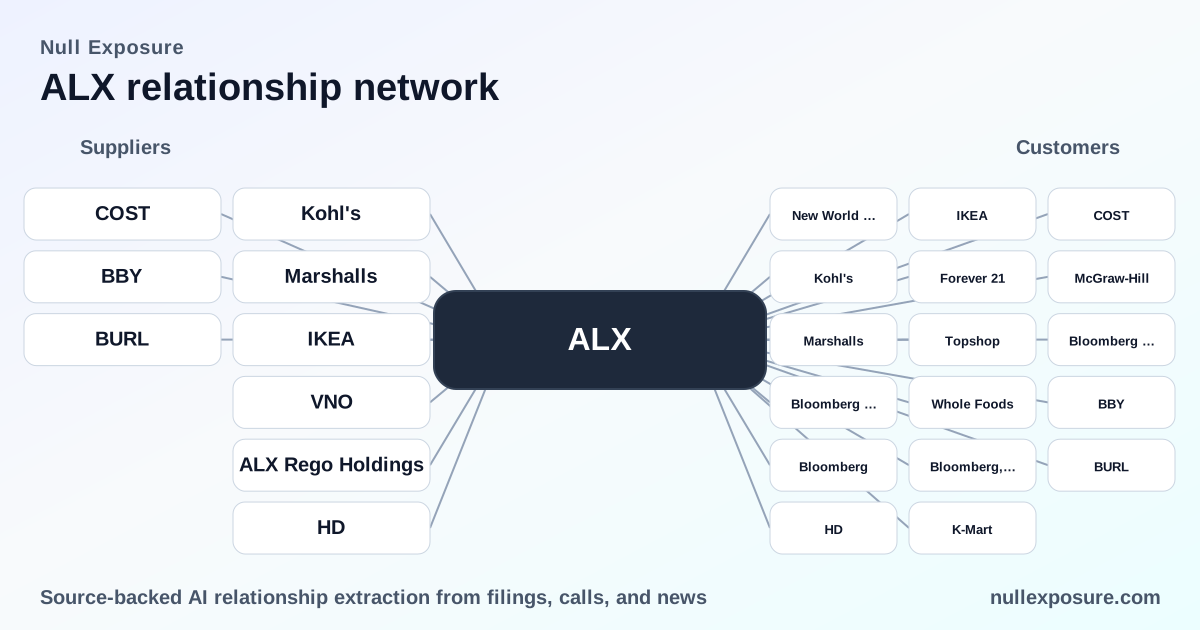
Alexanders Inc (ALX): Tenant Relationships Drive Cashflow and Concentration Risk
Alexanders Inc. is a New York–centric REIT that monetizes through long-term leases, anchored retail tenancy and selective property dispositions; the company combines stable, contracted office income (dominated by Bloomberg) with retail anchors at suburban shopping centers and opportunistic asset sales such as Rego Park I. For investors, the core thesis is clear: predictable, high‑value rental cashflow is offset by tenant concentration and localized geographic risk, while property sales provide tactical liquidity. Learn more about our coverage and signals at https://nullexposure.com/.
Long leases, large tenants, single‑market exposure — what that means for ALX
Alexanders’ public filings and press releases establish a contracting posture weighted toward long-term commitments — the company has negotiated multi-year lease extensions and ten‑year deals with several anchors. The tenant mix is tilted toward large-format and enterprise counterparties, which supports durable rent rolls but concentrates risk in New York City. Bloomberg is a single counterparty of critical importance, accounting for the largest share of rental revenue and occupying the office condominium at 731 Lexington Avenue. At the same time, the company uses asset sales (for example, the Rego Park I sale) to recycle capital and realize value.
- Key operating signals: long-term lease profile (explicit extensions/ten-year deals), counterparty mix dominated by large enterprises and anchors, geographic concentration in New York City, and reliance on a single material tenant for a large portion of rental income.
If you want a concise, investor‑grade extraction of ALX tenant relationships and implications, visit https://nullexposure.com/ for the full signal stack.
Tenant and counterparty rundown — each relationship recorded in filings and press
-
New World Mall LLC — Alexander’s 2025 Form 10‑K states the Flushing 167,000 sq. ft. building is subleased to New World Mall LLC through January 2037, establishing a long‑dated retail sublease at that asset (10‑K, FY2025).
-
Bloomberg — The 2025 10‑K reports Bloomberg accounted for $129,317,000 of revenue in 2025 (with $125,349,000 and $120,351,000 in 2024 and 2023), underscoring Bloomberg’s outsized contribution to rental revenue (10‑K, FY2025).
-
Bloomberg L.P. (occupancy detail) — Alexander’s 2025 10‑K notes Bloomberg L.P. occupies all of the office space at the 731 Lexington Avenue condominium, indicating full office tenancy by a single corporate tenant (10‑K, FY2025).
-
Kohl’s — The company’s 2025 10‑K describes a center anchored by a 133,000 sq. ft. Kohl’s, confirming large‑format retail tenancy at ALX shopping centers (10‑K, FY2025).
-
Marshalls — Alexander’s 2025 10‑K lists a 40,000 sq. ft. Marshalls at the same center, reflecting traditional anchor retail composition (10‑K, FY2025).
-
Bloomberg L.P. (lease amendment) — A May 2026 report on Investing.com states Alexander’s subsidiary 731 Office One LLC entered into a lease amendment with Bloomberg L.P. for the 731 Lexington office condominium, illustrating active lease management and concession structuring (Investing.com, May 2026).
-
Northwell Health, Inc. (Rego Park I sale announcement) — GlobeNewswire and other outlets reported Alexander’s entered an agreement to sell Rego Park I to Northwell Health for a gross $235.5 million, providing immediate liquidity and a material gain on the disposition (GlobeNewswire / company release, FY2026).
-
Home Depot (HD) — TradingView coverage of company filings notes a decline tied primarily to the expiration of Home Depot’s lease, signaling vacancy risk when large anchors exit (TradingView, FY2025).
-
HD (duplicate entry) — A second TradingView mention reiterates Home Depot’s lease expiration as a driver of revenue decline in the disclosed period (TradingView, FY2025).
-
Bloomberg (nine‑month revenue share) — TradingView’s reporting of interim filings indicates Bloomberg accounted for approximately 60% of rental revenues for the nine months ended September 30, 2025, reinforcing the tenant’s criticality (TradingView, FY2025).
-
Northwell Health (purchase price / proceeds detail) — Pulse2 reports the Rego Park I sale for $235.5 million with net proceeds ~ $202 million, highlighting the transaction’s scale and balance‑sheet impact (Pulse2, FY2026).
-
Northwell Health (additional press) — QuiverQuant’s release repeats the sale announcement, confirming market dissemination of the transaction terms (QuiverQuant, FY2026).
-
Northwell Health (gain detail) — MiniChart and related coverage note the Rego Park I sale included an expected gain (MiniChart, FY2026).
-
Northwell Health (GlobeNewswire release) — GlobeNewswire published the definitive sale announcement summarizing net proceeds and timing, serving as the company’s formal disclosure (GlobeNewswire, FY2026).
-
Forever 21 — A 2019 earnings call transcript (Fool.com) records that Forever 21 received rent relief during restructuring but remained a continuing tenant at specified Broadway locations, indicating historical retail workout experience (Fool.com, FY2019).
-
Topshop — The same 2019 transcript notes Topshop closed U.S. stores, including two Alexander’s locations, demonstrating prior retail tenant churn (Fool.com, FY2019).
-
Bloomberg (lease extension detail, FY2024) — TradingView reported that on May 3, 2024 Alexander’s and Bloomberg extended leases covering ~947,000 sq. ft. at 731 Lexington to February 2040, confirming a long‑dated renewal (TradingView, FY2024).
-
Northwell Health (Yahoo Finance reporting) — Yahoo Finance carried the company’s Rego Park I sale announcement, echoing the material disposition in mainstream financial media (Yahoo Finance, FY2026).
-
Whole Foods — A 2019 call transcript notes Alexander’s released space to Whole Foods for store expansion and actively negotiated to release additional space at higher rents, indicating redevelopment/leasing flexibility (Fool.com, FY2019).
-
IKEA — TradingView’s summary of filings reports a September 27, 2023 lease modification with IKEA that accelerated termination to April 1, 2024, and included payment of rent through March 16, 2026 plus a $10,000,000 termination payment (TradingView, FY2024).
-
K‑Mart — Historical commentary from 2019 references space coming out of a K‑Mart store and conversion of retail to office, showing past asset re‑positioning activity (Fool.com, FY2019).
-
Bloomberg, L.P. (historical HQ reference) — SimplyWall’s company profile and other historical filings identify 731 Lexington as Bloomberg’s world headquarters occupying office and retail space, reinforcing the long relationship (SimplyWall / company history, FY2017 reference).
-
Costco (COST) — Alexander’s 2025 10‑K discloses a 145,000 sq. ft. Costco anchoring the center, confirming a major national retail anchor (10‑K, FY2025).
-
Bloomberg LP (731 Lexington refinancing) — A 2024 GlobeNewswire release documents a $400 million refinancing of the 731 Lexington office condominium, evidencing capital markets activity tied to the Bloomberg‑occupied asset (GlobeNewswire, FY2024).
-
BBY (Best Buy) — Alexander’s 2025 10‑K lists a 47,000 sq. ft. Best Buy at the center, reflecting another national retailer anchor (10‑K, FY2025).
-
Best Buy (duplicate entry) — The filing reiterates Best Buy’s presence at the center as a 47,000 sq. ft. tenant (10‑K, FY2025).
-
Burlington (BURL) — The 2025 10‑K describes a 60,000 sq. ft. Burlington at the center and separately notes an August/2024 ten‑year lease relocation to Rego Park II, indicating a secured, long‑term retail commitment (10‑K, FY2025).
-
BURL (duplicate entry) — The same disclosure is captured again in the filing as BURL, confirming the lease and anchor status (10‑K, FY2025).
What investors should take away
-
Concentration is the defining risk and strength: Bloomberg’s tenancy provides durable, high‑quality office cashflow and underpins financing at 731 Lexington, but it represents a single‑counterparty concentration that is material to ALX’s revenue (company 10‑K disclosures and interim filings).
-
Long‑dated contracts lower rollover risk but lock geography: Multiple lease extensions and ten‑year deals with anchors (explicitly documented for Bloomberg, Burlington and Marshalls) create predictable cashflow while leaving the company materially exposed to New York City economic cycles.
-
Asset sales are actively used to manage liquidity: The Rego Park I sale to Northwell Health for $235.5 million demonstrates ALX’s willingness to monetize non‑core or opportunistic assets to strengthen the balance sheet.
-
Retail anchor mix is diversified among national chains, but historical tenant exits (Topshop, Home Depot lease expiration, Forever 21 restructurings) show retail churn can still drive near‑term volatility in occupancy and FFO.
-
Financing and capital markets strategy is informed by tenant strength: The $400 million refinancing tied to the Bloomberg‑occupied condominium and recent lease amendments illustrate how tenant credit and lease term structure feed ALX’s capital access.
For a structured, investor‑grade extraction of these relationship signals and how they impact covenant stress, occupancy projections and valuation sensitivity, visit https://nullexposure.com/.
Bottom line: Alexanders underwrites a high‑quality, long‑dated office cashflow stream anchored by Bloomberg and supplements it with large‑format retail anchors and tactical asset sales, but investors must price significant single‑tenant concentration and geographic concentration into any valuation or credit assessment.