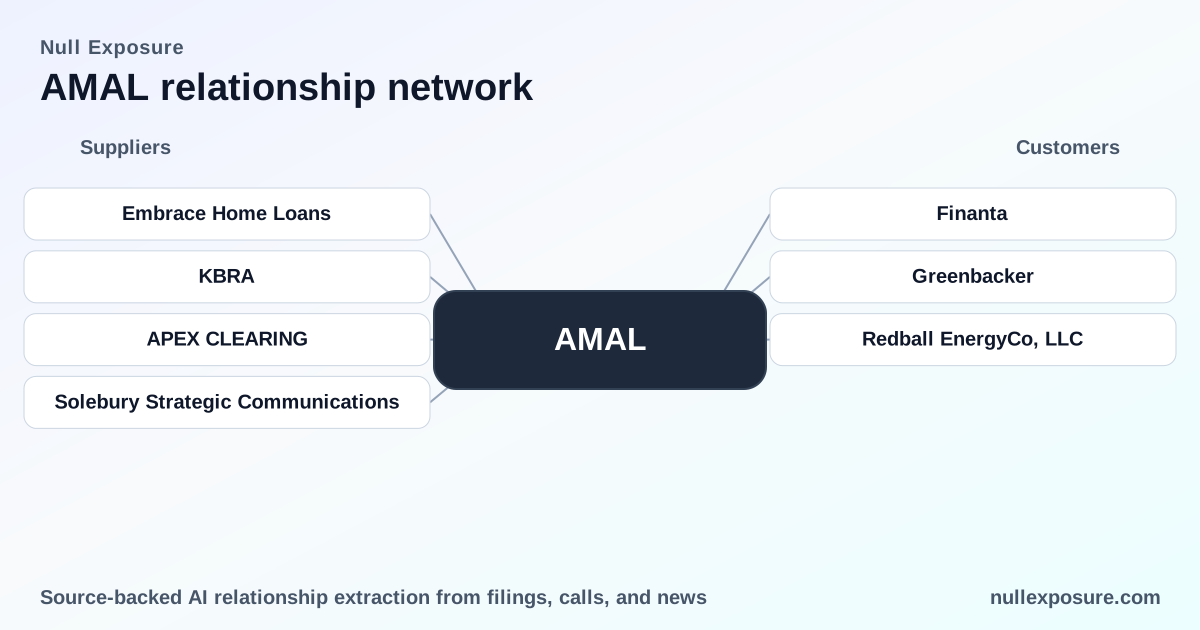
Amalgamated Bank (AMAL): Customer relationships that underpin a values-driven regional bank
Amalgamated Bank operates as a full-service regional commercial bank with a clear monetization model: net interest margin on loans funded by relationship deposits, supplemented by investment management, trust and custody fees. The franchise concentrates on values-based commercial clients, non-profits and mission-driven businesses in a small set of coastal metro areas, and translates that focus into stable deposit funding and targeted credit deployment—including community development and renewable energy financings that produce fee income and interest spread. For investors, AMAL’s customer ties represent both a differentiated deposit base and targeted credit exposure that support a predictable earnings profile while concentrating certain operational risks.
For a consolidated counterparty view and primary-source coverage on AMAL’s customer relationships see https://nullexposure.com/.
Relationships in plain language: community finance and clean energy partners
H3: Finanta — $5 million loan to a CDFI
Amalgamated Bank provided a $5,000,000 loan to Finanta, a 33‑year-old community development financial institution that underwrites affordable housing, small business and community-serving organizations across Pennsylvania, New Jersey and Delaware. News outlets including MyChesco (March 9, 2026) and AlphaStreet reported the loan as part of Amalgamated’s community lending activity (https://www.mychesco.com/a/news/regional/5m-loan-channels-capital-into-housing-small-business-across-region/; https://news.alphastreet.com/amalgamated-bank-announces-five-million-dollar-loan-to-nonprofit-finanta/amp/).
H3: Greenbacker — participation in large-scale solar financing
Amalgamated Bank participated in a financing package for Greenbacker’s Cider solar project, a 674 MW installation described as one of the largest in New York State, as part of broader project finance activity. CityBiz covered the bank’s role in the financing round and the associated clean‑energy exposure (CityBiz, March 2025 — https://www.citybiz.co/article/758978/amalgamated-bank-announces-25-million-commitment-to-redball-energy/?abkw=citybizwashington).
H3: Redball EnergyCo, LLC — $25 million corporate financing commitment
Amalgamated Bank announced a $25 million corporate financing commitment to Redball EnergyCo, a developer and operator of residential and commercial solar assets headquartered in the Washington, D.C. area; the commitment positions the bank as a direct lender to distributed‑generation developers and owner/operators. The commitment was disclosed in a CityBiz release highlighting Amalgamated’s targeted clean‑energy lending activities (CityBiz, March 2025 — https://www.citybiz.co/article/758978/amalgamated-bank-announces-25-million-commitment-to-redball-energy/?abkw=citybizwashington).
(For a consolidated view of AMAL’s transaction-level relationships and primary press coverage visit https://nullexposure.com/.)
What these counterparties reveal about Amalgamated’s operating model
-
Contracting posture: Amalgamated’s investment management relationships are structured with client-terminable arrangements on short notice, reflecting standard industry practice and underscoring the bank’s need to retain clients through service and performance rather than contractual lock‑in. This short‑term contracting posture increases the importance of deposit stability and client engagement for fee revenue.
-
Customer mix and concentration: The bank generates meaningful deposits from state and municipal accounts (government counterparties) and from values-based commercial and consumer customers, while its loan book targets non-profits, small businesses and mid‑market C&I borrowers. These composition signals indicate a customer base that is mission-oriented and relatively sticky, but also concentrated in specific sectors that can correlate with economic cycles and policy shifts.
-
Geographic footprint: AMAL’s lending and branch network are concentrated in New York City, Washington, D.C., San Francisco, and a commercial office in Boston, with primary lending stated for New York and California and Washington, D.C. Geographic concentration amplifies regional economic and real‑estate risk while supporting efficient client acquisition in mission-driven sectors.
-
Role and revenue mix: The company operates as both seller of banking products (loans, deposits) and service provider (asset custody, investment management, trust services); management treats the banking operation as the single reporting segment, with trust and investment management complementary to the core loan/deposit engine.
-
Relationship maturity and activity: Amalgamated runs a mix of active commercial relationships and mature institutional custody services—the bank has provided long‑standing trust and custody since 1973 while maintaining ongoing credit commitments and deposit relationships.
-
Materiality and exposure scale: Customer deposits are material and historically a stable, low‑cost funding source, while outstanding contractual credit commitments (commitments and letters of credit) run into the hundreds of millions of dollars—indicating meaningful on‑ and off‑balance sheet credit exposure. Simultaneously, select carrying values related to certain financial instruments are characterized as immaterial in disclosures, implying some limited exposures are not balance‑sheet critical.
Investment implications: risks and upside in the customer strategy
-
Upside — differentiated deposit base and climate finance optionality: AMAL’s focus on non‑profits, unions, socially responsible enterprises and municipal deposits generates sticky, mission-driven deposits that lower funding volatility relative to wholesale funding. The bank’s deliberate financing of community development and renewable energy projects—illustrated by the Finanta loan and solar commitments—creates fee and interest income upside as the clean-energy pipeline scales.
-
Risk — concentration and credit composition: Geographic concentration in a few expensive coastal markets and sizable credit commitments create regional real‑estate and borrower‑type concentration risk. Lenders with mission-oriented underwriting face tradeoffs between social objectives and credit economics; investors should track loss rates and provisioning trends for non-profit and small‑business portfolios.
-
Operational sensitivity — short‑term fee contracts: The short notice terminability of investment management contracts increases the bank’s reliance on continuous client servicing to preserve fee income; turnover in institutional relationships would pressure non-interest revenue.
-
Balance‑sheet scale and governance: With market capitalization near $1.21 billion and return metrics reflecting modest scale, governance around credit selection, municipal deposit concentration and project finance underwriting will determine how well AMAL converts customer relationships into durable shareholder returns.
Bottom line: a values-driven deposit franchise with targeted credit risk
Amalgamated Bank monetizes a mission-oriented customer base through a classic banking model—low‑cost, relationship deposits funding loans and fee-bearing trust services—while selectively deploying capital into community development and renewable energy. The Finanta, Greenbacker and Redball relationships illustrate the bank’s strategic focus: community finance and clean energy as earnings drivers. Investors should value AMAL’s deposit stickiness and mission differentiation while monitoring regional concentration, loan loss experience, and the sustainability of fee contracts as the primary levers that will determine capital efficiency and growth.
For a detailed counterparty map and primary-source links to the press above, visit https://nullexposure.com/.