Applied Materials: Customer Relationships that Drive and Constrain the Semiconductor Supercycle
Applied Materials sells capital equipment, spare parts, services and factory-automation software to semiconductor and display manufacturers and monetizes through high-margin equipment sales plus recurring services and subscription-like software tied to a massive installed base. The business model is dual: lumpy, high-value hardware orders drive near-term revenue and long-term, subscription and service streams convert that installed base into predictable aftermarket margins. Explore more on our homepage.
Why customers matter: a clear commercial profile
Applied’s customers are the world’s chip foundries, IDM fabs and advanced packaging houses. Revenue is geographically concentrated in Asia Pacific and concentrated by customer: two customers represented roughly 19% and 15% of net revenue in fiscal 2025, so a small number of large relationships materially drive top-line volatility and order cadence. According to the company’s fiscal disclosures, the AGS business grew in fiscal 2025 driven by higher customer spending on long-term service agreements and spares, while services revenue is often recognized over time—typically within 12 months—highlighting a mix of short-term and longer-term contractual economics.
The roster that matters — who Applied supplies, and why it matters to investors
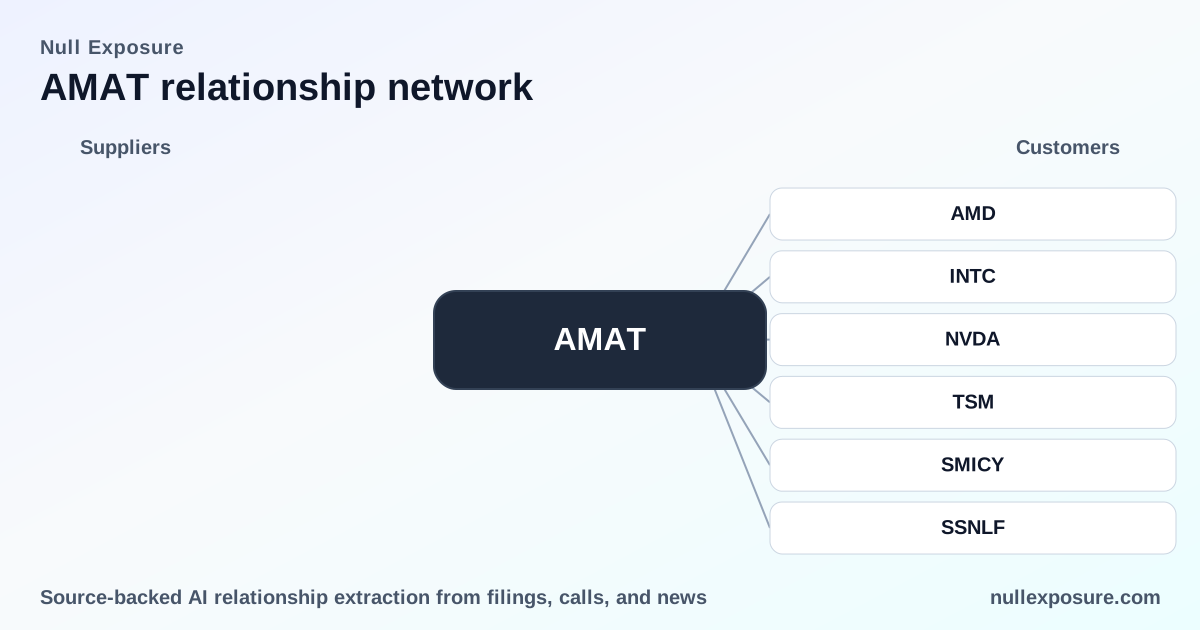
Below I cover every relationship in the source results with a concise, investor-facing take and a source reference.
TSMC
TSMC is a structural demand driver for Applied: when TSMC expands equipment budgets to support Apple, Nvidia and AI-server demand, Applied’s order pipeline fills in parallel, given the close alignment between TSMC capex cycles and tool suppliers. (Trefis, April 29, 2026: https://www.trefis.com/stock/amat/articles/597539/applied-materials-at-42x-boom-or-bubble/2026-04-29)
Intel
Intel’s fab expansions for AI, cloud and automotive chips increase demand for Applied’s semiconductor tools, positioning Intel as a meaningful customer for equipment sales and long-cycle projects. (Simply Wall St, May 2, 2026: https://simplywall.st/stocks/us/semiconductors/nasdaq-amat/applied-materials/future)
Nvidia
Nvidia’s appetite for advanced AI chips implicitly boosts demand for advanced lithography, deposition and packaging equipment from suppliers like Applied, making Nvidia-associated capex an indirect tailwind for AMAT’s order book. (Simply Wall St, March 9, 2026: https://simplywall.st/stocks/us/semiconductors/nasdaq-amat/applied-materials/news/applied-materials-amat-valuation-check-after-sector-sell-off)
AMD
High-performance computing and AI chips designed by AMD expand the addressable market for Applied’s tools; AMD’s product roadmap supports a multi-year equipment refresh cycle that benefits equipment and services revenue. (Simply Wall St, March 9, 2026: https://simplywall.st/stocks/us/semiconductors/nasdaq-amat/applied-materials/news/applied-materials-amat-valuation-check-after-sector-sell-off)
Samsung
Samsung’s foundry and memory fabs are another major consumption point for Applied: capacity increases at Samsung translate directly into incremental equipment orders and spares demand across Applied’s semiconductor systems and AGS segments. (Simply Wall St, May 2, 2026: https://simplywall.st/stocks/us/semiconductors/nasdaq-amat/applied-materials/future)
SMIC (SMICY)
Applied paid a settlement exceeding $252 million to resolve U.S. Commerce Department claims tied to unauthorized re-exports of equipment to SMIC, an event that underscores regulatory and compliance risk when serving Chinese fabs. That settlement has direct financial and reputational implications for customer exposure in China. (TradingKey, March 6, 2026: https://www.tradingkey.com/news/stocks/261654960-market-movers-amat-20260306; TS2, March 9, 2026: https://ts2.tech/en/applied-materials-stock-slips-after-hours-as-investors-scan-for-fresh-chip-spending-signals/)
Hua Hong
Hua Hong represents a meaningful Chinese customer for Applied, and recent export-control frictions and ordered export halts to China increase the company’s execution risk and potential near-term revenue impairment in that market. (Simply Wall St, May 2, 2026: https://simplywall.st/stocks/us/semiconductors/nasdaq-amat/applied-materials/news/applied-materials-faces-new-china-export-halt-and-revenue-ex)
What the customer mix implies for AMAT’s operating model
Applied’s customer relationships reveal a distinctive set of business-model characteristics that investors must weigh together:
-
Contracting posture — mixed-tenor, direct sales: The company sells principally through a direct sales force and locks revenue through a blend of high-ticket equipment orders (lumpy, long procurement cycles) and shorter-term service arrangements recognized over time (often within 12 months). Subscription-style factory automation software and spares give recurring revenue characteristics to the installed base.
-
Concentration and criticality — a small number of large customers, high criticality: Fiscal disclosures show two customers represented roughly 19% and 15% of net revenue in fiscal 2025, which makes certain customer relationships both financially material and strategically critical to Applied’s order book.
-
Revenue composition — hardware-led with expanding aftermarket: The business remains hardware-heavy (Semiconductor Systems) but AGS (services, spares, factory automation software) is an important growth and margin stabilizer, with the company explicitly highlighting long-term service agreements as a driver of AGS net revenue in fiscal 2025.
-
Geographic exposure — Asia Pacific dominant: Applied earns the majority of revenue in Asia Pacific (China, Korea, Taiwan, Japan and Southeast Asia), with China, Taiwan and Korea listed as substantial contributors versus a smaller U.S. share; this geography concentration amplifies both growth upside when APAC fabs spend and regulatory risk when U.S.–China export controls tighten.
-
Customer spend scale and maturity: The company’s own disclosures imply $100m+ spend bands exist among top customers, reflecting the large-ticket nature of equipment orders and the multi-year lifecycle of wafer-fab investments.
Investment implications and near‑term watchlist
-
Top-line sensitivity to a few accounts: The materiality of a couple of customers means order timing will continue to drive quarterly volatility; investors should model both the booking cadence of TSMC/Intel/Samsung and the recurring AGS revenue stream for margin stability.
-
Regulatory execution risk is non-trivial: The SMIC settlement and export-control headlines around Hua Hong underline that compliance and export licensing are active operational risks that can create one-off charges and restrict market access in China.
-
Margin and cash conversion upside from AGS and software: Applied’s strategy to monetize its installed base through spares, services and subscription-like automation software supports higher-margin, more predictable revenue, which is an important offset to cyclical equipment sales.
-
Geography and customer concentration = opportunity and risk: APAC dominance is the primary growth runway; however, dependence on a small group of foundries requires close monitoring of disclosed customer-level concentrations and public capex plans from TSMC, Intel and Samsung.
Bottom line
Applied Materials’ customer mix provides both the engine for outsized cyclical upside and the levers for durable aftermarket margins. Investors should track fab capex plans at TSMC, Intel and Samsung, monitor AGS subscription uptake, and watch regulatory developments in China closely — each will materially affect AMAT’s near-term revenue and risk profile. For further analysis on supplier–customer dynamics in semicap, see our homepage for ongoing coverage. https://nullexposure.com/