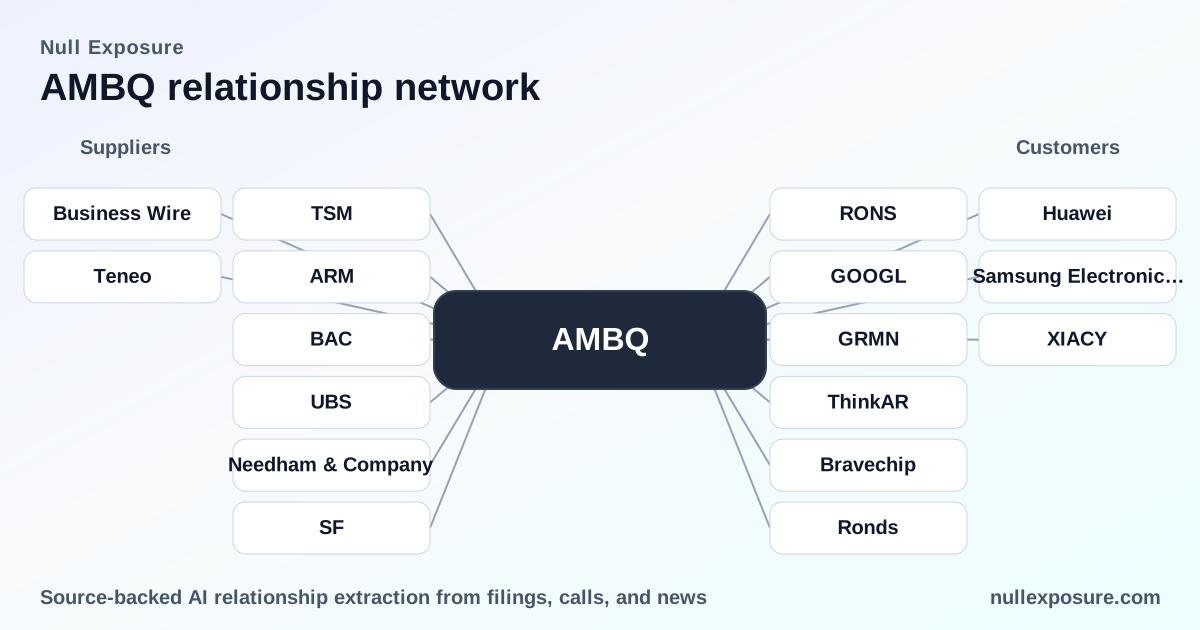
Ambiq Micro (AMBQ): Customer relationships that define its go-to-market and risk profile
Ambiq Micro designs and sells ultra-low-power system-on-chips (SoCs) and associated software, monetizing through product sales to OEMs and strategic partnerships that embed Ambiq’s SPOT power-optimization technology in consumer wearables, AR devices and industrial sensors. Revenue is driven by a small set of large customers and by co-development deals that turn Ambiq IP into product-level differentiation, creating both attractive gross margins on successful wins and concentration risk where a handful of partners drive a disproportionate share of net sales. For further research on Ambiq’s customer signals, visit https://nullexposure.com/.
Business model and operating posture in plain terms
- Ambiq sells silicon and software into end-product manufacturers rather than directly to consumers; this is a classic OEM/channel contracting posture where Ambiq is a component supplier and co‑developer for differentiated devices.
- Customer concentration is high: public reporting for FY2025 shows a small number of named customers accounted for large percentages of quarterly net sales. This implies revenue volatility tied to individual OEM programs.
- Customer relationships are strategically critical rather than commoditized: Ambiq’s SPOT platform and Apollo family SoCs are embedded in product designs (smartwatches, rings, AR glasses, industrial sensor networks), so wins translate into multi-year design cycles and inventory cadence.
- Maturity and diversity trade-off: partners range from global OEMs to niche AR and industrial players, giving Ambiq both scale channels (large consumer electronics) and high-growth product adjacencies (edge AI wearables, industrial sensors).
Key takeaway: Ambiq’s value accrues when design wins convert to production at scale; the reverse — lost or delayed wins at a major partner — compresses revenue sharply.
A second perspective and direct reference If you want a consolidated view of Ambiq’s coverage and signals, see the company page at https://nullexposure.com/ — the platform aggregates filings, transcripts and press coverage that drive investor diligence.
Customer map: what each partner contributes to Ambiq’s commercial story Below I cover every customer relationship flagged in the public results set, with a concise, source-linked summary of the role each plays in Ambiq’s revenue and product strategy.
RONS (earnings call — 2025 Q4)
Ambiq cited a recent partnership with RONS and the NavaSear brand as evidence of progress delivering “intelligent equipment operation maintenance solutions,” indicating Ambiq chips are embedded in large-scale industrial monitoring solutions. According to the Q4 2025 earnings call transcript, Ambiq highlighted the RONS relationship as a production-oriented partnership. (Ambiq Q4 2025 earnings call)
GRMN (news article / Embedded — FY2025)
An Embedded article reporting on Ambiq’s public market filing referenced GRMN as one of the top contributors in early 2025, with Garmin accounting for a material share of net sales in the first quarter of 2025. This underscores Garmin’s role as a major consumer-electronics anchor customer. (Embedded.com, FY2025)
Garmin (news article / Embedded — FY2025)
Garmin is explicitly named as representing 38% of net sales in Q1 2025, establishing it as Ambiq’s largest disclosed end customer in that period and a significant driver of near-term revenue. (Embedded.com, FY2025)
Google (news article / Embedded — FY2025)
Google is reported as representing 25% of net sales in Q1 2025, positioning it as another major commercial partner for Ambiq’s edge AI and ultra-low-power offerings. (Embedded.com, FY2025)
ThinkAR (GlobeNewswire press release — Jan 7, 2025 / FY2025)
Ambiq announced that ThinkAR’s AiLens AR glasses are powered by Ambiq’s Apollo4 SoC and SPOT technology, demonstrating the company’s push into AR wearables through co‑branded product integrations. (GlobeNewswire press release, Jan 7, 2025)
Bravechip (multiple press items — FY2026)
Ambiq’s Apollo330B Plus SoC powers Bravechip’s BCL603S3H platform used in smart rings and other wearables, with coverage highlighting improved energy efficiency and on‑device AI capabilities; Bravechip partnerships are cast as cost-reduction and scale-enabling for low-power wearables. (Sahm Capital release, FY2026; ElectronicsMedia, Jan 2026; Finviz summary, FY2026)
Ronds (news coverage / Sahm Capital & Finviz — FY2026)
Press coverage describes Ambiq’s strategic relationship with Ronds, noting deployment of more than 400,000 intelligent sensors across heavy industries such as petrochemical and coal processing, signaling Ambiq’s traction in industrial IoT at scale. (Sahm Capital release, FY2026; Finviz summary, FY2026)
Huawei (Embedded coverage — FY2025)
Embedded reporting referenced Huawei as a material end customer in the first three months of 2024, showing that Ambiq’s customer mix has included large international smartphone and device OEMs historically. (Embedded.com, FY2025 referencing FY2024 composition)
XIACY (Xiaomi) (Embedded coverage — FY2025)
Ambiq’s earlier customer composition included Xiaomi (reported under XIACY), illustrating exposure to major Chinese consumer electronics OEMs prior to changes in customer mix in 2025. (Embedded.com, FY2025)
Xiaomi (Embedded coverage — FY2025)
Xiaomi is explicitly named in Embedded coverage as part of Ambiq’s historical end-customer mix, reflecting past reliance on major handset and consumer-electronics customers. (Embedded.com, FY2025)
Samsung Electronics Co. Ltd. (SiliconANGLE coverage — FY2025)
SiliconANGLE coverage identifies Ambiq’s Apollo 510 SoC as the processor found in Samsung Galaxy Watch devices, confirming a concrete OEM design win with one of the largest consumer-electronics platform vendors. (SiliconANGLE, FY2025)
Notes on duplicate or closely related entries
- Several results reference the same corporate relationship from different sources (for example, Garmin and the GRMN ticker entries both come from the Embedded article). I include each result entry as provided, noting that multiple sources corroborate major customer concentration and large program exposure.
- Company names that differ by capitalization or small spelling variations in the results (e.g., RONS vs Ronds) are presented separately here to match the provided reporting events; both indicate Ambiq’s industrial-sensor partnerships and large-scale deployments across heavy industry.
Implications for investors
- Concentration risk is the dominant operating lever: public disclosures show a handful of customers accounted for most quarterly net sales in early 2025, so program flows at any one partner will materially swing Ambiq’s revenue. (Embedded.com, FY2025)
- Strategic co-development increases stickiness but also execution risk: Ambiq’s SPOT platform and Apollo SoCs function as product differentiators that create multi-year design cycles, but converting wins into volume is execution-dependent.
- Diversification is underway across wearables, AR and industrial IoT, demonstrated by partnerships with Samsung, Garmin, ThinkAR, Bravechip and Ronds; each vertical has different seasonality and procurement dynamics, which both hedges and complicates forecasting.
Final read: monitor partner production cadence and disclosed customer revenue breakdowns Ambiq’s role as an embedded SoC and platform supplier gives it attractive margin upside when design wins scale, but the same structure produces earnings and cash-flow volatility tied to a small number of customers. For trackable signals, follow quarterly customer disclosures, design-win press releases, and shipment-volume statements from the major OEM partners cited above.
For ongoing coverage, analysis and aggregated signals on Ambiq Micro’s customer relationships, see https://nullexposure.com/.