Amber International (AMBR): Customer Relationships and the Strategic Path from GTM to Real‑World Asset Tokenization
Amber International operates a two‑pronged commercial model: a legacy cloud-based Global Trade Management (GTM) software business that generates recurring enterprise subscription and implementation revenue, and an accelerating digital‑asset services arm — branded Amber Premium — that sells blockchain architecture and tokenization projects to institutional counterparties. Investors should value AMBR as a hybrid software operator where stable GTM cashflows underwrite experimental, higher-margin blockchain collaborations that could reprice growth expectations if institutional tokenization projects scale.
For a concise view of AMBR’s customer signals and partner footprint, visit https://nullexposure.com/.
How customers and partners shape AMBR’s operating posture
Amber’s customer list in available records spans traditional enterprise software clients, global asset managers, blockchain ecosystems, and specialized infrastructure partners. That spread reveals several business model characteristics investors must internalize:
- Contracting posture: Business combines recurring SaaS contracts in GTM with project‑based professional services for tokenization and blockchain architecture; partnerships with financial institutions suggest negotiated, multi‑quarter engagements rather than purely transactional sales.
- Concentration and diversification: The mix of a legacy client like Amway and strategic partners such as UBS and BNB implies revenue diversification across product lines and industries, reducing single‑client concentration risk for the core GTM business while introducing project concentration risk for tokenization initiatives.
- Criticality and maturity: GTM customers represent mature, mission‑critical enterprise relationships; tokenization engagements are nascent but strategically important — proof‑point collaborations with institutional asset managers provide credibility for future deal flow.
- Commercial implications: The company’s fiscal profile (Revenue TTM ~$66M; positive profit margin) supports incremental investment into Amber Premium while preserving the subscription base.
No explicit contractual constraints were captured in the reviewed source set; the above characteristics are company‑level signals derived from disclosed relationships and product announcements rather than from contract excerpts.
Customer and partner roll call (each relationship covered)
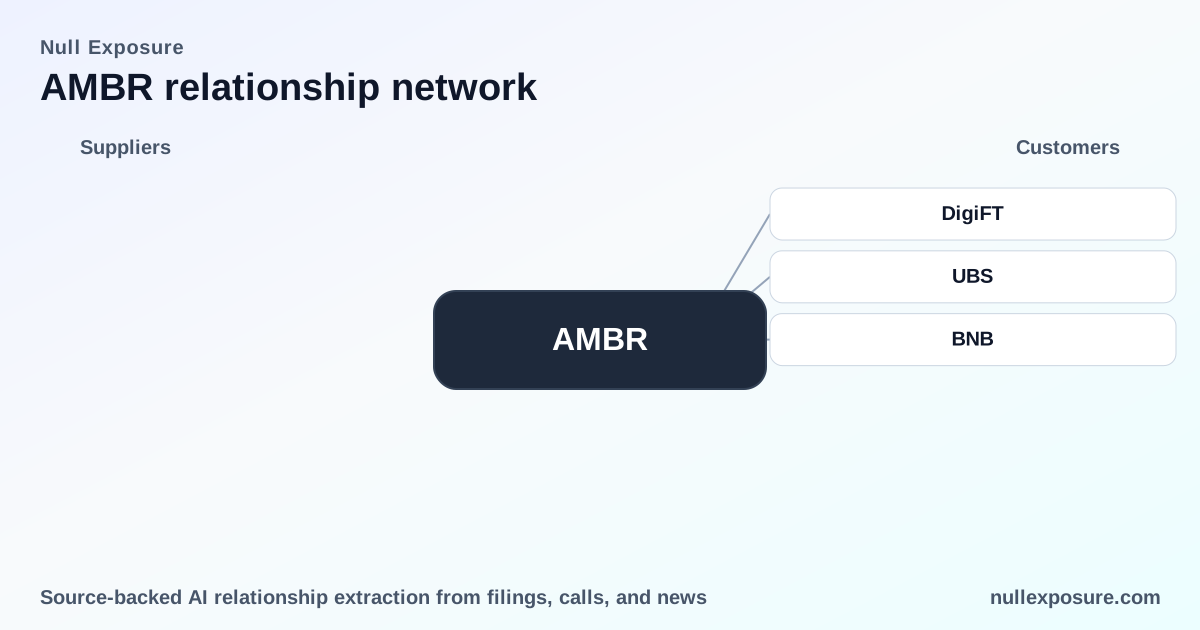
DigiFT
Amber disclosed DigiFT as a collaborator on its tokenization product uMINT during the 2025 Q1 earnings call, positioning DigiFT as a technical partner in the real‑world asset initiative. According to management remarks in the 2025 Q1 earnings call, uMINT was developed “in collaboration with UBS Asset Management and DigiFT.” (AMBR 2025 Q1 earnings call, March 2026)
UBS Asset Management
UBS Asset Management is named as a co‑developer on AMBR’s uMINT product, signaling a direct institutional client/partner relationship that underpins Amber’s push into tokenizing real assets. Management cited the UBS collaboration explicitly in the 2025 Q1 earnings call when announcing uMINT. (AMBR 2025 Q1 earnings call, March 2026)
UBS
Separate mentions of UBS alongside UBS Asset Management in the company’s earnings commentary reiterate that Amber is engaging with the UBS franchise at institutional levels for product development and distribution of tokenization capabilities. The company referenced UBS in the same 2025 Q1 call describing launch partners for uMINT. (AMBR 2025 Q1 earnings call, March 2026)
BNB ecosystem
Amber described expanding its blockchain footprint by collaborating with the BNB ecosystem to introduce a BNB fund, an initiative that broadens its technical distribution channels into an additional high‑impact blockchain network. Management commented on the BNB collaboration as part of the 2025 Q1 strategic update. (AMBR 2025 Q1 earnings call, March 2026)
AGMH (AGM Group Holdings Inc.)
AGM Group Holdings signed a memorandum of understanding with Amber Premium to explore real‑world asset (RWA) tokenization, with Amber Premium committing blockchain architecture and infrastructure design while AGM provides hardware and computing capability support. A QuiverQuant news release and complementary reporting on StockTitan described the MOU and spelled out Amber Premium’s role as providing blockchain‑based technology and infrastructure without undertaking issuance or distribution of tokenized assets. (QuiverQuant news, March 9, 2026; StockTitan, March 9, 2026)
Amway
A historical enterprise win: Amber Road’s global trade management solution was selected by Amway as reported in 2015, illustrating Amber’s long‑standing traction in large, complex supply‑chain implementations and the legacy GTM revenue stream that continues to underpin the company. The original selection was covered by industry press in FY2015. (247wallst report, August 2015)
What these relationships imply for revenue and risk
- Revenue composition: The presence of entrenched enterprise customers like Amway validates a core subscription and services revenue base. Tokenization contracts with UBS and AGMH represent upside optionality that can carry materially higher margins if adopted at scale.
- Execution risk: Project‑level tokenization work amplifies execution and regulatory complexity; Amber’s role as a technical provider (and its stated non‑involvement in issuance roles in the AGMH MOU) reduces balance‑sheet exposure but concentrates revenue on professional services and recurring infrastructure fees.
- Customer stickiness: GTM products are typically sticky once integrated into trade workflows; the 2015 Amway adoption demonstrates historical success in embedding Amber in enterprise operations, supporting revenue stability.
- Strategic credibility: Collaborations with UBS and the BNB ecosystem serve as high‑value signal transactions that improve Amber’s credibility with other institutional prospects and blockchain networks.
Investment takeaways and watch‑list items
- Bull case: Amber’s combination of a profitable GTM base and high‑profile tokenization partners creates a two‑track growth story — stable software cashflows plus scalable infrastructure projects that can re‑rate multiples if adoption accelerates.
- Bear case: Tokenization initiatives are nascent and project‑dependent; execution delays, regulatory headwinds, or a failure to convert pilot collaborations into recurring deals will compress expected upside.
- Near-term catalysts: Contract announcements converting pilots (uMINT) into fee‑bearing deployments, and any further institutional MOUs or fund launches with BNB or UBS, will materially affect investor sentiment.
For investors and operators seeking a deeper breakdown of AMBR’s customer map and risk signals, explore additional company relationship analytics at https://nullexposure.com/.
Boldly, Amber is not just a legacy GTM vendor — it is an operator actively monetizing blockchain infrastructure expertise through institutional collaborations that bridge traditional asset managers and newer chain ecosystems, a positioning that justifies close monitoring as tokenization projects move from pilots into commercial contracts.