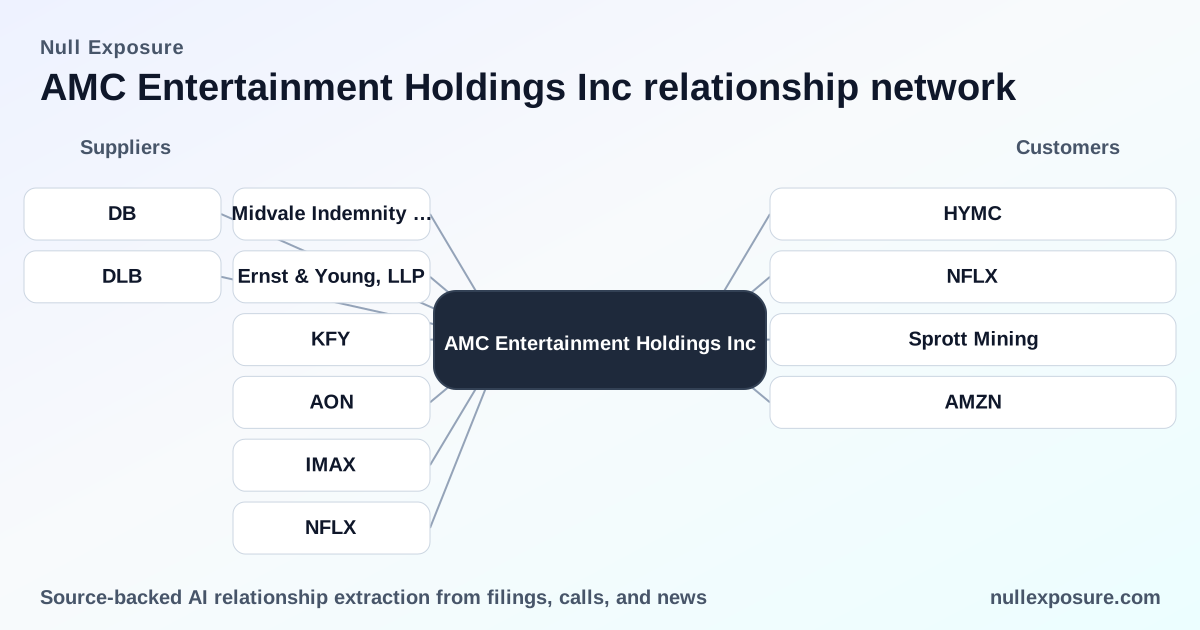
AMC customer relationships: what investors need to know
AMC Entertainment operates the world’s largest theatrical exhibition business and monetizes through a mix of box office admissions, food & beverage sales, advertising, loyalty subscriptions, gift card and ticketing fees, and a growing distribution arm. The company sells tickets and concessions at point-of-sale, recognizes recurring loyalty fees ratably, and leverages its scale to capture advertising inventory and occasional direct-distribution revenue from event films. That multi-channel monetization profile creates both stable per-visit economics and episodic revenue spikes tied to content and partner deals. For a concise, structured read on the customer counterparties that matter to AMC, see more at https://nullexposure.com/.
How AMC’s operating model shapes customer risk and opportunity
AMC’s customer relationships are not a single monolith — they split into retail consumers, advertising buyers, studio/content partners, distribution targets, and retail channels for branded merchandise. From the company filings and public remarks we derive several actionable operating signals:
- Revenue mix and contracting posture: Admissions and concessions are point-in-time transactions; loyalty subscription revenues (A‑List, Premiere) are recognized ratably, producing a predictable recurring revenue layer that smooths quarterly box-office cycles.
- Counterparty concentration: The primary customer base is individual consumers—AMC reports roughly 35 million member households across paid and unpaid loyalty tiers—so demand is broad but highly traffic-sensitive.
- Geographic footprint: AMC is concentrated in North America and Europe (NA + EMEA), with the U.S. representing the largest reportable segment and European markets delivering material international exposure.
- Relationship roles and maturity: AMC is primarily a seller (exhibitor), increasingly a distributor (select event films and sub-distribution), and a service provider for theatre IT, on-screen ad services, and gift-card programs; the distribution line is nascent but strategically important for higher-margin episodic revenue.
- Contract status: Most customer-facing activity is active and transactional, with membership and advertising agreements operating over time and standardized show structures introduced via recent partner deals.
These structural features imply that AMC’s revenue stability depends on steady foot traffic and advertising demand, while upside comes from premium event distribution and improved ad inventory monetization.
Line-by-line: the customer relationships investors should bookmark
Netflix (NFLX)
AMC reported that it screened Netflix’s K‑Pop “Demon Hunters,” contributing about 35% of the film’s total attendance during the Halloween weekend, demonstrating the exhibitor role AMC can play even for streaming-first content when studios or platforms opt for theatrical windows. This detail was disclosed in AMC’s 2025 Q4 earnings call (transcript dated March 8, 2026).
Liberty Puerto Rico / Liberty Global (LBTYA)
A 2015 report on Liberty Puerto Rico’s Choice channel lineup noted that AMC’s linear channel was added to subscriber packages, reflecting historical carriage of AMC-branded programming on cable platforms; this is archived news showing AMC’s presence in broader media distribution channels (newsismybusiness, FY2015).
Hycroft Mining Company (HYMC)
In AMC’s 2025 Q4 remarks, management referenced the rise in Hycroft Mining’s share price and noted it had exceeded financial expectations, reflecting AMC’s past equity exposure to Hycroft rather than a customer contract (AMC earnings call, March 8, 2026).
National CineMedia (NCMI)
NCMI publicly stated that it strengthened exhibitor relationships through a new deal with AMC announced in Q2, and referenced an amended AMC agreement that standardized show structure and improved premium inventory monetization, which management cited as driving early results; these points come from NCMI earnings commentary and press releases across FY2025–FY2026 (NCMI earnings call transcript and company press releases, Feb–Mar 2026).
Amazon.com (AMZN)
AMC’s FY2024 10‑K discloses that “AMC Theatres Perfectly Popcorn” products are sold in grocery stores and online via Amazon.com, indicating a retail distribution relationship for AMC-branded merchandise and a consumer retail revenue channel (AMC 2024 Form 10‑K).
Antara Capital, LP
Public reporting in 2026 notes that AMC planned to raise $110 million through the sale of APE stock to Antara Capital, LP, an institutional capital transaction that influences shareholder composition and liquidity of AMC’s APE program (trading commentary, May 2026).
Sprott Mining
Coverage from December 2025 indicates AMC transferred the majority of its equity investment in Hycroft Mining to Sprott Mining, a corporate portfolio transaction that reduces AMC’s exposure to that miner and crystallized gains reported in press commentary (Sahm Capital write‑up, Dec 2025).
What these relationships mean for valuation and downside protection
- Content partnerships (Netflix): When streaming platforms or studios elect theatrical windows or event releases, AMC captures outsized margins and foot-traffic-driven ancillary sales. These episodic events materially lift per-screen economics.
- Advertising (NCMI): The amended NCMI/AMC arrangement standardizes inventory and enhances premium ad monetization; advertising is a lever that scales with audience quality rather than just ticket count.
- Retail distribution (Amazon): Branded product sales on Amazon are a low-margin but diversified revenue line and serve marketing and brand extension purposes.
- Capital flows (Antara, Sprott, Hycroft): Recent transactions around APE stock and the Hycroft stake affect AMC’s balance-sheet flexibility and potential dilution pathways; investors should treat such equity transactions as active capital management rather than passive disclosures.
Risk checklist for operators and allocators
- Traffic sensitivity: Box office and concessions are highly correlated to the release slate and macro consumer discretionary spend; loyalty subscriptions smooth but do not eliminate volatility.
- Geographic exposure: NA + EMEA concentration means regional lockdowns, regulatory changes, or local competition have material P&L effects.
- Ad revenue dependency: Improved ad structures with partners like NCMI can raise yield, but advertising demand is cyclical and tied to broader ad markets.
- Capital markets activity: Sales of APEs or equity stakes to institutions alter shareholder structure and can introduce dilution or funding optionality that impacts equity valuations.
Bottom line
AMC’s customer relationships span mass-market consumers, major content partners, advertising platforms, retail channels, and institutional counterparties, creating a layered revenue model that combines steady transactional cashflow with episodic, high-margin uplifts. Investors should weight box-office cadence and the health of advertising markets equally when modeling near-term earnings, while monitoring capital transactions for balance-sheet effects. For ongoing monitoring of AMC’s customer signals and relationship disclosures, visit https://nullexposure.com/.