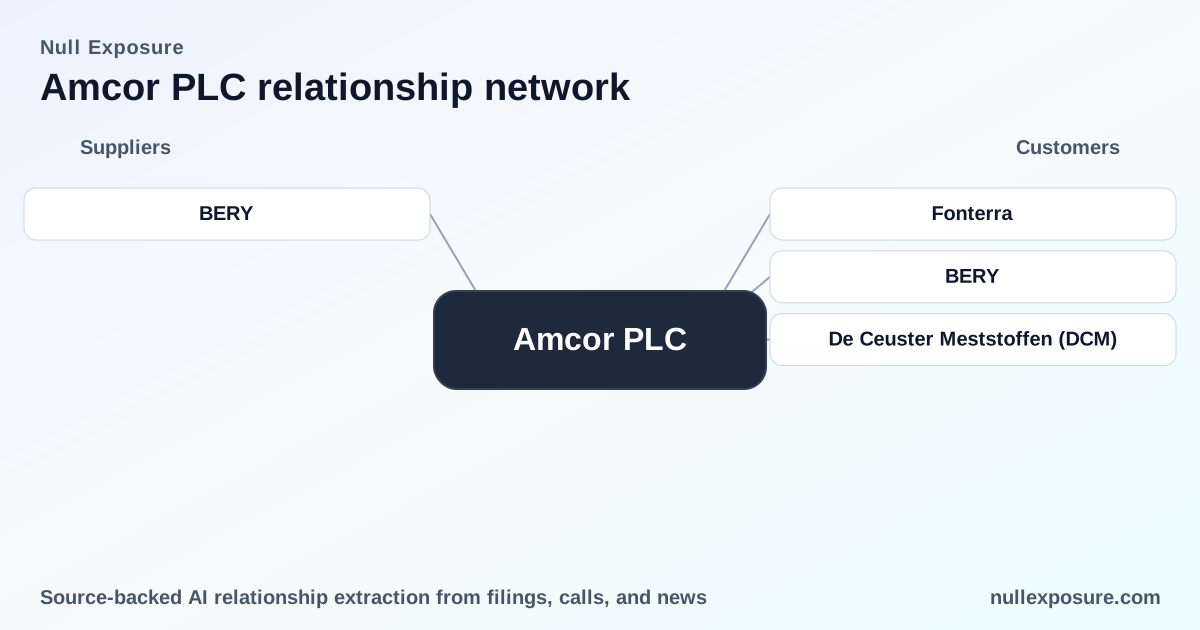
Amcor (AMCR): Customer Relationships, Contracts, and Strategic Signals
Amcor operates as a global packaging manufacturer that monetizes through the sale of flexible films, rigid containers, specialty cartons and dispensing closures to food, beverage, healthcare and personal-care customers; revenue comes predominantly from direct sales under a mix of purchase orders, master supply agreements and spot transactions, with manufacturing and distribution footprint across developed and emerging markets. Investors should view Amcor as a high-volume, low-customer-concentration industrial supplier where margin expansion depends on commodity input management, M&A integration and product sustainability adoption. For a concise look at how these customer ties affect risk and opportunity, see more at https://nullexposure.com/.
Why customers matter to Amcor: contracting, concentration and reach
Amcor's commercial model blends manufacturing scale with diverse contract forms. Company disclosures indicate revenues are generated mostly under purchase orders or purchase order combined with master supply agreements, alongside spot transactions and select long‑term commitments where Amcor makes up‑front investments to earn future benefits. This creates a dual exposure profile: stable recurring flows from framework customers and price/volume sensitivity where spot orders dominate. The business is globally distributed—North America and Europe are large revenue centers, with meaningful exposure to Latin America and Asia Pacific—so macro and logistics dynamics in each region have immediate customer impact.
- Contracting posture: mix of long‑term arrangements (for which Amcor accepts upfront obligations) and widespread framework/spot ordering across the customer base.
- Customer concentration: low — no single customer accounted for more than 10% of sales in recent fiscal years, reducing counterparty risk.
- Criticality & maturity: Amcor is a manufacturer-seller whose products are essential packaging inputs; relationships are operationally critical for customers but replaceable over time, putting pricing power in line with scale and sustainability differentiation.
- Geographic reach: truly global, which dilutes single‑market shocks but increases exposure to foreign‑exchange and regional cost dynamics.
Relationship roll call — what the sources show
Below are every customer-related item captured in the available results. Each entry is summarized in plain English with the original reporting source.
Fonterra — Finviz report (March 9, 2026)
Fonterra has adopted Amcor’s recycle‑ready film for cheese packaging, demonstrating adoption of Amcor’s sustainability‑oriented flexible packaging in major dairy supply chains. According to a Finviz news item published March 9, 2026, this placement underscores commercial traction in food packaging for large branded customers.
Fonterra — Bank of America coverage referenced on Finviz (March 9, 2026)
Bank of America’s coverage, relayed via Finviz on March 9, 2026, again highlights Fonterra’s use of Amcor’s recyclable film for cheese, reinforcing that Fonterra is a named adopter cited by sell‑side analysts when raising price targets.
Avantor / AVTR — Antara News (May 2, 2026)
Avantor India has been appointed exclusive distributor of Amcor Parafilm M sealing wrap products in India, expanding Amcor’s channel reach into laboratory consumables through regional distribution partnerships. Antara News reported this distribution agreement on May 2, 2026.
Butterfly Equity, LP — SimplyWall (May 2, 2026)
Butterfly Equity acquired a majority stake in ePac Flexible Packaging from a consortium that included Amcor, indicating Amcor exited or reduced its investor position in ePac as part of portfolio reshaping. SimplyWall coverage on May 2, 2026, describes the transaction and Amcor’s prior involvement.
Mediterrània Capital Partners Limited — SimplyWall (May 2, 2026)
Mediterrània Capital signed an agreement to acquire Amcor Flexibles Mohammedia from Amcor plc, signaling a targeted divestiture of a regional manufacturing asset in Morocco. SimplyWall reported this sale agreement on May 2, 2026, consistent with portfolio optimization.
Berry Global — Amcor FY2025 Q4 earnings call (March 7, 2026)
Management reported completion of the Berry Global acquisition and noted the company was 100 days into integration, positioning Amcor to realize expected synergies and revenue mix benefits from the transaction. The comment appears on Amcor’s Q4 FY2025 earnings call on March 7, 2026.
De Ceuster Meststoffen (DCM) — Packaging‑Gateway (March 9, 2026)
Amcor collaborated with Belgian fertilizer packager DCM to introduce a mono‑material polyethylene film for fertiliser packaging in Europe, showing cross‑industry product adoption beyond food and consumer goods. Packaging‑Gateway covered this partnership on March 9, 2026.
BERY (duplicate entry) — Amcor FY2025 Q4 earnings call (March 7, 2026)
A second mention in the earnings call reiterates the Berry Global acquisition progress and combination of complementary businesses; management uses repeated references to communicate integration focus and synergy capture. This is from the same March 7, 2026 earnings call transcript.
Fonterra — Finviz (alternate Finviz item, March 9, 2026)
An additional Finviz article on March 9, 2026, again notes Fonterra’s adoption of Amcor’s recyclable film, emphasizing consistent media coverage of the Fonterra product win across analyst and news channels.
Butterfly Equity, LP — SimplyWall (alternate SimplyWall item, May 2, 2026)
A second SimplyWall notice reiterates the Butterfly Equity acquisition of ePac and lists Amcor among prior consortium investors, confirming multiple outlets documented Amcor’s reduced exposure in ePac on May 2, 2026.
Mediterrània Capital Partners Limited — SimplyWall (alternate SimplyWall item, May 2, 2026)
An additional SimplyWall citation repeats the Mohammedia sale agreement, reinforcing that the divestiture was a material, publicly reported element of Amcor’s FY2026 activity.
What investors should take from these customer signals
- Sustainability is a commercial lever. Wins with Fonterra and DCM are evidence that Amcor’s recyclable and mono‑material films are being adopted by large industrial buyers, supporting premium positioning versus commodity packaging. (Finviz, Packaging‑Gateway, March 2026)
- Active portfolio management. The ePac and Mohammedia items indicate Amcor is pruning minority investments and regional assets to focus capital and simplify the operating footprint, which can improve capital allocation and margin profile if proceeds are redeployed effectively. (SimplyWall, May 2026)
- Integration is a near‑term earnings driver. Management’s repeated references to Berry Global integration suggest realized synergies and cost rationalization are central to the FY2026 profit narrative. (Amcor Q4 FY2025 earnings call, March 2026)
- Low single‑customer concentration reduces counterparty risk. Company disclosures show no single customer >10% of sales across several years, making revenue more resilient to individual account churn.
- Contract mix elevates volatility but preserves flexibility. The combination of long‑term agreements, framework arrangements and spot orders means Amcor can negotiate scale for strategic customers while retaining the ability to flex pricing and volumes in spot channels.
If you want a structured extraction of Amcor’s customer exposures and contract signals for portfolio analysis, visit https://nullexposure.com/ for further briefings.
Bottom line
Amcor remains a global manufacturing and packaging platform with diverse customer exposure, strategic emphasis on recyclable products, active asset reshaping, and near‑term upside from merger integration. For investors, the mix of sustainable product adoption and disciplined portfolio moves points to a company positioning for margin recovery while preserving low customer concentration risk.