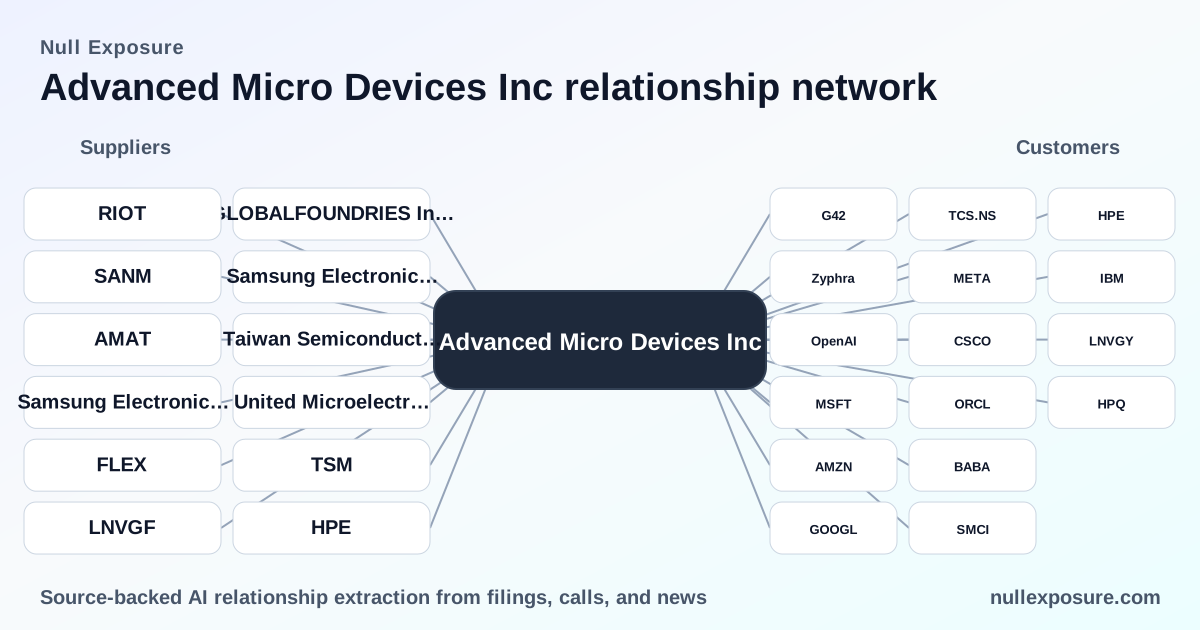
AMD’s customer map: who pays for the chips that power the AI era
Advanced Micro Devices (AMD) sells high‑performance CPUs, GPUs and AI accelerators to hyperscalers, OEMs/ODMs, system integrators and channel partners, monetizing primarily through hardware sales (EPYC CPUs, Instinct GPUs, Versal FPGAs) plus strategic software, co‑engineering partnerships and developer programs that drive long‑term platform adoption. Revenue is driven by a mix of large, gigawatt‑scale hyperscaler contracts and broad OEM/channel distribution, giving AMD both high‑value bilateral deals and extensive global volume exposure. Learn more about how we source this investor‑focused customer intelligence at https://nullexposure.com/.
How AMD’s customer model works in practice
AMD’s go‑to‑market is a hybrid of short‑term, purchase‑order driven sales and multiyear, capital‑intensive supply relationships with hyperscalers. The company sells discrete product (hardware) at scale through OEMs, independent distributors and direct hyperscaler contracts; those distributors carry return and price‑protection rights while hyperscalers secure capacity through multi‑year agreements for AI infrastructure. According to AMD’s FY2025 10‑K, international sales comprised 67% of revenue, underscoring a truly global footprint (NA, EMEA, APAC, LATAM) and a customer base that ranges from smaller OEMs to very large hyperscalers. The filing also notes that no single customer exceeded 10% of revenue in 2024–25, yet AMD historically depends on a small number of large customers for a material share of revenue — an operational mix that combines concentration risk with broad geographic diversification.
Key operating signals:
- Contract posture: predominantly short‑term and purchase‑order/spot transactions for many customers, but layered with large multiyear hyperscaler contracts for AI capacity (company 10‑K and earnings comments).
- Counterparties: a mix of large and very large enterprises — hyperscalers, OEMs/ODMs and systems manufacturers dominate data center and AI GPU demand.
- Product focus: hardware‑first (EPYC, Instinct, Versal) with software and developer programs to capture platform economics.
- Materiality: no individual customer >10% in 2024–25, but prior years and disclosures flag material relationships with a small number of customers that drive outsized revenue and strategic credibility.
Want a quick dashboard of AMD’s customer mentions and how we track them? See our research hub at https://nullexposure.com/.
The complete customer roll call (what the filings and calls show)
Below is a plain‑English summary of every customer relationship pulled from AMD’s recent public mentions and related press coverage. Each item cites the reporting source that documents the relationship.
- G42 — Cisco and G42 are deploying a large‑scale AI cluster in the UAE powered by AMD Instinct MI350X GPUs, per AMD’s 2025 Q3 earnings call noting regional Helios/Instinct deployments. (AMD 2025 Q3 earnings call, 2026)
- OpenAI — AMD disclosed a comprehensive multiyear agreement with OpenAI to deploy 6 GW of Instinct GPUs, positioning OpenAI as a strategic hyperscaler customer. (AMD 2025 Q3 earnings call, 2026)
- Zyphra — IBM and Zyphra will train future multimodal models on a large MI300X cluster, referenced during AMD’s earnings commentary on partner deployments. (AMD 2025 Q3 earnings call, 2026)
- AWS (Amazon Web Services) — AWS joined other public clouds in launching new EPYC‑powered instances; AMD reported significant growth in EPYC instances across cloud providers. (AMD 2025 Q4 earnings call, 2026)
- OpenAI (news context / broader reporting) — Multiple press pieces cite the company as one of AMD’s gigawatt‑scale hyperscaler customers under multiyear agreements. (Finviz / analyst coverage, FY2026 press)
- Meta Platforms (META) — AMD signed a multi‑year, gigawatt‑scale AI deal with Meta to deploy up to 6 GW of Instinct GPUs and EPYC CPUs, described in multiple news reports as transformational for AMD’s AI revenue outlook. (Finviz, InsiderMonkey and MarketBeat coverage, FY2026)
- Google (GOOGL) — Google launched new EPYC‑powered cloud instances as part of EPYC adoption across hyperscalers that AMD highlighted in earnings. (AMD 2025 Q4 earnings call, 2026)
- Tata Consultancy Services (TCS / TCS.NS) — AMD announced a strategic partnership with TCS to co‑develop industry‑specific AI solutions and accelerate customer deployments. (AMD 2025 Q4 earnings call, 2026)
- Avalon GloboCare (ALBT) — Avalon’s AI subsidiary was accepted into AMD’s AI Developer Program, gaining cloud credits, tools and access to Instinct/EPYC resources, per company press releases. (GlobeNewswire / StockTitan, Feb–Mar 2026)
- Arista Networks (ANET) — Arista referenced AMD among leading companies that compose the modern AI stack in its earnings call, indicating ecosystem integration. (Arista 2025 Q4 earnings call transcript, 2026)
- Cisco (CSCO) — Cisco stated close collaboration with AMD on integrated solutions and cited joint UAE cluster work with G42 using Instinct GPUs. (Cisco earnings call and AMD Q3 mention, 2026)
- IBM — IBM described new or deepened strategic partnerships that include AMD for AI infrastructure and training clusters. (IBM 2025 Q4 earnings call, 2026)
- Microsoft (MSFT / Microsoft Azure) — AMD’s 2025 10‑K flagged the risk of losing Microsoft support; separately Microsoft Azure is listed among hyperscalers launching EPYC‑powered instances. (AMD FY2025 10‑K; AMD 2025 Q3 earnings call, 2026)
- DigitalOcean (DOCN) — DigitalOcean expanded its Inference Cloud and GPU Droplets powered by AMD Instinct MI350X GPUs, noting production inference gains and collaboration with Character.ai. (DigitalOcean press coverage and SEC announcements, FY2026)
- Amazon (AMZN) — AMD reported AWS among public clouds launching new AMD instances; public earnings references list AMZN alongside other hyperscalers. (AMD 2025 Q4 earnings call, 2026)
- Oracle (ORCL) — Oracle was reported as the first hyperscaler to publicly offer MI355X instances, representing an early MI3XX adoption case. (AMD 2025 Q3 earnings call, 2026)
- Super Micro Computer, Inc. (SMCI) — Supermicro launched high‑density server platforms and MicroBlade systems using AMD EPYC processors; press releases tie SMCI to AMD server adoption. (Supermicro IR and news, Feb–Mar 2026)
- Absci (ABSI) — Absci disclosed a technology partnership and a $20 million investment with AMD to scale compute for protein design. (Absci press coverage, FY2026)
- Sanmina (SANM) — Sanmina completed acquisition of ZT Systems’ data center manufacturing business from AMD and maintains preferred new product introduction partnerships for AMD‑based accelerated compute. (Finviz, trading reports and Sanmina earnings coverage, FY2026)
- Alibaba (BABA) — Alibaba is listed among hyperscalers launching EPYC/“Turin” offerings in the quarter; AMD flagged hyperscaler instance rollouts including Alibaba. (AMD 2025 Q3 earnings call, 2026)
- HPE (HPE) — HPE announced ProLiant systems powered by AMD EPYC 8005 series and is working with AMD on Helios rack offerings with integrated networking. (HPE product announcements and press, FY2026)
- Celestica (CLS) — Celestica will co‑develop rack‑scale networking switches for AMD’s Helios architecture under a strategic collaboration. (Celestica/industry press reporting, FY2026)
- Myseum.AI (MYSE) — Myseum.AI was accepted into the AMD AI Developer Program to access developer cloud credits and resources. (GlobeNewswire / Investing press, May 2026)
- Nutanix (NTNX) — AMD announced a multi‑year partnership and a planned $150M equity investment to co‑develop an open, full‑stack agentic AI infrastructure platform. (Nutanix/AMD press and SahmCapital coverage, Feb–Mar 2026)
- HP / HP Inc. (HPQ) — HP engaged in deep co‑engineering with AMD to advance AI PC performance and will ship Ryzen AI systems; multiple OEMs are listed as partners. (CRN, AMD product announcements, FY2026)
- Dell Technologies (DELL) — Dell listed as an OEM expected to ship mobile workstations powered by Ryzen AI PRO 400 Series processors. (GlobeNewswire product release, Mar 2026)
- Lenovo (LNVGY) — Lenovo is named among OEMs adopting the Ryzen AI 400 Series for next‑gen AI PCs. (AMD product release coverage, FY2026)
- Newegg (NEGG) — Newegg ran AMD‑powered esports and gaming events tied to Ryzen and Radeon technology, highlighting retail/channel marketing activity. (SahmCapital / company event coverage, FY2025)
- Corsair (CRSR) — Corsair’s ORIGIN PC AI Workstation 300 uses AMD Ryzen AI Max 300 Series processors, evidencing PC/enthusiast OEM adoption. (Corsair product reporting, FY2025)
- Mercury Systems (MRCY) — Mercury adopted AMD Versal AI Core FPGAs in radiation‑tolerant subsystems sold into space and defense programs. (Mercury press and analyst coverage, FY2026)
- Iris Energy (IREN) — Iris Energy’s dual‑engine expansion mentions AMD MI350X deliveries for AI/cloud deployments. (PredictStreet / industry reporting, FY2025)
- Riot Platforms (RIOT) — Riot signed a long‑term agreement with AMD to lease data center capacity tied to AI deployments. (SimplyWall / news reporting, FY2026)
- BlackBerry (BB) — BlackBerry’s QNX division announced expanded support for AMD Ryzen Embedded processors for automotive and industrial systems. (Benzinga coverage, FY2026)
Investment implications and risk checklist
- Upside: Gigawatt‑scale hyperscaler contracts with Meta, OpenAI and others create multi‑year revenue backlogs and validate AMD’s Instinct/EPYC stack as a credible alternative to incumbent suppliers. (Earnings calls and multiple press reports, FY2026)
- Concentration risk: While no single customer exceeded 10% of revenue in FY2024–25, AMD acknowledges a small number of customers account for a substantial portion of revenue — monitor contract renewals and capacity timing in quarterly disclosures. (AMD FY2025 10‑K)
- Commercial posture: Short‑term / purchase‑order sales plus spot distributor activity coexist with capital‑heavy multiyear hyperscaler commitments; that mix drives revenue volatility and margin leverage depending on product cycles. (10‑K and earnings excerpts)
- Geographic diversification: Strong international revenue (67% of 2025 sales) reduces single‑market exposure but raises supply‑chain and regulatory considerations across APAC, EMEA and LATAM. (AMD FY2025 10‑K)
For a focused view on how these customer relationships affect revenue scenarios and counterparty exposure, visit our analysis hub at https://nullexposure.com/.
Bottom line: AMD’s customer base spans hyperscalers that provide high‑value, long‑cycle AI contracts and a broad ecosystem of OEMs and distributors that deliver volume and geographic reach. That duality is the key driver of both AMD’s growth opportunity and its exposure to contract timing and concentration risk.