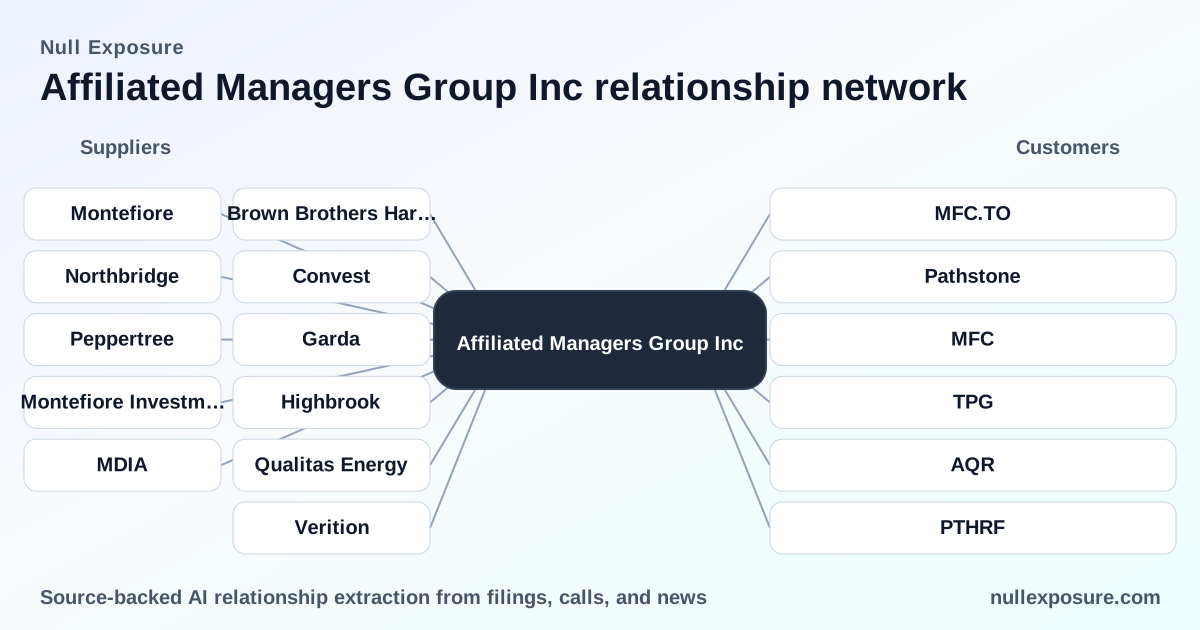
AMG’s customer footprint: fee capture from independent boutiques and active portfolio pruning
Affiliated Managers Group (AMG) acquires controlling and minority stakes in boutique asset managers, collects asset- and performance-based fees and a fixed revenue share from affiliates, and monetizes both recurring management streams and capital gains through selective divestitures. The firm’s operating model is a distribution-and-capital partner to independent managers: AMG provides scale, operational support and global distribution while affiliates retain investment autonomy, producing a cash-generative, recurring-fee business complemented by occasional one-time gains from asset sales. For a concise view of AMG’s corporate services and intelligence, visit https://nullexposure.com/.
How AMG’s operating model drives returns and risk
AMG’s strategy is concentration through diversification: it holds many affiliate relationships across liquid alts, equities and private markets to smooth revenue volatility while preserving idiosyncratic returns from each boutique. Contracts with clients are generally short-term and terminable—many investment management agreements are cancellable on roughly 60 days’ notice—which concentrates execution and retention risk onto AMG’s affiliates rather than locking clients into long horizons. The client base spans high-net-worth individuals and large institutional clients and is geographically skewed toward North America and the U.K./EMEA, with global distribution capabilities. AMG’s commercial posture is that of a service provider: consolidated revenue largely represents asset- and performance-based fees, and the company recognizes a single performance obligation — the provision of investment management services.
Recent transactions highlight active capital allocation
AMG has been actively pruning and re-shaping its affiliate portfolio, converting equity stakes into realized proceeds and strategic simplification. Sales in 2025 and early 2026 — including stakes in private credit and smaller affiliates — demonstrate AMG’s willingness to harvest non-core interests and redeploy capital or return cash to shareholders. These transactions are material to both near-term earnings and long-term mix of fee revenue, because AMG monetizes both recurring management fees and discrete gains when disposing of equity interests.
If you want a deeper intelligence package on AMG’s client and affiliate flows, see https://nullexposure.com/ for our research coverage.
Relationship roll call — what each mention in the record means for investors
Manulife Financial Corporation / MFC.TO — (news, Mar 9, 2026): AMG agreed to sell its interest in Comvest Partners’ private credit business to Manulife, a transaction that converts a strategic private-credit stake into cash and reduces AMG’s private-credit exposure (Yahoo Finance, Mar 2026: https://finance.yahoo.com/news/affiliated-managers-sell-comvests-private-125800469.html).
MFC / Manulife Financial Corporation — (news, FY2026): Multiple reports confirm Manulife completed acquisition of a ~75% stake in Comvest Credit Partners from Comvest Advisors, AMG and others, underscoring AMG’s exit from that private-credit position (SimplyWallSt summary, Mar 2026).
AMWL — (SEC filing excerpt, FY2020): A filing for AMWL states that its success depends on an affiliated medical group named AMG for telehealth provider access, indicating AMG-branded affiliates provide specialized distribution and operational support in healthcare services (SEC S-1 excerpt: https://www.sec.gov/Archives/edgar/data/1393584/000119312520228478/d943395ds1.htm).
Pathstone — (news, FY2023): Pathstone acquired Veritable (a $17 billion multifamily office) from AMG, illustrating AMG’s strategy of divesting wealth-management units to private-equity backed consolidators and crystallizing value from non-core wealth businesses (InvestmentNews report: https://www.investmentnews.com/ria-news/pathstone-tops-100-billion-with-latest-acquisition/239961).
TPG Inc. — (news, FY2026): TPG completed the acquisition of Peppertree Capital Management from AMG and others, consistent with AMG selling smaller affiliate stakes to large strategic buyers to tighten its affiliate roster (SimplyWallSt summary, Mar 2026).
Yacktman — (company profile, FY2026): Yacktman is listed among AMG’s affiliates that contribute to the firm’s equity and multi-asset strategies, part of an affiliate network that collectively managed approximately $813.3 billion at year-end 2025 (HeyGoTrade profile citing AMG network metrics, FY2026: https://www.heygotrade.com/en/us-stock/amg).
Parnassus — (company profile, FY2026): Parnassus is named as an equities affiliate within AMG’s network that contributes to the core long-only equity fee pool and supports AMG’s high-retention retail and institutional channels (HeyGoTrade profile, FY2026).
Tweedy Browne — (company profile, FY2026): Tweedy Browne appears in AMG’s affiliate roster focused on value equities and contributes to AMG’s diversified cash flow across equity mandates (HeyGoTrade profile, FY2026).
Abacus Capital — (company profile, FY2026): Abacus Capital is noted as a private-markets affiliate within AMG’s network, representing AMG’s exposure to private assets that account for a non-trivial portion of alternatives AUM (HeyGoTrade profile, FY2026).
AQR Capital — (earnings call, 2025Q4): AMG emphasized its partnership model and cited AQR as a key affiliate contributing to AMG’s cash generation and return profile entering 2026 (AMG Q4 2025 earnings call transcript).
Capula Investment Management — (company profile, FY2026): Capula is referenced as part of AMG’s liquid alternatives coverage, supporting AMG’s fee base in non-traditional, hedge-like strategies (HeyGoTrade profile, FY2026).
Harding Loevner — (company profile, FY2026): Harding Loevner is listed among AMG affiliates focused on global equity strategies that feed AMG’s recurring management fees (HeyGoTrade profile, FY2026).
Walter Global Asset Management Inc. — (news, FY2026): AMG recognized the sale of its interest in Montrusco Bolton Investments Inc. to Walter Global Asset Management as part of fourth-quarter 2025 transactions, another example of AMG monetizing affiliate stakes (AlphaStreet review of FY2025 activity, FY2026: https://news.alphastreet.com/affiliated-managers-groups-2025-in-review-liquid-alts-private-markets-and-aggressive-capital-allocation/amp/).
PTHRF / Pantheon — (earnings call, 2025Q4): Pantheon is specifically highlighted on AMG’s earnings call as an affiliate that contributed organic growth in AMG’s alternative strategies in 2025 (AMG Q4 2025 earnings call transcript).
Pantheon — (company profile, FY2026): Pantheon is included in AMG’s affiliate network as a private-markets manager that accounted for a portion of AMG’s alternatives AUM and contributed to third-party distribution revenue (HeyGoTrade profile; Pantheon referenced with PANR.LON).
Investment implications: what investors should watch
- Revenue durability depends on client retention: short-term, terminable management contracts mean AMG’s fee streams are robust only as long as affiliates retain clients; this is a structural operational risk.
- Diversified affiliate base dampens single-manager shocks: AMG’s exposure across public and private strategies reduces single-firm concentration, but capital allocation decisions (sales of interests) materially change future fee mix and earnings.
- Geographic mix is heavy in North America and the U.K./EMEA: investors should underwrite regional fund flows and regulatory trends in those markets when modeling fee growth.
- Active capital recycling is positive for shareholder returns when sales are at attractive multiples; however, consistent divestitures reduce future recurring fee potential unless redeployed into equal-or-better fee-yielding franchises.
AMG is a fee-first, capital-rotation business: success equals high affiliate retention, disciplined minority/majority stakes, and smart monetization timing. For ongoing monitoring of AMG’s affiliate transactions and client dynamics, see our AMG dossier at https://nullexposure.com/.