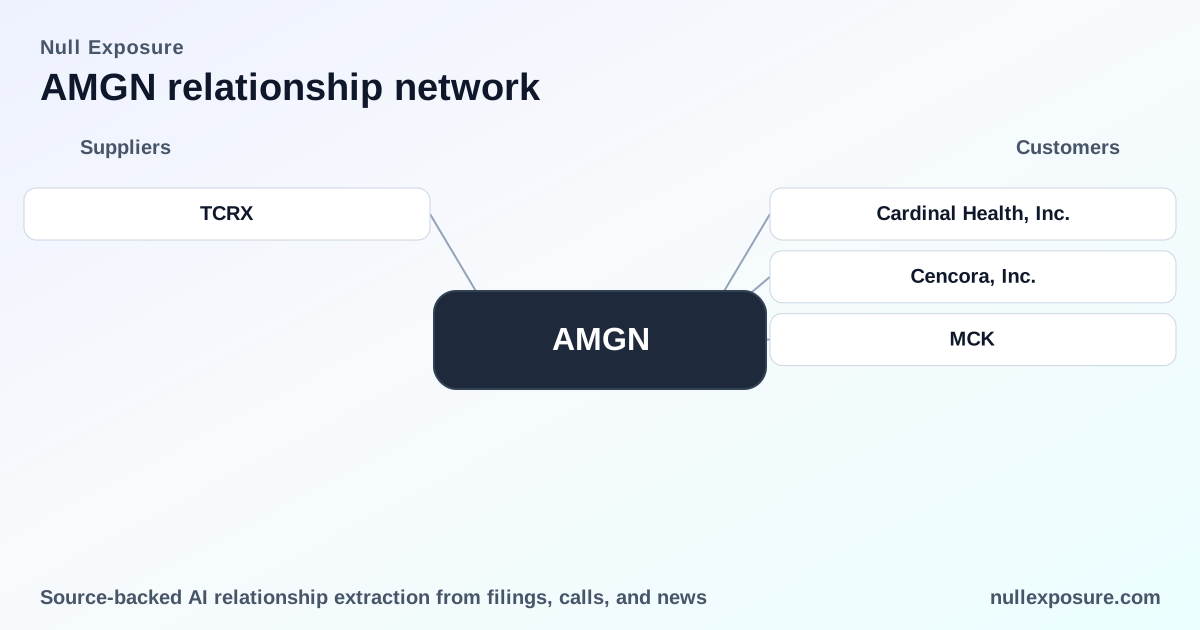
Amgen’s customer map: concentrated wholesalers, strategic partners, and royalty monetization
Amgen builds value by discovering and commercializing human therapeutics and monetizes primarily through product sales distributed at scale, strategic co‑development and licensing partnerships, and selective royalty monetizations. Revenue is concentrated through a small number of large distributors and complemented by targeted collaborations and royalty sales that accelerate cash realization without forfeiting full product economics. For investors, the key questions are concentration risk in distribution, counterparty pricing leverage (payers/PBMs), and the durability of co‑development links that support manufacturing and lifecycle revenue.
Explore the full customer relationship view and commercial signals at https://nullexposure.com/.
Distribution is the moat — and the vulnerability
Amgen’s commercial model routes the bulk of U.S. product flow through wholesale distributors. This channel strategy delivers scale and efficient clinic/hospital reach, but creates a concentrated counterparty footprint that is materially important to top‑line cash collection and product availability.
According to Amgen’s FY2025 Form 10‑K, product sales to three large pharmaceutical wholesalers each individually accounted for more than 10% of total revenues across 2023–2025, and the company has described the substantial majority of its U.S. product sales as made through these wholesalers. The filing signals a central operational constraint: distribution concentration creates both negotiating leverage for wholesalers and single‑point disruption risk for Amgen (Amgen 2025 10‑K).
How payers and PBMs amplify commercial pressure
The company also documents sustained pricing pressure from insurers, PBMs and government payers that demand rebates and formulary placements. This creates a two‑front commercial dynamic: large wholesalers control physical distribution while payers and PBMs control access and net pricing. Amgen’s public disclosures frame this as a structural constraint on margins and access, especially in the U.S. marketplace (Amgen 2025 10‑K).
Relationship roll‑call: who Amgen sells to and partners with
Below are concise, source‑tied summaries of every relationship in the available results.
McKesson Corporation (MCK)
McKesson is one of the three wholesale distributors that individually accounted for more than 10% of Amgen’s revenues in FY2025; McKesson is identified in Amgen’s FY2025 10‑K as a primary U.S. wholesaler. According to the 2025 Form 10‑K, these wholesalers are the principal means of distributing Amgen products to U.S. healthcare providers (Amgen FY2025 10‑K).
Cencora, Inc.
Cencora (formerly AmerisourceBergen) is listed among the three large wholesalers that each represented more than 10% of Amgen’s revenues for 2023–2025, reflecting its role as a core U.S. distributor for Amgen product sales (Amgen FY2025 10‑K).
Cardinal Health, Inc.
Cardinal Health is the third named wholesaler that individually accounted for more than 10% of total revenues in the FY2025 filing; Amgen cites wholesalers like Cardinal as central to U.S. distribution and revenue capture (Amgen FY2025 10‑K).
AstraZeneca (AZN)
Amgen and AstraZeneca operate a co‑commercial partnership for Tezspire in which costs and profits are shared after AstraZeneca pays a mid‑single‑digit royalty to Amgen; AstraZeneca leads development while Amgen leads manufacturing. This partnership was reported in coverage of Amgen’s Q1 results and public statements in FY2026 (news coverage, The Globe and Mail, FY2026).
Q32 Bio / QTTB
Q32 Bio (ticker QTTB) reacquired worldwide rights to bempikibart from Amgen in late 2023, indicating Amgen has divested or returned certain program rights and that commercialization responsibility shifted to Q32 for that asset (industry news coverage, FY2025/FY2023 reporting).
CytomX Therapeutics (CTMX)
CytomX lists Amgen among multiple oncology collaborators; the relationship is framed as a strategic collaboration where CytomX leverages partner resources in development and commercialization activities (company press coverage, FY2026).
Royalty Pharma plc (RPRX)
Royalty Pharma purchased a royalty interest in Amgen’s Imdelltra (a bispecific T‑cell engager) in 2025, with press reporting values around $885 million and structured payouts reported as up to approximately $950 million in some analyses—this is a classic royalty monetization that converts future product cash flows into near‑term cash (news reports, TradingView and Yahoo Finance, FY2025).
Heritage Global Partners (HGBL)
Press listings indicate a master agreement between Heritage Global Partners and Amgen Renew referenced in business‑wire reporting; this reflects non‑core commercial or asset disposition activity rather than a distribution or payer relationship (news listing, FY2026).
Neumora Therapeutics (NMRA)
Amgen made a strategic R&D equity investment (~$100 million) in Neumora and granted exclusive global rights to certain neuroscience programs (casein kinase 1 delta and glucocerebrosidase), illustrating Amgen’s use of equity and licensing to advance early‑stage programs; later disclosures note reductions in Neumora expense following expiration of some Amgen collaboration agreements (PR Newswire FY2021; later financial updates FY2025–FY2026).
ZLab (ZLAB)
ZLab’s FY2024 filings note that the company sources bemarituzumab from Amgen, confirming a customer/supply relationship where Amgen supplies specific therapeutic product to third‑party commercial partners (ZLab FY2024 10‑K).
Constraints and what they imply for investors
Amgen’s public disclosures surface a set of company‑level commercial constraints that shape risk and opportunity:
- Concentration of distribution and revenue: The company routes a substantial share of sales through a few large wholesalers; on a combined basis the wholesalers accounted for a very large portion of gross revenues in recent years, concentrating counterparty exposure and negotiating leverage (Amgen FY2025 10‑K).
- Counterparty scale and bargaining power: Large enterprise counterparties (wholesalers, integrated health plans, PBMs) exert meaningful pressure on net pricing and access, increasing discount and rebate requirements in core markets (Amgen FY2025 10‑K; FTC interim reporting cited).
- Commercial criticality: These distributor relationships are operationally critical—Amgen expressly warns that a material disruption at a wholesaler could significantly impair product delivery and revenue flow (Amgen FY2025 10‑K).
- Global footprint with regional routing: While the United States is the largest market and relies on wholesalers, Amgen uses affiliates, regional partners and distributors in EMEA, APAC and LATAM to commercialize products, creating a mix of direct and partner channels that diversify risk but preserve concentration in the U.S. (Amgen FY2025 10‑K).
Investment takeaways
- Positive: Amgen’s scale, deep manufacturing capability and selective partnerships (AstraZeneca Tezspire arrangement, royalty monetizations) provide multiple levers to monetize late‑stage assets and convert future cash flows.
- Risk: High distribution concentration and payer negotiation pressure are structural risks to growth and margins that warrant monitoring—particularly any shifts in contract terms with wholesalers or PBMs.
- What to watch next: renewal terms with the major wholesalers, any further royalty monetizations (which de‑risk pipelines but limit upside), and renewal or expansion of co‑development roles where Amgen retains manufacturing responsibilities.
For a consolidated, investor‑grade view of counterparty exposures and commercial signals, see NullExposure’s platform at https://nullexposure.com/.