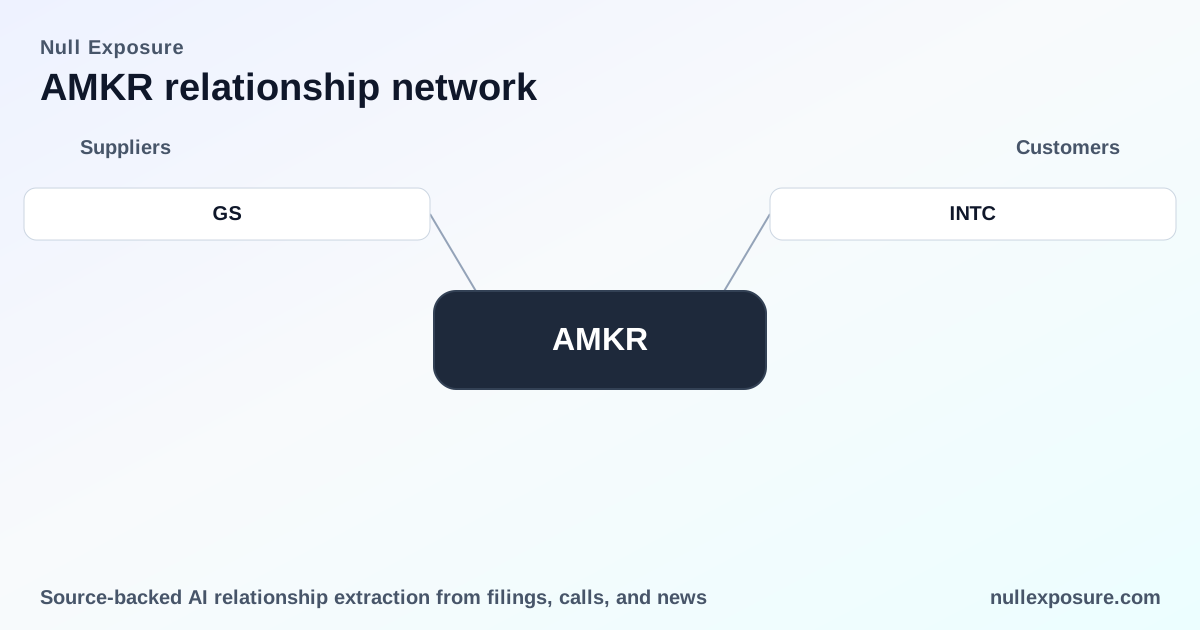
AMKR Customer Map: Where Amkor Earns Its Margins and How Customer Dynamics Drive Risk
Amkor Technology is the world’s largest U.S.-headquartered OSAT (outsourced semiconductor assembly and test) provider, monetizing through high-volume, turnkey packaging and test services sold on a per-job basis to leading device makers and foundries. Revenue is recognized as services are rendered—typically over two to three weeks—so the business converts volumes to cash quickly but carries limited contractual backlog and high sensitivity to customer demand swings. For investors, the key takeaways are concentration and counterparty quality: a handful of very large customers account for the majority of sales, which amplifies both upside in strong end markets and downside when large customers internalize capacity or reduce outsourcing. Learn more at https://nullexposure.com/.
How Amkor actually makes money, in plain terms
Amkor provides wafer bump, probe, back‑grind, package design, assembly, system-level and final test and drop-shipment services for customers across communications, computing, automotive, industrial and consumer markets. The company charges per-service and per-unit, with revenue recognized on delivery of service—packaging and test flows through the model as short-duration work without long-term firm purchase commitments. That operating posture gives Amkor flexibility to service spikes in semiconductor demand, but it also means revenue is inherently variable and tied to customer order behavior and product life cycles. Amkor reported roughly $7.07 billion in trailing twelve‑month revenue and $1.02 billion in gross profit, reflecting sizable scale but also tight margins typical of OSAT services.
Customer concentration: a double-edged competitive advantage
Amkor’s client roster is dominated by the largest semiconductor OEMs and fabless companies. In 2024 one customer (direct sales to Apple) accounted for 30.8% of net sales and a second customer (Qualcomm) accounted for 10.2%; the ten largest customers together made up 72% of net sales. Those figures come directly from company disclosures for 2024 and represent a structural risk: loss or volume reduction from one major customer materially affects consolidated results. At the same time, serving top-tier OEMs gives Amkor pricing power during capacity tightness and improves its visibility into future product cycles when customers provide forecasts—even if they are not binding.
Documented customer relationships in the recent coverage
Amkor’s monitored relationship records in the source set are concentrated on Intel. Each result below is presented as captured.
Intel — Finviz news note (record 1)
Intel historically provided overflow packaging volumes to Amkor, but Intel is increasingly prioritizing in-house packaging capabilities, which reduces a once-stable source of outsourced revenue for Amkor. (Finviz news article, March 9, 2026 — https://finviz.com/news/313052/amkor-trades-near-52-week-high-buy-sell-or-hold-the-stock)
Intel — Finviz news note (record 2)
The same coverage reiterates that Intel’s internal capacity build-out transforms it from a recurring overflow customer into a potential source of lost volumes for Amkor, highlighting a structural competitor shift among integrated device manufacturers. (Finviz news article, March 9, 2026 — https://finviz.com/news/313052/amkor-trades-near-52-week-high-buy-sell-or-hold-the-stock)
Operating constraints that shape customer risk and opportunity
The company disclosures and extracted constraints point to consistent, company-level operating characteristics that define Amkor’s customer relationships:
- Short-term contracting posture. Amkor recognizes revenue as services are rendered over two to three weeks and typically operates without material backlog; customers do not provide binding long‑term purchase commitments. This creates high revenue cyclicality tied to end-market demand.
- Large-enterprise counterparties. Customers are predominantly the world’s largest semiconductor companies and OEMs, which reduces counterparty credit risk but raises concentration and bargaining pressure.
- Global footprint and geographic diversification. Amkor generates significant sales across North America, EMEA, Japan and Asia Pacific, with manufacturing presence in multiple countries; this footprint supports global customers and regional supply-chain initiatives.
- Service-provider role and maturity of relationships. Amkor functions as a strategic manufacturing partner and seller of services; many customer relationships are long‑standing and mature, developed over decades.
- Materiality of top customers. The company-level signal that one customer represented 30.8% of sales in 2024 (Apple) and that the top ten customers represented 72% of sales underscores structural concentration risk.
Those constraints together produce a business model that is commercially robust in peak cycles but vulnerable to strategic in‑sourcing decisions by large customers and to demand troughs, because revenue is short‑term and concentrated.
Geographic and segment mix: where volumes live
Amkor serves customers globally—North America, EMEA, Japan and Asia Pacific—supporting product categories from smartphones and AI data-center components to automotive and EV applications. This geographic breadth reduces single‑region exposure but does not mitigate concentration by customer: the largest customers are global companies with diverse supply chains, and Amkor’s facilities are positioned to serve those needs.
Investment implications and near-term risk signals
- Concentration risk is the primary structural issue. With Apple and Qualcomm collectively representing more than 40% of sales in 2024, any decision by those customers to reduce outsourcing materially alters revenue trajectory. That concentration requires investors to track customer sourcing strategies and product ramps closely.
- In‑sourcing by major IDMs is a tangible downside. Intel’s shift to internal packaging capability is a concrete example of how a large customer can shrink Amkor’s addressable outsourced volumes; investors should treat similar moves by other IDMs as binary downside events.
- Short contract durations amplify volatility. The company’s operational model—service revenue recognized in weeks and no material backlog—means that quarterly results are highly sensitive to transient demand changes rather than multi-year contracted revenue.
- Scale, long-term relationships and global footprint are durable competitive assets. Serving top OEMs for decades and maintaining global manufacturing capacity create barriers for smaller OSAT entrants and position Amkor to capture cyclical upside when end markets tighten.
For ongoing diligence, monitor customer disclosures (especially Apple, Qualcomm, and large IDMs), plant capacity utilization updates, and any evidence of shifting outsourcing strategy from major semiconductor customers. If you want a consolidated view of Amkor’s customer relationships and constraint-derived signals, review our coverage at https://nullexposure.com/.
Conclusion: a leveraged play on end-market cycles with concentrated counterparty risk
Amkor combines scale, long-standing customer ties, and a global footprint to win outsourced packaging and test work, but its short-duration, high-concentration revenue mix creates asymmetric risk: strong upside in tight markets; significant downside if a large customer internalizes capacity or demand weakens. Investors should value the stock with explicit scenarios for customer volume retention and in‑sourcing trajectories, and monitor customer announcements as primary drivers of near-term earnings variability.