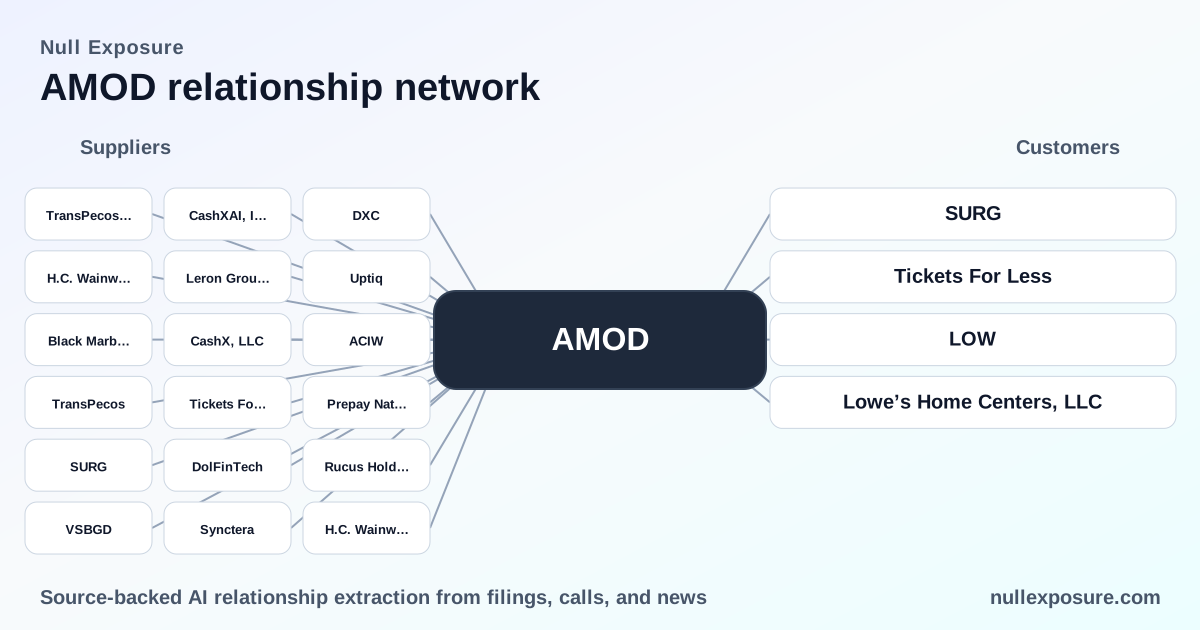
Alpha Modus (AMOD): Customer relationships driving a licensing-first fintech pivot
Alpha Modus monetizes by licensing proprietary AI and analytics technologies and embedding financial services through a newly formed Alpha Modus Financial Services (AMFS) arm. The company combines IP licensing to retailers and partners with targeted distribution deals for its forthcoming digital wallet, Alpha Cash, positioning recurring license fees and distribution economics as the revenue engine rather than traditional product sales. For investors and operators, the commercial cadence is partnership-led, with strategic integrations and litigation outcomes directly shaping near-term monetization.
If you want an ongoing feed of AMOD partner signals and filings, visit https://nullexposure.com/ for source tracking and document access.
How Alpha Modus structures commercial relationships today
Alpha Modus runs a hybrid model: IP licensing as the core contracting posture, plus targeted go-to-market distribution agreements through AMFS for consumer-facing wallet services. Public disclosures and news coverage show the company has executed exclusive and revenue-share license deals, and is now layering distribution LOIs to reach subprime and prepaid markets. This creates a business model where commercial success depends on partner distribution footprints and the legal defensibility of Alpha Modus’ patented technology.
- Contracting posture: Licensing and revenue-share agreements are the dominant form of commercial engagement based on company disclosures.
- Concentration and criticality: Revenue will be concentrated around a small number of distribution and license partners early on; those partners are critical to Alpha Cash adoption and near-term license income.
- Maturity: Market signals indicate Alpha Modus is early-stage commercially: historically low revenues but active movements toward deployment and distribution in 2024–2026.
The relationship map — what matters to investors and operators
Below I cover every customer relationship noted in the public record for AMOD. Each entry is written for quick underwriting and operational follow-up.
SurgePays / SURG — distribution LOI for Alpha Cash
Alpha Modus signed a Letter of Intent with SurgePays to integrate and distribute Alpha Cash into SurgePays’ prepaid and mobile services, targeting subprime and underserved consumers and leveraging SurgePays’ retail footprint and platforms such as ProgramBenefits.com and the ClearLine POS network. This LOI positions SurgePays as a distribution partner that could rapidly scale Alpha Cash adoption among prepaid customers. (Source: GlobeNewswire press release and StockTitan coverage, Jan 20, 2026 / March 2026)
Tickets For Less — embedded ticketing into Alpha Cash
Alpha Modus announced a multi-year integration with Tickets For Less to embed live-event ticketing into the Alpha Cash wallet ahead of a planned Q1 2026 rollout, adding consumer utility to the wallet and creating an extra revenue and engagement vector inside the AMFS product. This deal illustrates Alpha Modus’ strategy to bundle third-party services into its wallet to increase user retention and monetizable transactions. (Source: StockTitan article on AMOD retail operations announcement, March 2026)
Lowe’s (Lowe’s Companies, Inc. / Lowe’s Home Centers, LLC / LOW) — patent infringement litigation
Alpha Modus filed a patent infringement complaint naming Lowe’s and several of its in-store digital and computer-vision systems (including heat-mapping and retail-media platforms), alleging unauthorized use of Alpha Modus’ patented technology. The litigation is a non-commercial but strategically material relationship because outcomes could validate Alpha Modus’ IP and strengthen licensing leverage, or alternatively create legal costs and uncertainty tied to enforcement. (Source: Sahm Capital news release summarizing Alpha Modus complaint, Oct 14, 2025 / reported in filings 2025–2026)
What the constraints tell us about AMOD’s operating model
Public constraint excerpts provide company-level signals that explain the way Alpha Modus goes to market and how investors should think about revenue realization.
- Licensing-first posture: Multiple license agreements and company statements show Alpha Modus is focused on licensing its patented IP to others, often with revenue sharing and continuing license fees (evidence: license agreements with GZ6G and Xalles/CashX announced in 2024). This confirms the firm’s seller role is primarily IP licensing rather than direct product sales.
- Services segment focus: Alpha Modus classifies its offering as technology-as-a-service, consistent with its past deployments on third-party cloud platforms and award recognition; this is a services-led model rather than a one-time software sale.
- Early commercial maturity: The company has historically been non‑revenue producing as it builds out license deployments and the AMFS wallet, indicating high operational leverage—a small number of wins could materially change revenue, and conversely partner setbacks are magnified.
- Contract structure implications: Licensing deals commonly specify ongoing percentage fees (10% continuing license fees in cited agreements), which implies revenue scalability tied to partner sales volumes but also revenue volatility tied to partner performance.
Key investment implications and risk factors
Alpha Modus’ commercial value is tied to a narrow set of levers: IP enforceability, partner footprint, and the execution of wallet distribution through AMFS.
- Upside drivers: Successful integration with distribution partners like SurgePays and third-party embeds (Tickets For Less) will accelerate Alpha Cash user growth and generate recurring license/transaction economics. A court win or settlement in IP litigation could materially increase licensing leverage.
- Principal risks: Revenue concentration risk is high; licensing reliance exposes Alpha Modus to partner execution failure. Patent litigation with large retailers like Lowe’s introduces legal expense and timing uncertainty. Alpha Modus’ historical low revenue base makes short-term valuation sensitive to incremental announcements and partner milestones.
- Operational considerations: Partners with prepaid retail footprints are critical to reaching underserved segments; operational integration complexity (wallet pre-loads, POS integration, compliance) will determine go-to-market velocity.
Bottom line for investors and operators
Alpha Modus is executing a deliberate pivot from patented-technology holder to license-and-distribute fintech through AMFS. The company’s immediate commercial prospects are heavily contingent on a handful of partners—most notably SurgePays for distribution and a set of service embeds like Tickets For Less to broaden wallet utility—while patent litigation outcomes with retailers such as Lowe’s will shape long-term licensing leverage. Investors should track partner rollout timelines, licensing revenue recognition, and any material litigation developments, because each will drive binary changes in AMOD’s revenue profile.
For continuous monitoring of partner filings, press releases, and license documents, visit https://nullexposure.com/ for aggregated source coverage and document access.