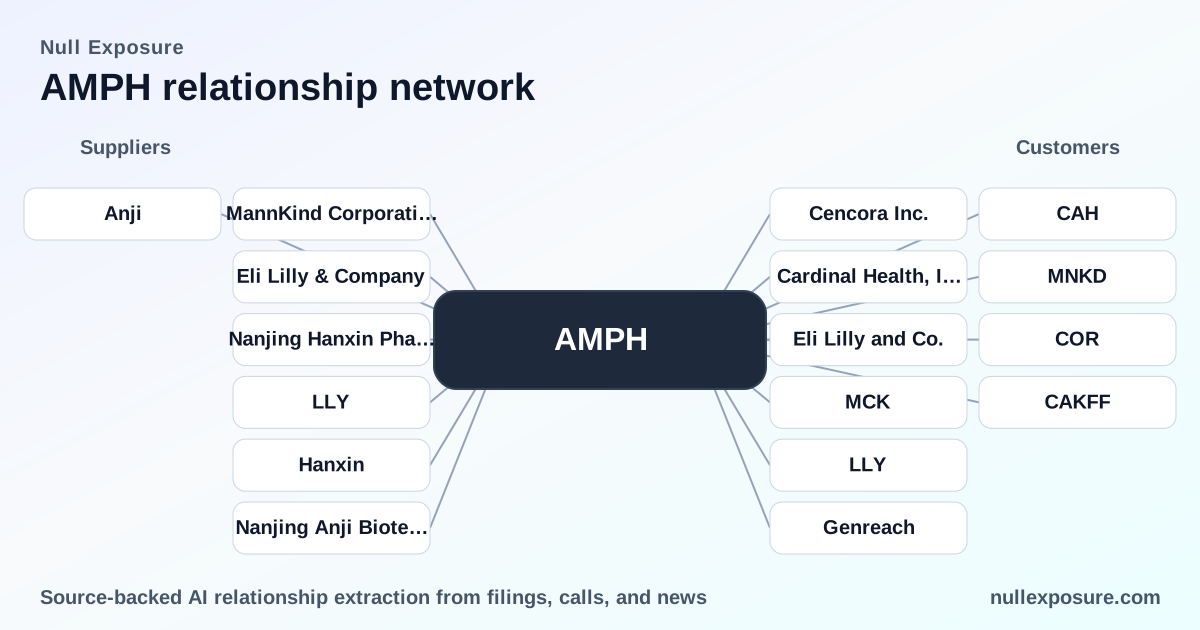
Amphastar Pharmaceuticals (AMPH): Customer relationships that shape revenue and risk
Amphastar Pharmaceuticals develops, manufactures and distributes specialty and generic injectable, inhalation, and intranasal products, and monetizes through direct product sales to U.S. wholesalers, group purchasing organizations (GPOs), retail pharmacies and international distributors, plus manufacturing and licensing fees for select partners. The company’s revenue profile is concentrated: Amphastar recognizes product revenue (including BAQSIMI distribution) and service/manufacturing revenue tied to a handful of large channel partners that control access to hospitals and pharmacy networks. For a granular counterparty view and primary-source citations, visit https://nullexposure.com/.
Investment thesis — why customers matter for AMPH valuation
Amphastar’s operating leverage depends on stable distribution relationships with major U.S. wholesalers and GPOs and on monetizing niche product rights (e.g., BAQSIMI). The economics are attractive when manufacturing scale and direct distribution convert into higher gross margins, but the stock is exposed to concentrated counterparty risk: three customers accounted for roughly two‑thirds of net revenues in recent years, amplifying revenue volatility and negotiation leverage held by large wholesalers. This counterparty structure is a primary driver of Amphastar’s revenue predictability and a key risk factor for investors.
- Key business drivers: concentration with large wholesalers/GPOs, ownership of niche branded assets (BAQSIMI), and an active international distribution strategy via exclusive distributors.
- Primary risk vector: revenue dependence on a small number of large buyers and transition arrangements with brand partners that affect near-term topline recognition.
Explore full counterparty mappings and source documents at https://nullexposure.com/.
What filings and news disclose about customer relationships
Below I list each relationship captured in Amphastar’s source materials and recent press, with a concise, plain-English summary and the source reference. Each entry corresponds to a relationship record in Amphastar’s public disclosures or to related news filings.
Cardinal Health, Inc. (multiple entries)
Amphastar’s FY2024 10‑K reports that Cardinal Health accounted for 19% of Amphastar’s net revenue for the year ended December 31, 2024 and represented 16% of accounts receivable as of year‑end, reflecting Cardinal’s status as a major distributor for the company (Amphastar FY2024 10‑K).
(See Amphastar FY2024 10‑K disclosure of customer concentrations.)
CAH (ticker alias for Cardinal Health) — same filing
The company’s customer‑concentration table in the FY2024 10‑K lists Cardinal Health under the shorthand CAH with the same 19% revenue and 16% receivable figures, underscoring that Cardinal is a top revenue source in Amphastar’s distribution mix (Amphastar FY2024 10‑K).
Cardinal Health (repeat row)
Amphastar’s 10‑K repeatedly identifies Cardinal Health as one of the four major customers driving a material share of revenue and receivables, reinforcing concentration risk in distribution channels (Amphastar FY2024 10‑K).
Cencora Inc. / Cencora / COR
Amphastar’s FY2024 10‑K shows Cencora accounted for approximately 20% of net revenue in 2024 and 23% of total accounts receivable, making Cencora a second major wholesale/GPO channel for Amphastar’s U.S. sales (Amphastar FY2024 10‑K).
Eli Lilly and Company / LLY / Lilly (news and 10‑K)
Amphastar discloses a commercial transition arrangement related to BAQSIMI: the company recognized $19.2 million of BAQSIMI sales made by Lilly on Amphastar’s behalf during 2024 under a Transition Service Agreement, net of costs, and Amphastar stated a prior three‑year marketing commitment with Lilly that expired in July (8‑K filing and Q4 2025 earnings call transcript, StockTitan 8‑K and Globe and Mail/Motley Fool transcript, Mar 2026).
Eli Lilly (FY2024 10‑K customer table row)
The FY2024 customer concentration table lists Lilly as a named customer with a smaller percentage of revenue (3% of net revenue in 2024) but highlights the commercial relationship around BAQSIMI and transitional sales (Amphastar FY2024 10‑K).
McKesson Corporation / McKesson / MCK / CAKFF (multiple rows)
Amphastar’s FY2024 disclosures list McKesson as the largest single accounts receivable participant (34% of total accounts in 2024) and representing 25% of net revenue, signaling McKesson’s central role in Amphastar’s U.S. distribution footprint (Amphastar FY2024 10‑K).
McKesson (alternate symbol entry)
A duplicate entry in the results reiterates McKesson’s material share of receivables and revenue, reinforcing the company’s outsized negotiating and credit importance in Amphastar’s channel mix (Amphastar FY2024 10‑K).
Genreach / Genrearch (exclusive distributor)
Amphastar amended a distribution pact with Genreach to cover Middle East and Southeast Asian countries and appointed Genreach as exclusive distributor for certain territories (Greater China), with Genreach responsible for local regulatory approvals; Amphastar recognized modest revenue from that agreement in 2024 and reported no receivables from Genreach as of year‑end (TradingView news and Amphastar FY2024 10‑K disclosure of Genreach distribution; FY2024 results).
MannKind Corporation / MNKD
Amphastar’s 8‑K and earnings commentary attribute increased selling and co‑promotion expenses to expanded sales efforts for BAQSIMI, including a co‑promotion contract with MannKind, indicating an active commercial partnership on promotional economics (StockTitan 8‑K, Mar 2026).
MannKind (duplicate row)
A repeat news entry confirms Amphastar’s disclosure that its co‑promotion with MannKind contributed to higher selling and distribution expenses tied to BAQSIMI commercialization activities (StockTitan 8‑K, Mar 2026).
Nanjing Hanxin (Hanxin)
MarketScreener reported Amphastar signed a license deal with Nanjing Hanxin for AMP‑110 compound, and Amphastar’s FY2024 disclosures describe multi‑faceted agreements with Hanxin including RCB licensing, contract manufacturing, and the company receiving manufacturing revenues from Hanxin‑related services (MarketScreener May 2026; Amphastar FY2024 10‑K).
Nanjing Hanxin (FY2024 contract/manufacturing rows)
Amphastar’s filings state Hanxin entered a three‑year contract research agreement to develop recombinant insulin cell banks and license those RCBs to Amphastar, and Amphastar also recognizes manufacturing revenue from Hanxin engagements (Amphastar FY2024 10‑K).
Hanxin (service revenue row in Amphastar 10‑K)
During 2024 Amphastar recognized $0.5 million of manufacturing services revenue from Hanxin, which places these services in the $100k–$1m spend band and highlights a supplier/customer duality in the relationship (Amphastar FY2024 10‑K).
MNKD (MannKind FY2024 10‑K cross‑reference)
MannKind’s FY2024 filings note payment and contract terms (e.g., denominated in Euros under an insulin supply agreement) when engaging Amphastar — a detail that surfaces Amphastar’s exposure to contract currency clauses when partnering with specialty firms (MannKind FY2024 10‑K).
Operational constraints and what they mean for investors
- Concentration and counterparty power are structural: Amphastar reports that sales to three large wholesalers/GPOs made up approximately 64% of net revenues in 2024, a company‑level signal that negotiating leverage resides with a few customers and that revenue is sensitive to contract renewal dynamics (Amphastar FY2024 10‑K).
- Contracting posture skews toward multi‑year relationships but with termination clauses: Amphastar’s agreements include long‑term terms in some cases (e.g., ten‑year agreement language) and multi‑year GPO pricing arrangements that can be terminated on relatively short notice (60–90 days), creating a mix of stability and exit risk that investors must price into valuation models (Amphastar FY2024 10‑K excerpts).
- Geography is predominantly North American with expanding APAC channels: Amphastar’s products are primarily sold in the U.S., limiting foreign‑currency exposure, although targeted international distribution (e.g., Genreach in Greater China and other APAC markets) opens growth avenues but also adds regulatory and execution risk in new markets (Amphastar FY2024 10‑K; TradingView Mar 2026).
- Partner roles are varied and material: Amphastar lists partners that act as distributors (Genreach), licensees/manufacturers (Hanxin) and large wholesale buyers (McKesson, Cardinal, Cencora). Where a constraint explicitly names a counterparty (Hanxin, Genreach), attribute that role directly; other role signals (buyer/distributor) are company‑level and describe Amphastar’s overall go‑to‑market posture (Amphastar FY2024 10‑K).
Investor takeaway: Amphastar’s revenue and margin outlook is driven less by broad retail penetration and more by execution with a handful of large distributors and a small set of specialty commercialization partners; value accretion requires stable renewals and successful international rollouts, while downside is concentrated around a few counterparties.
For a full counterparty dossier and drill‑downs on the source filings cited here, visit Null Exposure: https://nullexposure.com/.