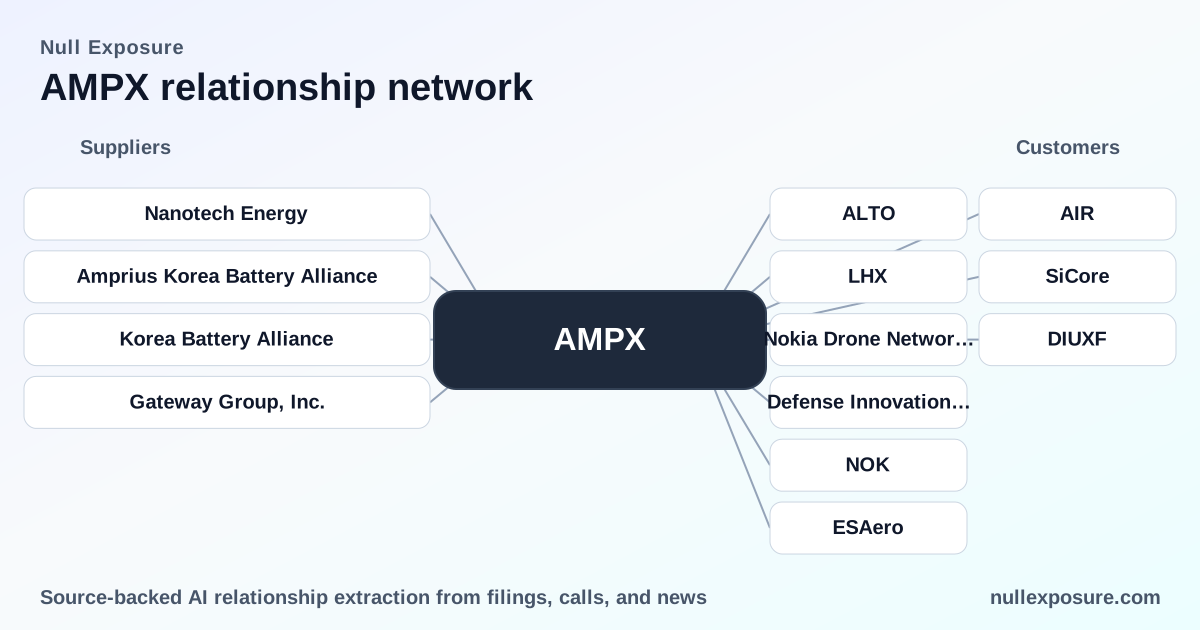
Amprius (AMPX): Customer relationships that underwrite rapid commercial scaling
Amprius builds and sells silicon‑anode and SiCore® lithium‑ion cells for mobility and aerospace applications, monetizing through sales of finished battery products and prototype/customization services to commercial OEMs and government customers. Revenue is recognized primarily at shipment or upon delivery of prototypes, and the company leverages selective strategic partnerships to validate performance and accelerate qualification into defense and drone markets. For investors, the commercial thesis is straightforward: technical differentiation (high energy density) + select high‑profile customers = revenue leverage as manufacturing scales. Explore deeper coverage at https://nullexposure.com/.
How Amprius goes to market — practical operating dynamics investors should track
Amprius sells hardware — finished cells and bespoke prototypes — which produces a spot-contract, shipment‑based revenue profile rather than long‑duration recurring contracts. The company reports significant customer concentration: three customers accounted for roughly half of revenue in recent years, indicating volatile revenue swings if a win is delayed or a buyer scales down. Geographic delivery is already global, but the business is in an active commercial stage with expanding engagements (over 260 total engagements and 235 shipped customers by 2024). The combination of high concentration, government relationships, and product criticality for safety‑sensitive aerospace/drone applications makes customer wins strategically important and risk‑sensitive to qualification timelines and supply‑chain compliance.
- Contracting posture: transactionally recognized at point of transfer (shipment/prototype delivery), supporting near‑term revenue visibility tied to shipments.
- Concentration: materially concentrated with a small number of large customers representing a disproportionate share of revenue.
- Criticality & maturity: batteries are safety‑critical components for aerospace and defense; qualification cycles and compliance (NDAA/safety tests) determine how quickly prototype validation converts to volume orders.
- Stage: commercial but still scaling manufacturing capacity to convert proofs‑of‑concept into steady volume.
Customer map: the relationships that matter now
The following summaries cover every customer relationship cited in the available reporting. Each entry is paired with the reporting source used by market and company commentary.
Airbus / Alto
Alto, a division of Airbus, is cited as a long‑standing customer for Amprius’ aviation and drone battery offerings, reflecting continued OEM engagement in aerospace applications. According to Amprius’ Q4 2025 earnings commentary and related transcripts, Alto remains a validated user of the company’s cells (Q4 2025 earnings call; insider media coverage).
L3Harris Technologies (LHX)
L3Harris is identified as a validating customer for Amprius’ domestic cell supply and NDAA‑compliant capabilities, underlining defense market traction for national‑security applications. The company referenced readiness to supply domestic cells specifically to customers such as L3Harris in its Q4 2025 earnings call and in subsequent press coverage (Q4 2025 earnings call; industry news, early 2026).
Nokia / Nokia Drone Networks
Nokia Drone Networks selected Amprius cells for commercial drone‑in‑a‑box systems after qualification testing that demonstrated endurance and safety for mission‑critical subsystems; Amprius highlighted this as a recent win on its Q4 2025 call and in related coverage (Q4 2025 earnings call; market press February–March 2026).
KULR Technology Group (KULR)
KULR partnered with Amprius to integrate thermal management with Amprius’ ultra‑high energy density SiCore cylindrical cells as part of an integrated line for unmanned aircraft systems, demonstrating collaborative system‑level solutions for the drone market. This partnership was reported in KULR and industry press in mid‑ to late‑2025 (industry release, Nov 2025; SUASnews coverage).
Defense Innovation Unit (DIU / DIUXF)
Amprius’ agreement with the Defense Innovation Unit was expanded, with incremental funding reported that accelerates production of NDAA‑compliant SiCore batteries geared toward unmanned systems. The company disclosed contract increases and a total DIU agreement value in fiscal reporting and press summaries (company release and earnings reporting, FY2026 disclosures).
ESAero
ESAero is cited in market commentary as a selection that reinforces momentum for Amprius in advanced aircraft/drone markets; industry write‑ups list ESAero among partners that underscore commercial validation. Coverage tying ESAero to Amprius’ selection appeared in market commentary on Amprius’ progress (finviz market narrative, early 2026).
SiCore (product adoption signal)
SiCore is Amprius’ product platform — press and analyst notes highlight a major SiCore order and product adoption as a driver of valuation narratives and near‑term revenue potential. Industry analyst reporting and company commentary in Q4 2025 emphasize SiCore adoption and its role in NDAA‑compliant supply (analyst notes and market summaries, March–April 2026).
What these customer ties imply for investors
- Validation from aerospace and defense primes accelerates commercialization. Wins with Airbus/Alto, Nokia Drone Networks, and endorsements from customers like L3Harris provide outsized credibility for conversion of prototype qualifications into serial orders.
- Revenue concentration is a double‑edged sword. The company disclosed that three customers represented around 47% of revenue in 2024; this concentration amplifies upside from ramping customers and downside if a single partner delays (company filings and FY2024–2025 revenue breakdown).
- Government channels raise both runway and compliance obligations. Company statements confirm engagements with U.S. government agencies and expanded DIU funding; that supports access to defense budgets but imposes NDAA, safety, and domestic‑sourcing constraints that influence CAPEX and manufacturing decisions (company disclosures and DIU reporting).
- Commercial sales are point‑in‑time and tied to shipments. Amprius recognizes revenue on shipment or prototype delivery, which produces lumpy revenue correlated to qualification cycles and production capacity (company revenue recognition disclosures).
Risks, catalyst timeline, and investor checklist
- Risks: qualification delays, manufacturing scale constraints, and concentration risk remain primary hazards. Safety testing and NDAA compliance are gatekeepers for defense and some commercial channels; failure to meet timelines will compress revenue realization.
- Catalysts to monitor: ramp schedules for SiCore production, the timing and size of orders from Airbus/Alto and Nokia Drone Networks, DIU contract milestones, and any disclosure of multiyear supply agreements that would shift the revenue mix away from spot shipments.
- Key signals in near term: quarter‑over‑quarter shipment volumes, customer qualification milestones cited on earnings calls, and any expansion of DIU or prime integrator contracts.
For a focused investor briefing that tracks these customer dynamics and the supplier relationships that underpin Amprius’ commercial trajectory, visit https://nullexposure.com/ for ongoing updates and original market analysis.
Conclusion: Amprius’ value proposition rests on converting high‑profile customer validations into repeatable, volume shipments at scale. The current customer map demonstrates credible technical adoption across aerospace, drones and defense, but revenue remains concentrated and shipment‑timing sensitive — the next 12–24 months of qualification and production ramps will determine whether validation translates into predictable top‑line growth.