Amplify Energy (AMPY) — Customer Relationships That Drive Revenue and Risk
Amplify Energy is a U.S.-focused oil & gas E&P company that monetizes through the sale of produced oil, natural gas and NGLs to a small set of buyers; commodity receipts and marketing agreements are the company’s principal revenue engine. Amplify’s top three customers together represented a meaningful share of 2024 revenues, and recent asset sales change the composition of the production base and counterparty mix. For investors, the story is a tradeoff: concentrated, contractually flexible sales expose Amplify to counterparty and regional demand shifts while asset dispositions create near-term cash and optionality. For a deeper look at how these customer dynamics map to commercial risk, see more on our homepage: https://nullexposure.com/
How Amplify sells and how contracts actually work
Amplify operates in one reportable segment — acquisition, development and production of oil and natural gas — and recognizes revenue when production is delivered under sales agreements tied to prevailing regional pricing. The company’s contracts are a mix: a majority renew month-to-month, giving buyers and Amplify operational flexibility, while a subset of contracts exceed one year and are accounted for accordingly under ASC 606 practical expedients. Accounts receivable tied to these sales were material ($28.5 million at 12/31/2024). These are company-level signals drawn from Amplify’s 2024 10‑K and related filings.
- Contracting posture: Predominantly short-term/month-to-month arrangements with some longer-term obligations where ASC 606 treatment applies.
- Geography and market: All revenues derive from U.S. operations (Rockies, offshore Southern California, East Texas/North Louisiana, Oklahoma, Eagle Ford).
- Commercial role: Amplify is primarily the seller of production; purchasers include pipelines, marketing affiliates and independent marketers.
The customer list you need on your desk
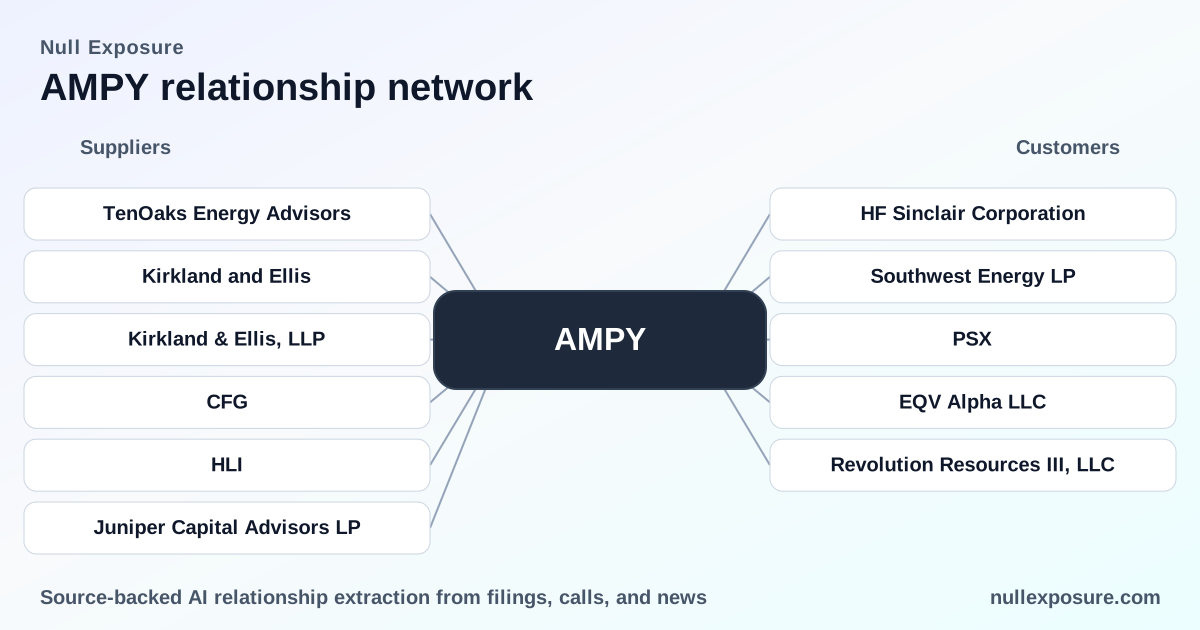
Below are every customer or counterparty relationship disclosed in the public results set, with a concise plain-English summary and the source noted for investor verification.
Phillips 66 — a major buyer and a current operational headwind
Phillips 66 accounted for 33% of Amplify’s revenues in 2024 (17% in 2023); Amplify disclosed active engagement with Phillips 66 after Phillips 66 announced the planned 4Q2025 closure of a Los Angeles-area refinery that historically absorbed a significant portion of sales to that buyer. According to Amplify’s 2024 10‑K, this buyer concentration is material and management is assessing the full impact on volumes and pricing. (Source: Amplify 2024 Form 10‑K)
PSX — same counterparty reported under ticker synonym
PSX is the tickered reference for Phillips 66 and is reported separately in the filings; the disclosure mirrors the Phillips 66 entry: 33% of 2024 revenue with refinery closure risk noted. Treat PSX as the same commercial exposure flagged above. (Source: Amplify 2024 Form 10‑K)
HF Sinclair Corporation — a top customer contributing scale
HF Sinclair represented approximately 25% of Amplify’s revenues in 2024 (24% in 2023), making it one of the company’s largest single customers and a material revenue contributor. Amplify lists HF Sinclair among the three customers that each contributed 10% or more of total reported revenues. (Source: Amplify 2024 Form 10‑K)
Southwest Energy LP — material but smaller concentration
Southwest Energy LP accounted for roughly 10% of revenues in 2024 (13% in 2023) and is listed among the three customers that meet the 10% threshold; it is material enough to affect results if volumes or payment performance change. (Source: Amplify 2024 Form 10‑K)
EQV Alpha LLC — asset purchaser, not a production buyer
An 8‑K filed and summarized in market coverage reported that Amplify completed the EQV Asset Sale, where indirect subsidiaries sold specified oil and gas properties and equipment in East Texas and Louisiana to EQV Alpha LLC. This is a divestiture transaction that transfers producing assets (and associated buyers) out of Amplify’s balance sheet and can materially alter future production and counterparty exposure. (Source: 8‑K disclosure reported via StockTitan / SEC filing, March 9, 2026)
Revolution Resources III, LLC — planned Oklahoma sale expected to close in late 2025
Amplify disclosed a separate sale — the Probable Revolution Asset Sale — under which Oklahoma properties and equipment were to be sold to Revolution Resources III, LLC, with expected closing on or about December 29, 2025. Like the EQV transaction, this sale reduces the company’s operated footprint and will shift which buyers receive production if closed as planned. (Source: 8‑K disclosure reported via StockTitan / SEC filing, March 9, 2026)
What the relationship map says about risks and optionality
- High customer concentration is a structural risk. Three customers each accounted for 10%+ of reported revenues in 2024; losing a single major buyer without replacement would have a measurable impact on top-line and working capital. This is explicitly called out in the 2024 10‑K as a material dependency.
- Contract flexibility cuts both ways. The prevalence of month‑to‑month arrangements gives Amplify the ability to reprice to prevailing markets quickly, but also means buyers can shift supply or volume allocations with limited notice.
- Geographic concentration in the U.S. focuses political/regulatory risk but reduces currency/geopolitical diversification. All revenues are U.S.-sourced across a handful of basins and offshore Southern California, concentrating exposure to regional demand cycles and infrastructure changes.
- Asset sales materially change counterparty exposure. The EQV and Revolution transactions transfer producing assets (and thus associated buyers and receipts) off Amplify’s books, delivering immediate cash or debt reduction while shrinking the production base that generated sales to top customers.
- Receivables and credit exposure matter. Accounts receivable balances tied to sales were disclosed at $28.5 million at year-end 2024, which highlights counterparty credit and collection risk if major purchasers slow payments.
Investment implications — what active managers should consider
Amplify’s customer list is a central lens for valuation and risk calibration. If you underwrite stable volumes to Phillips 66/HF Sinclair, stress test refiners’ procurement shifts and the effect of facility closures; if you assume the asset sales continue, update production and cash-flow profiles to reflect the reduced asset base and changed buyer mix. Management’s disclosure practice — month-to-month sales terms for most contracts and use of ASC 606 practical expedients where applicable — signals operational pragmatism but also limited contractual lock‑ins. For active investors, monitor realized volumes to Phillips 66/PSX and the operational impacts of the Los Angeles refinery closure notice, and track closing notices and proceeds from the EQV and Revolution transactions for balance-sheet relief.
For a working repository of counterparty shifts and contract signals across energy issuers, visit our analysis hub: https://nullexposure.com/
Bold takeaway: Amplify generates meaningful revenue from a very small set of counterparties, sells primarily under short-term regional agreements, and is actively reshaping its footprint through asset sales — a profile that amplifies both downside concentration risk and near-term liquidity optionality.