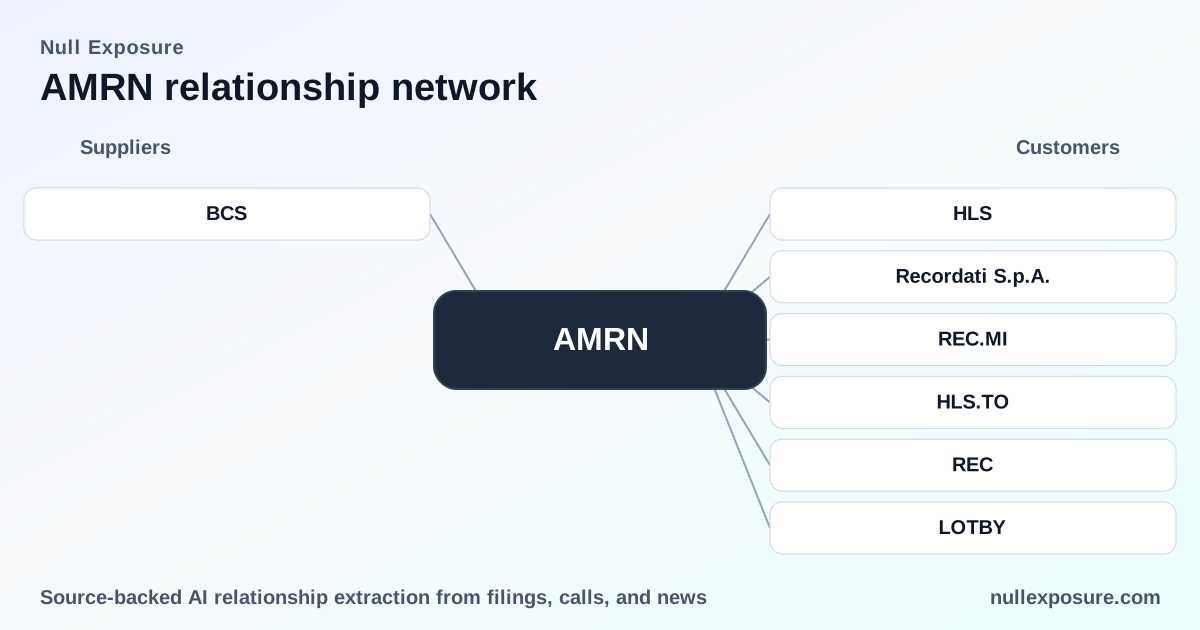
Amarin’s customer map: how VASCEPA monetization shifted from direct sales to partner-led supply
Amarin generates cash and value primarily by commercializing VASCEPA (icosapent ethyl): direct product sales into major U.S. wholesalers and pharmacies, supplemented by licensing and long‑term supply agreements outside the U.S. that convert local commercial execution into licensing revenue and supply shipments. Recent 2025–2026 activity shows a deliberate pivot to partner-led international commercialization that reduces Amarin’s direct selling footprint in Europe while establishing recurring supply and license income streams. For a structured view of these customer relationships and what they mean for revenue, risk and growth, read on — or visit NullExposure for deeper signals and sourcing: https://nullexposure.com/
The operating reality beneath the headlines
Amarin’s commercial model blends point‑in‑time product sales with multi‑year licensing/supply contracts. Company disclosures identify two dominant revenue mechanics:
- Spot product sales: revenues are recognized at delivery or shipment when the distributor obtains control, reflecting a traditional pharmaceutical distributor channel and concentrated U.S. wholesaler base.
- Licensing and supply: long‑term licenses transfer commercialization responsibilities to local partners while Amarin records supply shipments and upfront/ongoing license consideration.
These mechanics create a few material investor implications:
- Concentration: Amarin sells principally to a limited number of major wholesalers and specialty pharmacy channels in the U.S., which concentrates counterparty risk and channels pricing pressure through a small set of large customers.
- Counterparty mix and reimbursement sensitivity: outside the U.S., government and large third‑party payors dominate payment decisions; reimbursement regimes therefore determine whether partnered launches translate into meaningful revenue.
- Contracting posture and maturity: the firm is transitioning from direct selling in many ex‑U.S. markets to long‑term licensing and supply relationships, a more mature commercialization posture that trades direct margin upside for scale, lower selling cost and predictable supply revenue.
- Scale signal: Amarin’s revenue profile places it above the $100M spend band, consistent with the company’s reportable revenue and the decision to pursue large strategic licenses for international expansion.
Who Amarin is doing business with (complete list from recent disclosures)
Recordati / Recordati S.p.A. / REC.MI
Amarin signed an exclusive long‑term license and supply agreement with Recordati to commercialize VAZKEPA across 59 countries in Europe, shifting European commercialization to a fully partnered model and converting future European sales into supply shipments and license economics. Amarin’s earnings commentary documents the transition to a fully partnered international model and notes supply shipments recorded as product revenue during the transition period. (Sources: Amarin Q3 & Q4 2025 earnings calls; press releases and news coverage including Globenewswire and FiercePharma — see https://www.globenewswire.com/news-release/2026/01/08/3215221/ and https://www.fiercepharma.com/pharma/recordati-pays-25m-front-commercialize-amarins-heart-pill-vascepa)
HLS Therapeutics / HLS.TO
HLS in‑licensed exclusive rights to commercialize VASCEPA in Canada, acting as Amarin’s local licensee and commercialization partner for the Canadian market; Amarin recognizes performance obligations consistent with a license arrangement. The partnership positions Canada as a market where local execution and reimbursement processes are handled by HLS while Amarin supplies product and collects license‑related consideration. (Source: Marketscreener and corresponding Amarin partner disclosures — see https://www.marketscreener.com/news/hls-therapeutics-and-amarin-collaborate-on-presenting-reduce-it-and-epa-mechanistic-data-at-the-can-ce7d5ad9de8cfe22 and related corporate notices)
Lotus / LOTBY
Amarin has a distribution/commercialization arrangement with Lotus Pharmaceuticals covering South Korea and several Southeast Asian markets; the company disclosed that, together with Lotus, it secured regulatory approvals in South Korea and Singapore and is preparing for future launches. Lotus functions as a regional distribution partner under contractual terms that transfer commercialization execution to the counterparty. (Source: Amarin Q4 2025 earnings commentary — identified in filings and call transcripts)
How these relationships change the revenue profile and risk posture
The Recordati agreement is the single largest structural shift: Europe moved from direct Amarin sales to a partner-led model, which reduces the company’s direct European sales line but replaces it with supply shipments and license economics. Amarin reported European product revenue declines during the transition and recorded supply shipments (e.g., $1.7M noted in a reporting period) as part of product revenue. (Source: Amarin Q3 2025 transcript and financial highlights reporting, e.g., https://www.insidermonkey.com/blog/amarin-corporation-plc-nasdaqamrn-q3-2025-earnings-call-transcript-1637195/)
Key investor implications:
- Predictability vs. upside: licensing and supply agreements increase revenue visibility and reduce go‑to‑market costs, but cap upside relative to direct commercial margins.
- Reimbursement sensitivity remains material: Amarin identifies reimbursement availability and pricing as a potential material factor for ex‑U.S. commercialization success; in partnered markets, outcomes depend on partner execution and payer negotiations. (Company filings and revenue commentary)
- Geographic concentration shifts: the U.S. remains the primary direct revenue source; partnered regions (Europe, Canada, parts of Asia) will contribute through supply shipments and partner milestones.
Constraints and company‑level signals that matter to operators and investors
Several company disclosures frame the commercial constraints that determine how customer relationships operate:
- Contracting types: Amarin uses both licensing and point‑in‑time product sale contracts; licensing arrangements sit squarely within revenue recognition guidance and transfer commercialization rights to partners, while product sales are recognized upon delivery or shipment.
- Counterparty types and payment risk: company disclosures emphasize government payors and large payors outside the U.S., signaling payment and reimbursement risk that is country specific.
- Role definitions: Amarin consistently treats partners as customers when it licenses rights or supplies product, and it documents distributors and wholesalers as the primary buyers in the U.S. and other markets.
- Materiality and scale: the firm’s revenue runs in the low‑hundreds of millions (RevenueTTM ~$216.8M), consistent with a spend band above $100M, which justifies long‑term licensing as a scaling strategy.
For operators evaluating counterparties, these constraints imply priority checks: contract term length, pricing and margin mechanics on supply shipments, partner capabilities for securing reimbursement, and milestone/payment timing.
Visit NullExposure for a consolidated view of Amarin partner disclosures and signal extraction: https://nullexposure.com/
Near‑term catalysts and monitoring checklist
- Recordati launches and reimbursement progress across EU markets — licensing success depends on country‑by‑country reimbursement wins.
- Supply shipment cadence and recognition — monitor quarterly disclosure for supply revenue versus legacy direct sales.
- HLS commercialization outcomes in Canada — prescriptions, formulary placements and payer coverage will determine Canadian contribution.
- Asian regulatory and launch progress with Lotus — approvals and initial reimbursement decisions set the path for regional growth.
- U.S. wholesaler dynamics and pricing — continued concentration among major wholesalers sustains pricing and inventory risks.
Bottom line for investors
Amarin has intentionally rebalanced its commercial model: keep U.S. direct sales into a concentrated wholesaler base and scale internationally via long‑term licenses and supply relationships that trade direct margin for steady, partner‑executed expansion. Recordati is the pivotal partner for Europe; HLS handles Canada and Lotus anchors parts of Asia. For investors, the next inflection points are partner‑led reimbursement wins and the quarterly pattern of supply shipments versus direct sales — those items determine whether licensing delivers steady cash flow or simply shifts revenue recognition without net growth.